"To survive and prosper, a small company must establish a marketing presence based upon a sustainable competitive advantage."
Explore this principle (which makes it easy for people to buy from you) by first defining some terms:
Marketing presence is the message your business communicates to its prospect and customer base. To be effective, the message should be clear and simple -- and contain the key attributes you want associated with your business.
Competitive advantage is the sum of those attributes that differentiate your business from its competitors. This is your core competence. You develop, build and enhance it through a clear understanding of your customers' wants and needs. You implement it through a strategic plan (a directional compass) that can help you quickly adapt to changes in their wants and needs.
Sustainable means to keep in existence, to maintain and affirm the validity of, to support the spirit, vitality and resolution of, to encourage, to endure and withstand.
BOTTOMLINE: Only through your continuous understanding of what makes your business competitive can your business survive and prosper. GE's former CEO, Jack Walsh, once said, "If you don't have a competitive advantage, don't compete."
Wednesday, September 13, 2006
Step I-B: Renew Values
Each discipline in the Six Disciplines Methodology consists of a number of individual steps.Within the Six Disciplines, there are 31 steps.
Beginning with Discipline I - Decide What's Important, let's cover Step I-B, Renew Values.
- Whereas mission statements answer the question of "why" an organization existing, values speak to the character or personality of the organization. Shared values should be as enduring as your mission, and are just as important - if not more so.
- Values should be based on what is already important to you - not on what you wish was important to you. Your values have to be based on integrity, passion and conviction.
- Keep the list of values between 3 and 5. Any more than that, and you'll lose focus.
BOTTOMLINE: Instilling values is a matter of talking the talk and walking the walk. People must both understand what the values are and mean, AND see how they're applied in everyday decisions and interactions in your company.
Success Requires Support
Jacob, over at SuccessMinders, recently posted a great entry on "Success Requires Support."
His assertion?
"Recently I was talking with my wife about this web site; asking her thoughts about it. She told me that she thought the articles were good, but she didn’t see anywhere on the site where I mentioned her. Why wasn’t she one of my passions? I have to admit I was taken aback - how could my wife think she wasn’t one of my passions?"
His plan?
Every day do the following for the people that support your success:
(Special thanks to JB for her continued inspiration - in all aspects of life)
His assertion?
"Recently I was talking with my wife about this web site; asking her thoughts about it. She told me that she thought the articles were good, but she didn’t see anywhere on the site where I mentioned her. Why wasn’t she one of my passions? I have to admit I was taken aback - how could my wife think she wasn’t one of my passions?"
His plan?
Every day do the following for the people that support your success:
- Encourage them
- Challenge them
- Excite them
- Congratulate them
- Help them
- Praise them
- Love them
- Teach them
- Learn from them
- Support them
(Special thanks to JB for her continued inspiration - in all aspects of life)
The Power of Focus
This from Management-Issues:
A study by Time Magazine indicates that everyday interruptions cost Western economies billions of dollars in lost productivity, with the average worker interrupted by an email, phone call or simple tap on the shoulder every 11 minutes.
Two other disturbing facts from the study:
A study by Time Magazine indicates that everyday interruptions cost Western economies billions of dollars in lost productivity, with the average worker interrupted by an email, phone call or simple tap on the shoulder every 11 minutes.
Two other disturbing facts from the study:
- Interruptions now took up an average of 2.1 hours of every working day, or 28 per cent of the average person's nine-to-five schedule, including the time to recover your train of thought following an interruption.
- It takes an average of 25 minutes to return to a task after being disturbed, according to the magazine.
BOTTOMLINE: Focus.........Focus..........Focus........
Small Business Advantages

Small-business owners have their worries, but they count their blessings, too.
According to a recent poll, conducted for online small-business guide, Allbusiness.com, by Frank Magid Associates, comes the following survey results:
- 79% say that it is more rewarding to work in a small business than a large one.
- 76% of the owners and executives also say that in general small operations have more flexibility than big companies.
Tuesday, September 12, 2006
How To Plan And Execute Strategy
Ah...if it was only this easy...
How to Plan and Execute Strategy: How To Implement Any Corporate Strategy Successfully
How to Plan and Execute Strategy: How To Implement Any Corporate Strategy Successfully
- Appreciate the benefits of strategic management
- Understand the logic of the process
- Assess your readiness
- Planning to plan and getting organized
- Define your businesses
- Assess your current situation
- Understand your business model
- Know your market
- Assess the competitive landscape and forces of change
- Understand your opportunities and threats
- Set feasible goals and objectives
- Create the strategies to achieve your objectives
- Identify and set priorities for the strategic initiatives
- Write your business plan
- Write your annual plan
- Get the right people
- Communicate the strategy and obtain commitment
- Establish alignment with structure, systems, and culture
- Integrate across functions
- Execute your strategy with discipline
- Monitor results, evaluate, and react
- Learn, change, and institutionalize
Sounds so ....simple, eh? Why then....is it so hard?
Principles of Strategy and Execution
Principles are the fundamental essences out of which and from which all things are and exist.
Some fundamental principles about strategy and execution:
Some fundamental principles about strategy and execution:
- Making strategy work is more difficult than the task of strategy making
- A focus on making strategy work pays major dividends.
- Strategy execution deals with the managerial exercise of supervising the ongoing pursuit of strategy, making it work, improving the competence with which it is executed, and showing measurable progress in achieving the targeted results.
- Strategy and execution are independent - yet interdependent.
- Execution takes much longer than strategy formulation.
- Execution involves many more people than strategy creation.
- Execution is a process, not a single step.
- Less than 10% of strategies effectively formulated are effectively executed.
Click here for more thoughts on What is Strategy...or over here at the Strategy Wiki.
Change, Coaching and Sustainability
“Employee loyalty is definitely at the forefront of many organizations discussions,” said Charles Orlando, director of marketing at Ninth House, a provider of learning and development solutions for employees at all levels of an organization.
Their key findings:
"We believe coaching is twofold,” he said “One part of it has to do with a combination of formal coaching and/or mentoring by an expert, a manager, etc. The real question for this type of coaching is how information, once learned, is sustained. In order to sustain that, those same methodologies need to be offered on a continuous basis after the event has taken place, whether it is more coaching, online learning or whatever it may be, so it can be sustained.”
BOTTOMLINE: Changing habits and behaviors takes time, and typically is very hard to do "if left alone" to happen by itself. That's where coaching comes in. Typically, this means someone from the outside who focuses on the benefits of change, continually reinforcing the results of change, and works to make it continually better over time - to make it sustainable. (That's what Six Disciplines Leadership Centers do - it's where organizations come to learn to Be Excellent.)
Their key findings:
"We believe coaching is twofold,” he said “One part of it has to do with a combination of formal coaching and/or mentoring by an expert, a manager, etc. The real question for this type of coaching is how information, once learned, is sustained. In order to sustain that, those same methodologies need to be offered on a continuous basis after the event has taken place, whether it is more coaching, online learning or whatever it may be, so it can be sustained.”
BOTTOMLINE: Changing habits and behaviors takes time, and typically is very hard to do "if left alone" to happen by itself. That's where coaching comes in. Typically, this means someone from the outside who focuses on the benefits of change, continually reinforcing the results of change, and works to make it continually better over time - to make it sustainable. (That's what Six Disciplines Leadership Centers do - it's where organizations come to learn to Be Excellent.)
Performance Management Survey Results
In a recent workforce performance survey from Watson Wyatt (based on a survey of 1,191 US workers from a broad cross-section of industries):
- Approximately 90% of surveyed employees participate in a performance management program.
- Only 30% of employees believe the program helps them improve their performance.
- Less than 40% say the system establishes clear performance goals or generates honest feedback.
- Only 39% of employees see the connection between their day-to-day work and company goals.
- Only 54% of workers think their companies set high performance standards.
- Only 44% feel that people are held accountable for their performance.
- 20% say their companies help poorly performing employees improve.
- 43% of employees feel they don’t get enough guidance to improve their performance.
- Only 38% of employees say that their company uses technology to streamline the performance management process.
BOTTOMLINE: The highlighted survey results above tell the story: Existing performance management programs are "missing the boat" because:
- Lack of connection betweeen day-to-day activities and goals (Discipline II - Set Goals That Lead, Discipline III - Align Systems, Discipline IV - Work The Plan)
- Lack of accountability (Discipline IV - Work The Plan)
Using technology to help streamline the performance management process helps (Six Disciplines Business System) - but it is the ongoing coaching and strategic advisory services that keep individuals accountable, and organizational aligned.
Monday, September 11, 2006
On Attitude and Talent
Which has greater growth potential: Attitude or Talent?
This post comes from John Maxwell on his recent book The Difference Maker.
His assumptions?
This post comes from John Maxwell on his recent book The Difference Maker.
His assumptions?
- For people show say that "attitude is everything," we know that isn’t true. Talent matters.
- On the other hand, some people dismiss attitude as inconsequential.
Maxwell says that attitude is the difference maker. He believes it so much that he wrote a book with that title. Whatever God-given talent you have can be taken farther with a great attitude.
BOTTOMLINE: Says Maxwell: "A good attitude is a lot like success. A person must go through a process to have it, and the hardest part is that you have to keep working at it. Having a good attitude is one of the key decisions I made early in life, and I wake up every morning determined to make my attitude all it can be. Why? So that it can make a difference in my life."
What's Better Than GTD?
Adrian Savage, over at Slow Leadership, posts this good one on LifeHack.Org "GTD? Try WNTGD Instead."
The essence?
The essence?
- The GTD (Getting Things Done) phenomenon is yet another symptom of today’s short-term mentality and our obsession with activity (getting things done.)
- Getting Things Done is useful, of course for people with bulging schedules and huge to-do lists, who seek a better way to organize themselves.
- People would be better advised to turn their attention first to WNTGD: What Needs To Get Done.
BOTTOMLINE: In other words, the focus needs to change from getting things done (efficiency) to getting the right things done (effectiveness).
Translating this from individual efficiency (productivity) to organizational performance (execution), we begin to understand that execution means getting things done.
Strategy-driven execution means getting the right things done. There is a big difference. Among other things, a company's strategy describes how a company is going to survive and thrive over the long-run. Strategy-driven execution is all about the careful alignment of limited resources to the organization's strategy and to nothing else. Research shows that most businesses fail, not because of poor strategy, but because of poor execution of strategy.
Six Disciplines is the first complete strategy-driven execution program optimized for small businesses. It’s a systematic program for establishing six basic business disciplines related to strategy, planning, organization (of people, processes and technologies), connecting every employee’s daily actions, along with measurement and learning.
While larger businesses have spent millions of dollars on individual disciplines like strategy, performance management, etc., it has now become economically feasible for small businesses to benefit from the combination of these in a complete on-going business improvement “fitness” program. However, with any fitness program, the biggest hurdle is making it last.
To sustain these fundamental disciplines requires tight integration with day-to-day activities from every employee in the organization. To achieve maximum results, every employee must understand company strategy and how their daily work connects to it so they can self-manage to the strategy. In addition, it requires the accountability of an outside coach or advisor to keep organizations on track in learning and applying the disciplines. It also requires a community of like-minded organizations sharing best practices and accelerating learning.
The Internet and the convergence of efficiency and effectiveness are the enabling factors for the packaging of a next-generation program for breakthrough results in small business execution – strategy-driven execution.
Six Disciplines removes the barriers that prevent organizations from effectively executing their strategy, while creating a new culture of effective work habits and focused business processes.
Unlike other business improvement attempts like seminars, consultants or quick fixes, Six Disciplines make these new habits “stick” by providing practice tools to align individual performance, and on-going coaching to ensure organizational progress and accountability.
ConverStations Reviews Six Disciplines for Excellence
Mike Sansone, over at ConverStations, just posted his review of Six Disciplines for Excellence, calling it "Six Disciplines: A Playbook for Sustainable Success."
His assessment?
"Two weeks ago, I began reading the book, Six Disciplines for Excellence. Any business could benefit greatly by ditching their Operations Manual - if they have one - and using Six Disciplines in its place. Without a doubt - Buy It."
(And we're humbled to add that Mike also said some nice things about Be Excellent as well. Thanks Mike!)
His assessment?
"Two weeks ago, I began reading the book, Six Disciplines for Excellence. Any business could benefit greatly by ditching their Operations Manual - if they have one - and using Six Disciplines in its place. Without a doubt - Buy It."
(And we're humbled to add that Mike also said some nice things about Be Excellent as well. Thanks Mike!)
Friday, September 08, 2006
High Performance Organizational Cultures
George Ambler, over at The Practice of Leadership posts about five key values that support high performing cultures of companies.
The five values:
The five values:
- Openness and candor. Candor involves more people, results in speedier decisions, and more meaningful conversations.
- Collaboration. It’s easy to talk about teamwork but difficult to achieve. You have to rise above it
- Common shared goals. A good mission and compelling vision are the “hard strategy” elements that can motivate people to work together.
- Involvement. Getting the different perspectives of everyone on the management team leads to a better mission statement and strategy .
- Feedback. Feedback is formalized candor. It compares performance to plan. Feedback is essential for the continuous improvement of both people and businesses.
BOTTOMLINE: These attributes are directly related to high performance. Your culture -- and the mission, vision, values and behaviors that produce it -- must be unique to your company. How are you doing in your leadership role, relative to candor, collaboration, shared goals, involvement and feedback?
Creating The Performance-Driven Organization
From his new book: Performance: Creating the Performance-Driven Organization published by John Wiley & Sons in March 2006, Mark Stiffler, Founder, President, and CEO of Synygy Inc. describes the five different components of performance managemen for HR.Com:
The Measurement component is then how you measure both the performance of the organization and the performance of the individuals. The important aspect of Measurement is that it occurs frequently, at least quarterly, and that the measures of the people are aligned with the measures of the organization.
The Reward component links the measures of organizational and individual performance to the pay of individuals, so every person in an organization’s pay is linked to their measures of performance that they affect.
The Report component reports both organizational and individual performance and giving people the information and feedback they need to help them improve performance and again, that is a process that needs to be at least quarterly.
The Analyze component is about using models and analytics and other tools to automate the process of analyzing data so that answers to key business questions are understood by managers and employees.
- Align
- Measure
- Reward
- Report
- Analyze
The Measurement component is then how you measure both the performance of the organization and the performance of the individuals. The important aspect of Measurement is that it occurs frequently, at least quarterly, and that the measures of the people are aligned with the measures of the organization.
The Reward component links the measures of organizational and individual performance to the pay of individuals, so every person in an organization’s pay is linked to their measures of performance that they affect.
The Report component reports both organizational and individual performance and giving people the information and feedback they need to help them improve performance and again, that is a process that needs to be at least quarterly.
The Analyze component is about using models and analytics and other tools to automate the process of analyzing data so that answers to key business questions are understood by managers and employees.
Small Business Statistics
Small businesses in the U.S.:
- Create 75% of the net new jobs in our economy.
- Start-up at a rate of over 400,000 per year.
- Make up 97% of exporters and produce 29% of all export value.
- Small businesses employ about 50% of all private sector workers.
- Create more than 50% of the non-farm private gross domestic product (GDP).
- Those with fewer than 100 employees make up more than 99.7% of all employers.
- 1 out of 11 people is a small business owner.
- Of the businesses that approach sustainability, over 70% "go down" with their founder
The most common measure of business success for small business owners is:
- The ability to balance life and work (39%), a goal shared by four out of ten small business owners.
- Making money takes second place as a measure of success for entrepreneurs (25%)
- Doing good for their community and employees (16%)
- Getting recognition for accomplishments (9%)
- Creating a legacy (4%)
- Combination of it all (1%)
With all of this excitement surrounding small businesses, there are a few very alarming facts:
- By the end of the first year, at least 40% of them will be out of business.
- 80% of all new business start-ups are out of business within five years.
- 80% of the 20% that survive the first five year don’t survive the second five years.
Entrepreneurship Week 2007
EntrepreneurshipWeek USA officially launched its nationwide promotional and advertising program today.
The promotion will culminate in events across the United States during EntrepreneurshipWeek USA, Feb. 24 – March 3, 2007.
Official events will be held in five U.S. cities and a number of other regional and local events will take place across the country.
So far, national partners include The New York Times, Inc. magazine and the Kauffman Foundation.
The goal of EntrepreneurshipWeek USA is to celebrate the spirit of innovation and entrepreneurial thinking and to encourage young people to consider entrepreneurship as part of their future.
The promotion will culminate in events across the United States during EntrepreneurshipWeek USA, Feb. 24 – March 3, 2007.
Official events will be held in five U.S. cities and a number of other regional and local events will take place across the country.
So far, national partners include The New York Times, Inc. magazine and the Kauffman Foundation.
The goal of EntrepreneurshipWeek USA is to celebrate the spirit of innovation and entrepreneurial thinking and to encourage young people to consider entrepreneurship as part of their future.
Thursday, September 07, 2006
Readers Are Leaders
"A recent book seller survey of American business people indicates that the average respondant reads .7 business books every three years! In sharp contrast, respondants that are executives at Fortune 1000 companies read 6.7 books per year.
Readers are leaders.
Why?
Because most business books reflect current business trends and the everchanging leadership landscape. If you keep reading, long after you finish college, you remain a student."
BOTTOMLINE: Try and read one complete business book every six weeks. Want good business book recommendations? Try 800-CEO-READ Blog.
Readers are leaders.
Why?
Because most business books reflect current business trends and the everchanging leadership landscape. If you keep reading, long after you finish college, you remain a student."
BOTTOMLINE: Try and read one complete business book every six weeks. Want good business book recommendations? Try 800-CEO-READ Blog.
Aligning Resources With Performance Appraisals
It seems these days that everyone is bashing performance appraisals for one reason or the next.
They take too long, they're backward-looking, they take practice - you name it, and there are more excuses than
In Increasing the Value of Performance Appraisals, the point comes down to the fact that performance appraisals do look backward, but it is the forward-looking aspect that is part of the continuous process of securing and aligning resources. That's why Discipline III. Align Systems is so critical to the small business.
BOTTOMLINE: Alignment ensures that the right tasks are being done with clear targets and priorities that are in collaboration with and driven from the overall corporate goals and objectives. (Sounds like "strategy-driven execution" to me!)
They take too long, they're backward-looking, they take practice - you name it, and there are more excuses than
In Increasing the Value of Performance Appraisals, the point comes down to the fact that performance appraisals do look backward, but it is the forward-looking aspect that is part of the continuous process of securing and aligning resources. That's why Discipline III. Align Systems is so critical to the small business.
BOTTOMLINE: Alignment ensures that the right tasks are being done with clear targets and priorities that are in collaboration with and driven from the overall corporate goals and objectives. (Sounds like "strategy-driven execution" to me!)
CEO Confidence Sinks
With small and mid-sized businesses in the U.S. create 75 percent of all new jobs and generate 50 percent of national revenue, it is concerning that CEOs of small and mid-sized businesses said their confidence in the economy and prospects for the coming year are at their lowest levels since 2003, according research findings from the Vistage Confidence Index, a quarterly measure of economic, market and industry trends.
(Vistage polled 1,939 CEOs of small- to mid-sized companies between May 15-24, with a margin of error of 1.9 percentage points.)
Key findings:
(Vistage polled 1,939 CEOs of small- to mid-sized companies between May 15-24, with a margin of error of 1.9 percentage points.)
Key findings:
- The data clearly indicates a much more cautious outlook among CEOs.
- CEOs are already beginning to modestly scale back their plans for future growth of their business, as they expect to reduce the pace of investment spending and add slightly fewer new employees during the year ahead.
The top concern?
- Finding qualified employees was reported by one-third of all CEOs as their top concern.
- Hiring and retaining qualified employees was mentioned more than twice as frequently as other problems.
BOTTOMLINE: Finding and keeping the right people continues to be one of the toughest challenges. Use an integrated approach of finding (selecting, screening, interviewing, using behavioral assessments, hiring) and keeping (mentoring, setting expectations, individual plans, performance appraisals, individual development, rewards.)
Essentials for Organizational Growth
Ready to drive the growth of your small business?
In “Blueprint to a Billion”, David Thomson provides 7 essential components of a successful growth-focused organization.
- Create and Sustain a Breakthrough Value Proposition
- Exploit a High-Growth Market Segment
- Marquee Customers Shape the Revenue Powerhouse
- Leverage Big Brother Alliances for Breaking into New Markets
- Become the Masters of Exponential Returns
- The Management Team: Inside-Outside Leadership
- The Board: Made Up of Essentials Experts
BOTTOMLINE: Managing all seven essentials at the same time is the toughest challenge of all. The formula is: Organizational Growth=Focus on people and product X Drive for exploration and innovation X Ability to manage the seven essentials simultaneously.
Wednesday, September 06, 2006
Improving Strategic Planning
Strategic planning is critical to the continued success of any organization, yet fewer than half of the executives who responded to a new online survey conducted by The McKinsey Quarterly say that they are satisfied with their company's approach to planning strategy.
Some key findings:
Some key findings:
- More than half of all respondents say that at their company the important strategic decisions are made by a small group of senior managers, including the CEO.
- No matter who leads the decision making, executives at companies that make good use of a formal process seem to be more satisfied with strategic planning.
- Most respondents say that their company's board of directors focuses on a few roles in planning strategy. Boards are seen to be most active in challenging strategy during the development process and in approving the final strategy .
More important than strategy, however is execution.
- A significant number of respondents express concern about executing strategy. Some 28 percent say that their company produces a strategic plan that reflects the company's goals and challenges but is not effective.
- Another 14 percent say the strategy and plans for executing it are not necessarily aligned with each other.
- 67 percent say aligning management with the strategy is an element of the strategic-planning process.
On measurement:
- Monitoring progress is an area where many executives see room for improvement. Only 56 percent of respondents say that their company currently tracks the execution of its strategic initiatives.
Strategic Learning and Execution
Although the central challenge facing most small business leaders today is how to work with change, one-time change isn’t good enough for today’s fast-paced small businesses.
How can established organizations create the capacity for ongoing adaptation?
This paper provides a practical leadership process for creating an adaptive enterprise by mobilizing a dynamic cycle of four steps:
How can established organizations create the capacity for ongoing adaptation?
This paper provides a practical leadership process for creating an adaptive enterprise by mobilizing a dynamic cycle of four steps:
- Learn
- Focus
- Align
- Execute
BOTTOMLINE: "These steps build on one another and through repetition become a dynamic cycle of renewal: Strategic Learning. Think Cycle … Not Straight Line. Simply following the Strategic Learning process once is not enough. The leadership challenge is to repeat it over and over, so that an organization continuously learns from its own actions and from scanning the environment, and then modified its strategies accordingly."
Execution - The Determination To Get Things Done
It's perhaps the most crucial ingredient of organizational leadership, and you can't learn it in business school:
The stubborn determination it takes to get stuff done.
Small business CEOs must cultivate a "don't-give-up mentality" as the most crucial ingredient to their success.
Good article here from Business 2.0: Secret of success: Be a bulldog
BOTTOMLINE: "All my years of experience have taught me that the greatest attribute for any business leader is perserverance. As long as you keep trying, you'll keep learning. (Gary Harpst, founder of three companies, CEO, and author of Six Disciplines for Excellence.)
The stubborn determination it takes to get stuff done.
Small business CEOs must cultivate a "don't-give-up mentality" as the most crucial ingredient to their success.
Good article here from Business 2.0: Secret of success: Be a bulldog
BOTTOMLINE: "All my years of experience have taught me that the greatest attribute for any business leader is perserverance. As long as you keep trying, you'll keep learning. (Gary Harpst, founder of three companies, CEO, and author of Six Disciplines for Excellence.)
Tuesday, September 05, 2006
Aligning Business Strategy and IT
The August 2006 issue of Business Performance Management magazine offers up this detailed article on "Aligning Business Strategy and IT."
Their premise?
"As vendors peddle the slickest new dashboards, scorecards, and planning applications to get your attention, they probably are glossing over the behind-the-scenes work that makes these tools perform reliably. It's not just about a pretty interface anymore. Infrastructure is back in fashion. Companies have realized that a dashboard, planning, budgeting, or forecasting system needs to deliver trustworthy, integrated, and timely information that supports key performance indicators (KPIs) and serves as a foundation for business decisions. Companies need information strategies that are aligned to their business strategies. They're inextricably linked -- two sides of the same coin."
BOTTOMLINE: "Adopting the old real estate mantra for organizations today, it's "alignment, alignment, alignment." Of course, the main motivational drivers are business ones. In the final analysis, there are no problems unless they are business problems, and there are no solutions unless they solve a business problem."
Their premise?
"As vendors peddle the slickest new dashboards, scorecards, and planning applications to get your attention, they probably are glossing over the behind-the-scenes work that makes these tools perform reliably. It's not just about a pretty interface anymore. Infrastructure is back in fashion. Companies have realized that a dashboard, planning, budgeting, or forecasting system needs to deliver trustworthy, integrated, and timely information that supports key performance indicators (KPIs) and serves as a foundation for business decisions. Companies need information strategies that are aligned to their business strategies. They're inextricably linked -- two sides of the same coin."
BOTTOMLINE: "Adopting the old real estate mantra for organizations today, it's "alignment, alignment, alignment." Of course, the main motivational drivers are business ones. In the final analysis, there are no problems unless they are business problems, and there are no solutions unless they solve a business problem."
Succession Planning
Succession planning no longer can be an occasional activity for businesses or exclusively an HR responsibility, leadership experts say.
According to the Center for Creative Leadership and author of "Succession Planning and Management: A Guide to Organizational Systems and Practices", to prepare their businesses for the future, “managers and executives need to be hands-on in strengthening organizational talent and filling the leadership pipeline.”
Leader development is a core element for effective succession management, so why is it often overlooked? Many organizations understand succession practices but fall short when it comes to implementation (sounds like an execution challenge!)
BOTTOMLINE: "With a time investment of just eight hours per year per direct report, it can be done, and with the next generation of leaders replacing the retiring baby boomers, it is critical to ensure that tomorrow’s leaders are ready for the road ahead."
According to the Center for Creative Leadership and author of "Succession Planning and Management: A Guide to Organizational Systems and Practices", to prepare their businesses for the future, “managers and executives need to be hands-on in strengthening organizational talent and filling the leadership pipeline.”
Leader development is a core element for effective succession management, so why is it often overlooked? Many organizations understand succession practices but fall short when it comes to implementation (sounds like an execution challenge!)
BOTTOMLINE: "With a time investment of just eight hours per year per direct report, it can be done, and with the next generation of leaders replacing the retiring baby boomers, it is critical to ensure that tomorrow’s leaders are ready for the road ahead."
Monday, September 04, 2006
Excellence in Sports: Andre Agassi

Nothing else needs to be said...
Thank you Andre, for an amazing career...and for the excellence you brought to the sport of tennis - for over 20 years.
The best article on Andre?
Read this one from Sports Illustrated.
Friday, September 01, 2006
Excellence Quotes for 9/1/06
"Excellence is not an accomplishment. It is a spirit, a never-ending process." (Lawrence M. Miller)
"With regard to excellence, it is not enough to know, but we must try to have and use it." (Aristotle)
"The secret of joy in work is contained in one word - excellence. To know how to do something well is to enjoy it." (Pearl Buck)
"If you are going to achieve excellence in big things, you develop the habit in little matters. Excellence is not an exception, it is a prevailing attitude." (Colin Powell)
"The sad truth is that excellence makes people nervous." (Shana Alexander)
Performance Management
According to Simon Caulkin, "You could be a genius - if only you had a good system."
The "system" Simon refers to is that of performance management.
"Performance management is one of those many management issues (leadership is another) that becomes more puzzling the more you look at it. At first sight it seems evident that teams and individuals should be managed to produce good performance. But that doesn't make it effective or easy. A recent report by the Work Foundation notes that despite intensive attention from academics and practitioners over the last two decades, for many organizations performance management remains a vexed subject with a 'grail-type quality' always out of reach."
BOTTOMLINE: 'Bad systems do far more damage than bad people, and a bad system can make a genius look like an idiot. Try redesigning systems and jobs before you decide that a person is "crappy",' they advise.
(Tip of the hat to Dave Sovde, over at Frontline Team Achievement)
The "system" Simon refers to is that of performance management.
"Performance management is one of those many management issues (leadership is another) that becomes more puzzling the more you look at it. At first sight it seems evident that teams and individuals should be managed to produce good performance. But that doesn't make it effective or easy. A recent report by the Work Foundation notes that despite intensive attention from academics and practitioners over the last two decades, for many organizations performance management remains a vexed subject with a 'grail-type quality' always out of reach."
BOTTOMLINE: 'Bad systems do far more damage than bad people, and a bad system can make a genius look like an idiot. Try redesigning systems and jobs before you decide that a person is "crappy",' they advise.
(Tip of the hat to Dave Sovde, over at Frontline Team Achievement)
Are We Ready for Self-Management?
"On its face, self-management looks like a "win-win" answer to the scarcity of good managers and the predominance of low-involvement entry-level jobs. But are sufficient numbers of entry-level employees ready for self-management? And is management ready?"
The challenges?
The challenges?
- It flies in the face of traditional command and control management practices.
- And in many cases it will require the development and use of new management information systems in which many organizations may be unwilling or unable to invest.
Seven Secrets to Leadership Success
Paul B. Thornton has written a book Leadership—Best Advice I Ever Got, which describes the best leadership advice 136 successful CEOs, coaches, consultants, professors, managers, executives, presidents, politicians, and religious leaders received that most helped them become effective and successful leaders.
Here are seven secrets to leadership success:
Here are seven secrets to leadership success:
- Leadership is about making things happen. (Execution!)
- Listen and understand the issue, then lead. (Communication - two way)
- Answer the three questions everyone within your organization wants answers to. ( Where are we going? How are we going to get there? What is my role?)
- Master the goals that will allow you to work anywhere in today’s dynamic business world. (Work to be known for delivering excellence)
- Be curious. (Curiosity is a prerequisite to continuous improvement and even excellence.)
- Listen to both sides of the argument.
- Prepare, prepare, prepare.
Going Full Circle
Ann Michael, over at Manage To Change, offers this great insight that really lets us know we've come full circle.
Something deep to think about for a Friday, and the beginning of September!
Something deep to think about for a Friday, and the beginning of September!
Link Between Mission Statement, Long-Term Revenue Growth
The folks at Kinetic Wisdom recently published a study to determine what, if any effect, the presence of a mission statement might have on a company's success.
The survey findings:
The survey findings:
- 98% of the top 50 companies showing the highest 5-year growth in revenues had published mission statements
- 90% of the top 50 companies showing the highest 1-year growth in revenues had published mission statements
- 96% of the top 50 companies showing the highest 1-year and 5-year growth in profits had published mission statements
Also try out the company's unique Mission Statement Finder search engine!
Thursday, August 31, 2006
Strategic Position
Long-term business success is rooted in the ability to build and sustain a product or service offering that is different than that of its rivals, and different in ways that are important to customers.
The definition of this offering, and how it relates to the customer and competitive offerings is a strategic position.
For a strategic position to be sustainable, the detailed activities required to deliver it must be different. The offereings and activities must force competitors to choose between maintaining their current strategic position - or attack yours.
If you're not familiar with strategic position, we encourage you to read Michael Porter's Harvard Business Review article "What Is Strategy?"
The definition of this offering, and how it relates to the customer and competitive offerings is a strategic position.
For a strategic position to be sustainable, the detailed activities required to deliver it must be different. The offereings and activities must force competitors to choose between maintaining their current strategic position - or attack yours.
If you're not familiar with strategic position, we encourage you to read Michael Porter's Harvard Business Review article "What Is Strategy?"
- Keep the description of the strategic position simple - just a few words.
- Your strategic position should not change much - should last for at least 10 years.
Download an example of a Strategic Position from the top-rated book, Six Disciplines for Excellence.
Wednesday, August 30, 2006
Creating A High Performance Culture
Creating a high-performance culture with requires a systematic approach to managing the performance of organizations, teams and individuals.
While leadership and discipline are the defining elements of that approach, they are not the only elements.
Over at the Ivey Business Journal, these authors outline a road map for changing organizational behaviour and, ultimately, for implementing, promoting and sustaining a high-performance culture.
In order to make this disciplined performance culture work, organizations must have:
While leadership and discipline are the defining elements of that approach, they are not the only elements.
Over at the Ivey Business Journal, these authors outline a road map for changing organizational behaviour and, ultimately, for implementing, promoting and sustaining a high-performance culture.
In order to make this disciplined performance culture work, organizations must have:
- Openness and trust
- Managed differences
- Simplicity and focus
- Playing to people's strengths
BOTTOMLINE: "Human performance is the function of many influences: accountability, feedback, motivation, skills and knowledge, rewards and recognition. It is the combination of these factors that results in the desired performance and the associated leadership
behaviors that support the performance culture."
Be Excellent™ Named A Top Blog for Entrepreneurs
Scott Allen, over at About Entrepreneurs posts his list of the Top Blogs for Entrepreneurs.
"Here are some of the best blogs with information to help entepreneurs succeed. These cover a wide range of topics and were selected for their relevance, quality, timeliness and consistency (very important in a blog). If you are only going to read a few blogs about entrepreneurship, this is where to start."
Humbly, Be Excellent™ is included on the list.
"Skip Reardon and the folks at Six Disciplines Corporation offer up an insightful mix of original content and commentary on leadership, strategy and personal development. I particular like the frequent "Bottom Line" comments which cull out the key points from the articles and news stories they coment on. Nice, concise reading."
Check out all of the Top Blogs for Entrepreneurs here.
"Here are some of the best blogs with information to help entepreneurs succeed. These cover a wide range of topics and were selected for their relevance, quality, timeliness and consistency (very important in a blog). If you are only going to read a few blogs about entrepreneurship, this is where to start."
Humbly, Be Excellent™ is included on the list.
"Skip Reardon and the folks at Six Disciplines Corporation offer up an insightful mix of original content and commentary on leadership, strategy and personal development. I particular like the frequent "Bottom Line" comments which cull out the key points from the articles and news stories they coment on. Nice, concise reading."
Check out all of the Top Blogs for Entrepreneurs here.
What Makes Six Disciplines Work?
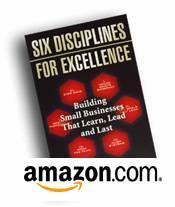
There are many business improvement methods out there. What we don't really need is YAGI (yet another great idea.)
But if you've been following our blog, you'll understand that the reasons most businesses fail is not strategy - it's execution.
More to the point: Knowing what to do isn't the problem - doing it is!
The Six Disciplines program is specifically designed and optimized for strategy-driven execution.
When diligently and consistently applied (with the help provided by Six Disciplines Leadership Centers), the Six Disciplines program will help organizations go beyond efficiency - and beyond effectiveness - to achieve lasting excellence.
The design requirements behind the Six Disciplines Methodology are:
- Make it easier than alternatives
- Think holistically about the business
- Be process-driven
- Establish business habits
- Promote life-long learning
- Instill constructive accountability
- Build a measurement culture.
- Encourage effective communication
- Leverage the Internet
- Proactively pursue alignment
BOTTOMLINE: It you've read Good to Great, E-Myth and others - and were left hungry for more - not how why companies can become excellent, but HOW they can be come that way, it's time to read Six Disciplines for Excellence.
Five Keys To Building A High-Performance Organization
A recent Gartner review , published in Business Performance Management Magazine, of the practices of successful companies in a variety of industries reveals five characteristics that are key to success. Emulating these organizations requires a focus on performance management.
High-performance organizations (HPOs) seem to understand the market earlier and more thoroughly than other businesses, retain the best staff members, and have less trouble responding to external pressures.
Gartner analysts found that HPOs share five characteristics:
High-performance organizations (HPOs) seem to understand the market earlier and more thoroughly than other businesses, retain the best staff members, and have less trouble responding to external pressures.
Gartner analysts found that HPOs share five characteristics:
- They set ambitious targets and consistently and continuously achieve those objectives.
- They display a strong sense of purpose through shared values both inside (among employees) and outside the organization (among customers, suppliers, and other stakeholders).
- They have a strategic focus and alignment so that employees know how they are contributing to the results of the organization.
- They have the agility to adapt to changing circumstances quickly.
- And, finally, they have a common and shared business model throughout the organization
Small Business Trends Showcases Six Disciplines Podcast
On this Small Business Trends radio broadcast, Anita Campbell has as her special guest, Gary Harpst, CEO and founder of Six Disciplines Corporation.
According to Anita:
"As the former founder and CEO of Solomon Software, Harpst’s company grew to over 400 employees, merged with their largest competitor — and eventually was acquired by Microsoft."
"Gary has a strong interest and passion for understanding how high-performing organizations develop and maintain culture. His presentations weave together the principles and strategies which are the foundation of the Six Disciplines™ Methodology."
"Gary’s work as an author, keynote speaker, television and radio guest, and executive mentor has created nationwide interest in applying the Six Disciplines Methodology for ready and able organizations that passionately want to be excellent."
Gary talks with Anita about why most businesses eventually lose their edge, and what are some things that can be done to keep their edge.
You can download the podcast (in Windows Media format or MP3) here.
According to Anita:
"As the former founder and CEO of Solomon Software, Harpst’s company grew to over 400 employees, merged with their largest competitor — and eventually was acquired by Microsoft."
"Gary has a strong interest and passion for understanding how high-performing organizations develop and maintain culture. His presentations weave together the principles and strategies which are the foundation of the Six Disciplines™ Methodology."
"Gary’s work as an author, keynote speaker, television and radio guest, and executive mentor has created nationwide interest in applying the Six Disciplines Methodology for ready and able organizations that passionately want to be excellent."
Gary talks with Anita about why most businesses eventually lose their edge, and what are some things that can be done to keep their edge.
You can download the podcast (in Windows Media format or MP3) here.
Focused Strategic Planning
Marakon Associates published a quick review of the Harvard Business Review article from Michael Mankins and Richard Steele of Marakon entitled "Stop making plans; start making decisions."
Their premise?
- Most executives view traditional strategic planning as worthless. Why? The process contains serious flaws.
- First, it’s conducted annually, so it doesn’t help executives respond swiftly to threats and opportunities (a new competitor, a possible acquisition) that crop up throughout the year.
- Second, it unfolds unit by unit—with executive committee members visiting one unit at a time to review their strategic plans.
The solution? How to improve the quality and quantity of your strategic decisions?
- Use continuous issues-focused strategic planning. Throughout the year, identify the issues you must resolve to enhance your company’s performance—particularly those spanning multiple business units. Debate one issue at a time until you’ve reached a decision. And add issues to your agenda as business realities change.
BOTTOMLINE: Your reward? More rigorous debate and more significant strategic decisions each year—made precisely when they’re needed. Don't make strategic planning just an annual event!
Make The Choice to Be Excellent
Over at ThinkTQ, they offer up "10 choices you must make"....to chose EXCELLENCE over MEDIOCRITY:
- Choose to be ENERGETIC—instead of permitting yourself to become run-down and burned-out.
- Choose to be PASSIONATE—instead of permitting yourself to become aimless, apathetic and indifferent.
- Choose to be ENTHUSIASTIC—instead of permitting yourself to become half-hearted and discouraged.
- Choose to be SELF-DIRECTED—instead of permitting yourself to become directionless and uncertain.
- Choose to be PREPARED—instead of permitting yourself to become shortsighted and reactive.
- Choose to be FOCUSED—instead of permitting yourself to become scattered and impulsive.
- Choose to be SUPPORTIVE—instead of permitting yourself to become critical and judgmental.
- Choose to be SYSTEMATIC—instead of permitting yourself to become haphazard and disorganized.
- Choose to be TIMELY—instead of permitting yourself to become distracted and preoccupied.
- Choose to be PROACTIVE—instead of permitting yourself to become procrastinating and hesitant.
BOTTOMLINE: Within your organization, you have choices every day, every hour, every minute. Don't just choose to do things right (efficiency). Don't even stop at doing the right things (effectiveness). Make the choice to Be Excellent™.
Does Discipline Squelch Flexibility and Creativity?
Here's one from Inc. Magazine: Does Discipline Squelch Flexibility and Creativity?
"Can a business have formal disciplined systems, yet still provide a creative environment for employees while profitably providing responsive flexibility for customers?"
BOTTOMLINE: "The reality is you have a much better chance with disciplined systems than you do without them. How can that be? Because without discipline and systems, decision-making is more chaos than repeatable or reliable. Moreover, if there is no defined way for how things get done, any idea for an improved method merely means one more option for employees to ignore when they choose to. As they say in movie disclaimers, any resemblance between chaos and profitable responsive flexibility is purely coincidental."
Ready to read "Six Disciplines for Excellence" now?
"Can a business have formal disciplined systems, yet still provide a creative environment for employees while profitably providing responsive flexibility for customers?"
BOTTOMLINE: "The reality is you have a much better chance with disciplined systems than you do without them. How can that be? Because without discipline and systems, decision-making is more chaos than repeatable or reliable. Moreover, if there is no defined way for how things get done, any idea for an improved method merely means one more option for employees to ignore when they choose to. As they say in movie disclaimers, any resemblance between chaos and profitable responsive flexibility is purely coincidental."
Ready to read "Six Disciplines for Excellence" now?
Weekly Planning - Why We Resist
From Ricky Spears, comes this insightful piece called, "Why We Resist the Weekly Review and Plan (and What You Can Do About It)"
His assertion?
"Regardless of whether you are keeping your life organized using the Getting Things Done methodology or the FranklinCovey methodology, a central component of both systems is the “weekly review” or the “weekly plan”.
For many practitioners, this is the single most difficult discipline and yet also the most crucial discipline. Over the past few months I’ve spent some time thinking about why we resist the weekly review or plan, and what we can do about it. I trust that the following will help you in discovering why you are resisting the weekly review or plan and in discovering ways to overcome them.
BOTTOMLINE: Weekly planning - very critical to becoming more self managing. Read the entire, very useful article here.
(Tip of the hat to LifeHack.Org for this one!)
His assertion?
"Regardless of whether you are keeping your life organized using the Getting Things Done methodology or the FranklinCovey methodology, a central component of both systems is the “weekly review” or the “weekly plan”.
For many practitioners, this is the single most difficult discipline and yet also the most crucial discipline. Over the past few months I’ve spent some time thinking about why we resist the weekly review or plan, and what we can do about it. I trust that the following will help you in discovering why you are resisting the weekly review or plan and in discovering ways to overcome them.
BOTTOMLINE: Weekly planning - very critical to becoming more self managing. Read the entire, very useful article here.
(Tip of the hat to LifeHack.Org for this one!)
Tuesday, August 29, 2006
Five Actions for Organizational Change
Hal, over at Reforming Project Management, posts this entry on Five Necessary Actions for Organizational Change
- Be clear why change is necessary in terms that make sense to the individuals.
- Declare an initial set of standards for measuring performance and get agreement that people will set out to perform to those standards.
- Show how it is done.
- Measure, acknowledge, reward new behavior, and be clear on the consequences.
- Work with them on improving.
Monday, August 28, 2006
Examples of Excellence: Tiger Woods in Golf
So much has been written about Tiger Woods, that to wax on eloquently about his passion for excellence - would be superfluous.
But when you see headlines like:
But when you see headlines like:
....you just have to sit and ponder about the level of excellence he has achieved already, at the ripe old age of 30.
Doing The Right Things Right
Successful companies execute well against their strategic plans and deliver against goals and measured expectations.
Simply put:
Simply put:
- Figure out what to do (doing the right things) - primarily effectiveness
- Then you need to do it (doing things right) - primarily efficiency
- Then, you need to (do the right things right) - combining effectiveness and efficiency
BOTTOMLINE: By doing the right things right - and doing it over the long-term, transforms your organization into one that learns, leads and lasts.
Change Is A Good Thing
Ann Michael, over at Manage to Change, offers this great thought provoker:
Change is offensive. It challenges the status quo.
Learning is offensive. It forces us to grow.
Decision making is offensive. It’s discriminating.
Leadership is offensive. We don’t always get our way.
Innovators are offensive. They challenge us.
Thinkers are offensive. They ask a lot of annoying questions.
Honesty is offensive. Sometimes the truth hurts.
Integrity is offensive. Its presence highlights where it’s absent.
Offensive: causing resentful displeasure; highly irritating, angering or annoying.
Change is offensive. It challenges the status quo.
Learning is offensive. It forces us to grow.
Decision making is offensive. It’s discriminating.
Leadership is offensive. We don’t always get our way.
Innovators are offensive. They challenge us.
Thinkers are offensive. They ask a lot of annoying questions.
Honesty is offensive. Sometimes the truth hurts.
Integrity is offensive. Its presence highlights where it’s absent.
Offensive: causing resentful displeasure; highly irritating, angering or annoying.
Culture and Passion Are Key Drivers
The new Inc. 500 is out. According to one new inductee:
"It's definitely an honor to make the 500, and a nice boost to the team. But it definitely signifies a transition from scrappy disrupter to growth-oriented execution company. What keeps me up at night? It's not cash flow. It's not marketing. If I'm going to rant on any topic, it's culture."
"It's definitely an honor to make the 500, and a nice boost to the team. But it definitely signifies a transition from scrappy disrupter to growth-oriented execution company. What keeps me up at night? It's not cash flow. It's not marketing. If I'm going to rant on any topic, it's culture."
- We did a Stop/Start/Continue exercise recently ("what's one thing we should stop doing, one thing to start doing and one thing to continue doing?"), and 75% of the team said that we need to continue our passionate culture.
The big question then is how do you combine your aggressive growth plans without losing the culture that has defined you? What are the best practices?
- Take interviewing seriously: We have a detailed, consistent, structured process for finding the right people, (consider using behaviorial assessments)
- Accept change: We need to embrace the growth process and understand that some changes are inevitable. We want to operationalize the elements of culture that are most important so they don't get lost in the process.
- Market the culture: We write down what makes our culture great. Then share it, live it, update it. Do some internal marketing that reflects our core brand to keep people fired up about why the company is great....and that the mission has never waivered.
- Hire athletes: Great people that don't have the specific skill set ("athletes") are much better for us than good people with the exact skill set ("experts"). Athletes can be trained, but we can't train passion.
- Keep the magic: It's not about money -- money is the air we breathe to help us chase our goals. It's about a bigger mission.
Ways To Stay Focused At Work
An individual's competence to execute strategy on a daily basis is key to a successful small business. But we all recognize how easily and quickly it is to be distracted.
Here are 18 ways to stay focused at work:
And...here are 11 more ways!
BOTTOMLINE: Decide what's important, set goals that lead, align systems, work the plan. Stay focused!
Here are 18 ways to stay focused at work:
And...here are 11 more ways!
BOTTOMLINE: Decide what's important, set goals that lead, align systems, work the plan. Stay focused!
Friday, August 25, 2006
Planning and Execution
From the "School of Doing Business":
Running a small business can be boiled down to TWO activities:
Running a small business can be boiled down to TWO activities:
- PLANNING
- EXECUTION
There are only 4 possible combinations to the above formula, and two possible outcomes:
- GOOD execution of a BAD plan ----> leads to failure.
- BAD execution of a GOOD plan----> leads to failure.
- BAD execution of a BAD plan----> leads to failure.
- GOOD execution of a GOOD plan----> leads to success.
Top Six Drivers for Business Success
eePulse Inc. and the University of Michigan's Ross School of Business today announced the results of the Leadership Pulse, which reveals leadership energy trends, the importance of specific drivers for business success and undervalued drivers in select industries.
Out of 22 drivers, based on a study of long-term stock price and earnings growth conducted by eePulse, respondents indicated six “higher-order” categories in order of relative importance to their firm’s overall performance (1-to-5 scale was used, where 1 = not at all important and 5 = very important):
Out of 22 drivers, based on a study of long-term stock price and earnings growth conducted by eePulse, respondents indicated six “higher-order” categories in order of relative importance to their firm’s overall performance (1-to-5 scale was used, where 1 = not at all important and 5 = very important):
- 4.34 Agility and Quality
- 4.25 Strategy/Leadership
- 4.12 Technology
- 3.97 Human Capital
- 3.91 Product
- 3.82 Costs
Thursday, August 24, 2006
The Strategy Execution Disconnect
OnPoint Consulting's recent survey yields insights into what causes the strategy-execution gap . . . and what might be done to close it.
Their assertions:
Their assertions:
- We discovered that almost half of the leaders surveyed—49%—do perceive a gap between their organizations' ability to develop and communicate sound strategies and their ability to implement those strategies.
- 64% don't have full confidence that their companies will be able to close the gap.
- "Vision" isn't the problem. The majority of respondents - 75% believe their companies have clear and inspiring visions.
So what is contributing to the strategy-execution gap?
Eight central factors set apart those companies whose employees have confidence in their company's ability to effectively execute from those with reported strategy-execution gaps:
- Change is well managed by top management
- Decisions and actions are well coordinated across different levels of management
- The actions and decisions of top management are consistent with their espoused objectives, values, and priorities
- Decisions and actions are well coordinated across different work units
- Effective human resource management systems and practices are in place for selecting, training, and compensating employees
- The current organizational structure supports the implementation of the business strategy
- There is a proper balance of centralized and decentralized responsibility required to achieve the strategy
- Top management appropriately involves people in decisions
What are the implications? Their survey yields several critical lessons for business leaders:
- Successfully achieving execution takes more than clarifying and communicating the organization's strategic direction. You've got to come up with a common picture, clarify the focus and scope, before you can get to the actual behaviors. For many companies, this step—clarifying assumptions—is missing. (See Discipline I - Decide What's Important)
- Few organizations appear to ask whether or not they have the proper management systems in place to support the achievement of the strategy. (See Discipline III - Align Systems)
- It is also important to go beyond gaining understanding and acceptance of the strategy throughout the organization. Monitoring may be the most critical aspect of the process. (See Discipline III. Align Systems)
- Leaders must behave in a way that is consistent with organizational values and priorities. (See Discipline I - Decide What's Important)
BOTTOMLINE: "Gaps between strategy and execution that are neglected tend to grow into chasms. Closing the gap between strategy and execution may be the most important thing you can do for the future of your company."
Knowing vs. Doing: Why Is It So Hard?
A key challenge for today’s small businesses – and for the team members within them – is to build a culture of execution.
It's not enough to know what to do (theory). It's doing it (execution).
Knowledge is only useful if you do something with it.
So...why is it so hard?
Today, there are plenty of management experts on everything, even on how to get things done.
But even those who focus on getting things done, focus primarily on efficiency.
But what about getting the right things done? What about effectiveness?
Perhaps even more important, what about getting the right things done....right?
BOTTOMLINE: "Your job is to do something today that’s better than what you did yesterday. And to do something tomorrow that’s better than what you did today."
Continual improvement. Doing things right (efficient) - AND - doing the right things (effective) - and doing the right things RIGHT.
(Hat tip to Jeffrey Pfeffer)
It's not enough to know what to do (theory). It's doing it (execution).
Knowledge is only useful if you do something with it.
So...why is it so hard?
Today, there are plenty of management experts on everything, even on how to get things done.
But even those who focus on getting things done, focus primarily on efficiency.
But what about getting the right things done? What about effectiveness?
Perhaps even more important, what about getting the right things done....right?
BOTTOMLINE: "Your job is to do something today that’s better than what you did yesterday. And to do something tomorrow that’s better than what you did today."
Continual improvement. Doing things right (efficient) - AND - doing the right things (effective) - and doing the right things RIGHT.
(Hat tip to Jeffrey Pfeffer)
The Craft and Art of Running A Business
Rhonda Abrams is the author of "The Owner's Manual for Small Business," and published a great article on "Put passion, soul in business in order to excel."
In it, she talks about the CRAFT of business:
In it, she talks about the CRAFT of business:
- To run a good company, you need to know the "craft" of business.
- The skills you need to know to run and grow a business -- how to improve your marketing, hire employees, use technology -- are basic to running your company every day; they're the "craft" of business.
- of what we do on a day-to-day basis is craft -- the workmanship of running a company.
- The "craft" of business enables you to survive.
And...the ART of business:
- To run a great company, you also need to practice the "art" of business.
- The "art" of business propels you to succeed.
- Exceptional companies infuse their workmanship with extra care. They put their heart into the process. They pay attention to the little things.
- When you put yourself -- your unique vision, your talents, your creativity, your passion -- into your business, you can create something exceptional.
BOTTOMLINE: "Make no mistake, learning the craft of business is essential. Many decent businesses survive on craft alone by consistently doing the basic day-to-day tasks well. None survives on art alone. It's the difference between concept and execution, inspiration and perspiration. Even the most inspired business concept goes nowhere without hard-working execution.
But if you want an exceptional business, one that not only survives but excels, a business that provides you with exceptional rewards in both personal satisfaction as well as financial gains, that's where the art of business takes over. When you put your passion and soul into your day-to-day operations, then you've become an artist as well as an entrepreneur."
(Tip of the hat to Dane Carlson at Business Opportunities Weblog for the link!)Entrepreneurs and Growth Opportunities
Visa USA and SCORE, a nonprofit association dedicated to entrepreneur education recently published the results of a survey in which they found:
- Sole proprietors, who make up three-fourths of all small businesses, lack the time and resources to focus on generating new business
- 35% of sole proprietors say their primary challenge in maintaining and growing a small business is an inability to focus on generating new business
- 27% cite stretching themselves across multiple roles and projects.
- Other challenges mentioned by sole proprietors included:
- limited resources (23%)
- lack of time to focus on their passions (23%)
- difficulties in running their businesses efficiently (23%) - 52% said that with the help of an additional employee, generating new business would become a focal point and personal priority
Why Most CEOs and Entrepreneurs Fail
"In an excellent article by Chet Holmes, he discusses the reason behind why so many CEOs and entrepreneurs fail.
The major reason he cites is that they fail to "tap into the incredible treasure trove of knowledge, harness the energies and then channel the efforts of your employees to help you become great."
When talking about the saying we hear that says "work on the business not just in the business," he says that you must ask three questions of your people:
(Tip of the hat to Gary Bourgeault at Managers Realm for the link!)
The major reason he cites is that they fail to "tap into the incredible treasure trove of knowledge, harness the energies and then channel the efforts of your employees to help you become great."
When talking about the saying we hear that says "work on the business not just in the business," he says that you must ask three questions of your people:
- Where's the pain?
- What needs to be fixed?
- What can we do to fix it?
(Tip of the hat to Gary Bourgeault at Managers Realm for the link!)
Kauffman Foundation Mentions Six Disciplines
Always good to know we're getting the word out!
And in this entry on Kauffman's Entrepreneur's Viewpoint blog, we're humbled to see a link to the Six Disciplines web site -- from one of the best entrepreneurial resources on the planet!
(Thanks to the good folks at Kauffman!)
And in this entry on Kauffman's Entrepreneur's Viewpoint blog, we're humbled to see a link to the Six Disciplines web site -- from one of the best entrepreneurial resources on the planet!
(Thanks to the good folks at Kauffman!)
Wednesday, August 23, 2006
Change Options
Steve Rucinski, over at Small Business CEO, offers this insightful entry on "Change: Get Better or Get Worse – That’s It For Options."
His premise?
His premise?
- People and organizations have only two alternatives: get better or get worse, improve or decay.
- Our choice is to manage this process and improve the things that can be improved, or ignore the process and decay. This idea is a key element in the concept of life long learning.
- The question for us as individuals, and for organizations, is how to keep on the growth, innovation and improvement upward vector. It can be done, but it takes positive, continuous action and energy.
- In almost all of these tasks, the required decision-making leads to changes. Therefore, change is what we are actually managing.
- The point is the blanket comment; “I don’t like change” is untrue. We generally like changes that affect us positively and tend to resist changes that affect us in a negative way.
BOTTOMLINE: "We are on the threshold of an entirely new way of thinking about change. Soon, there will be a generation that will resist the lack of change. Are we ready to manage people who think that way? The challenge is to proactively manage change. Become the change agent and you are shaping the future."
Communicating The Mission
Even if you can't build a relationship with each of your employees in person, here are three ways to communicate your company's mission, as described in this Business Week article, showcasing the president of Travelocity, Michelle Peluso.
Stay remarkably connected with your team members by:
Stay remarkably connected with your team members by:
- Be Visionary. A mission must be both emotional and tangible. Employees need to be excited about the roles they play in making that mission a reality. The CEO's job is to make sure all employees understand how their work advances the mission. It's up to the leader to craft a compelling mission and to communicate the importance of everyone's role in fulfilling that mission.
- Be Genuine and Passionate. Be compassionate, yet aggressive and open. Communicate the facts as you know them and to craft a positive, energizing, and inspiring vision of the future
- Be Present. Great leaders are "present," or available. Answer or acknowledge emails directly. If you can get back to an employee immediately, employees, in turn, should be able to quickly respond to customers, colleagues, and vendors. By being responsive and showing appreciation, everyone wins—staff, customers, and investors.
BOTTOMLINE: CEOs are the the leaders. Act as the role model. Be available, present, and connected, and communicate the mission as often as you can.
Tuesday, August 22, 2006
Signs of Change Fatigue
Any change initiative, whether one with a specific focus or comprehensive organizational change, will reach a point when it stalls - a leader's will starts to sag and the minions, employees, start to tune out.
Mastering how to make mid-course adjustments will give new life and momentum to these change initiatives.
In this article, Eric Beaudan, a Principal with Healthy Companies International, a consulting firm based in Washington DC., describes how leaders can make those key midcourse adjustments.
Here are 6 Signs of Change Fatigue within Organizations:
organization's power structure. Individuals who support change at the beginning may become neutral, passive or active resisters over time."
Mastering how to make mid-course adjustments will give new life and momentum to these change initiatives.
In this article, Eric Beaudan, a Principal with Healthy Companies International, a consulting firm based in Washington DC., describes how leaders can make those key midcourse adjustments.
Here are 6 Signs of Change Fatigue within Organizations:
- Outsiders increasingly question the value/objectives of the change effort
- Change effort leaders/coordinators are stressed out and/or leaving
- Reluctance to share or comment on data about the effort
- Budget and resources are diverted to other strategic initiatives
- Customer impatience with duration of change effort
- Key leaders not attending progress reviews
organization's power structure. Individuals who support change at the beginning may become neutral, passive or active resisters over time."
Top 10 Reasons Why Businesses Fail
Bobby Guy, an attorney in Nashville, practices bankruptcy law. How often do entrepreneurs get to hear from a person who understands business failure from the inside before they start their ventures? He likes to give a talk called “A View From Down-Under: The Top Ten Reasons Companies That Should Make It…Don’t.”
And here are his Top 10: (drum-roll please....)
10. Over-expansion
9. Poor Capital Structure
8. Failure to Control the Controllable Costs
7. Failure to Prepare for Volatility of Uncontrollable Costs
6. Add New Products or Divisions that Drag Down the Profitable Ones
5. Poor Internal Controls and Execution
4. Poorly Designed Business Model
3. Reliance on Critical Financing that Dries Up
2. Failure to Adapt to a Changing Market
AND THE #1 REASON? Top Management in Complete Denial......
BOTTOMLINE: Hmmmm.....What if an organization would use a systematic business-building methodology, designed to focus on execution - along with integrated Internet technologies to make the repeatable processes practical - along with a local business coach who helps the organization keep on track?
Not only would the organization be in a better position to avoid these Top 10 reasons, they'd have a built-in process to continually improve it.
(Thanks to Dr. Jeff Cornwall at The Entreprenurial Mind for this one)
And here are his Top 10: (drum-roll please....)
10. Over-expansion
9. Poor Capital Structure
8. Failure to Control the Controllable Costs
7. Failure to Prepare for Volatility of Uncontrollable Costs
6. Add New Products or Divisions that Drag Down the Profitable Ones
5. Poor Internal Controls and Execution
4. Poorly Designed Business Model
3. Reliance on Critical Financing that Dries Up
2. Failure to Adapt to a Changing Market
AND THE #1 REASON? Top Management in Complete Denial......
BOTTOMLINE: Hmmmm.....What if an organization would use a systematic business-building methodology, designed to focus on execution - along with integrated Internet technologies to make the repeatable processes practical - along with a local business coach who helps the organization keep on track?
Not only would the organization be in a better position to avoid these Top 10 reasons, they'd have a built-in process to continually improve it.
(Thanks to Dr. Jeff Cornwall at The Entreprenurial Mind for this one)
Forbes Magazine On Business Planning
As mentioned before in Be Excellent, Tim Berry knows business planning. (He's the successful founder of Palo Alto Software.)
A few key points from the interview with Tim in Forbes Magazine:
Business-building involves the integration of key management elements, including strategy, planning, measurement, execution, learning and leadership.
A few key points from the interview with Tim in Forbes Magazine:
- "There is a myth that a business plan is about starting a business, getting a loan or attracting capital. But many businesses may not need to raise capital, so they think business plans are a waste of time. They use it once and stick it away in a drawer."
- "Business planning should be a process that allows for regular review. A good business plan is never done. It is a projection of what you think you're going to do, after which it becomes a tool for comparing, month by month, what you did to what you thought you were going to do. It becomes a guide. "
- " The plan contains as many measurable objectives as possible. Sales by product, cost by product, basic financial stuff. But we'll also look at other markers like the number of tech support calls every month, things that don’t show up in the financials. Maybe a couple dozen data points."
Business-building involves the integration of key management elements, including strategy, planning, measurement, execution, learning and leadership.
About Lasting Excellence And Decision-Making
To quote Jim Collins (author of Good to Great and Built to Last):
"Lasting excellence in corporations seems to stem less from decisions about strategy than decisions about people, and seeking consensus is not the way to make the tough calls."
In this Fortune Magazine article, (subscription required) Collins reveals the one theme discovered by looking at the decision-making process was:
"the greatest (business) decisions were not 'what' but 'who.' They were people decisions."
BOTTOMLINE: For an organization to achieve lasting excellence takes strategic decisions - the most important of which are those based on your organization's key asset - your people.
Interesting, though, that Collins' books are runaway best-sellers.....they focus on telling you what and why - but very little on HOW to make it happen in your OWN organization.
"Lasting excellence in corporations seems to stem less from decisions about strategy than decisions about people, and seeking consensus is not the way to make the tough calls."
In this Fortune Magazine article, (subscription required) Collins reveals the one theme discovered by looking at the decision-making process was:
"the greatest (business) decisions were not 'what' but 'who.' They were people decisions."
BOTTOMLINE: For an organization to achieve lasting excellence takes strategic decisions - the most important of which are those based on your organization's key asset - your people.
Interesting, though, that Collins' books are runaway best-sellers.....they focus on telling you what and why - but very little on HOW to make it happen in your OWN organization.
The Winning Spirit: Principles That Drive Performance Excellence
"Widely considered the best NFL quarterback of all time, Joe Montana personifies performance excellence and personal integrity both on and off the field. Since his retirement a decade ago, he has become a popular motivational speaker sought out by corporations nationwide, speaking to capacity audiences as large as twenty thousand.
Now making his message available to a broader audience, Montana teams up with performance coach Tom Mitchell to extend to all areas of life the truths of success on the field. " The Winning Spirit: Sixteen Timeless Principles That Drive Performance Excellence" by Joe Montana, shows that ultimately performance excellence is fueled by personal integrity."
A few examples from the book:
Now making his message available to a broader audience, Montana teams up with performance coach Tom Mitchell to extend to all areas of life the truths of success on the field. " The Winning Spirit: Sixteen Timeless Principles That Drive Performance Excellence" by Joe Montana, shows that ultimately performance excellence is fueled by personal integrity."
A few examples from the book:
- Know What You Want: First, identify goals, then turn clarity into action.
- Strive for Excellence: Surpass expectations and reach new heights
- Fail Fast and Move On: Take chances, learn from mistakes, and keep pressing forward–don’t let fear or regret take you out of the game.
- Remember the “I” in Team: Make yourself the priority–because intense preparation is the individual responsibility of each member of the team.
- Welcome Pressure: Want to be the best? Work with or compete against the best!
- Walk Like a Champ: Your life is not just about achieving success, but also about having a purpose and creating significance.
The Time for Action Is Now: Execution is the Key
Todd Sattersten, who works for business book vendor 800-CEO-READ recently published this short entry at FastCompany.com on the importance of Action (i.e., Execution):
"The ever common debate is "What is more important -- the idea or the execution?" I have recently come on the side of action.
I have never found the idea part difficult. If you are a student of business, you can find inspiration all around you. Read the business media. Go to conferences. Good ideas are everywhere." (Read the rest here.)
BOTTOMLINE: Ideas are everywhere. The key is to execute on the right ideas, continually, consistently and systematically. Execution is the fundamental design principle behind Six Disciplines.
"The ever common debate is "What is more important -- the idea or the execution?" I have recently come on the side of action.
I have never found the idea part difficult. If you are a student of business, you can find inspiration all around you. Read the business media. Go to conferences. Good ideas are everywhere." (Read the rest here.)
BOTTOMLINE: Ideas are everywhere. The key is to execute on the right ideas, continually, consistently and systematically. Execution is the fundamental design principle behind Six Disciplines.
Monday, August 21, 2006
Organizing To Execute
"Thankfully, organizational DNA can be changed or modified, a distinct advantage when the behavior of certain managers, for example, throws programs or goals off the rails. But like human DNA, the organizational variety has building blocks.
The latter, however, can be changed by manipulating and modifying those blocks. These authors explain how it can be done."
BOTTOMLINE: "Any attempt to address a business weakness or strategic opportunity must explicitly address the underlying organizational reasons the current strategy is not working.
The attempt cannot begin, as many traditional approaches do, with the conclusion that the problem lies in the strategy itself or the culture of the company.
While culture plays an important role in organizational performance, it is an outcome of the organizational system, not an input. Adjust the building blocks, and you change the system. Change the system, and you change the culture. Change the culture and you unlock strategy by enabling execution."
The latter, however, can be changed by manipulating and modifying those blocks. These authors explain how it can be done."
BOTTOMLINE: "Any attempt to address a business weakness or strategic opportunity must explicitly address the underlying organizational reasons the current strategy is not working.
The attempt cannot begin, as many traditional approaches do, with the conclusion that the problem lies in the strategy itself or the culture of the company.
While culture plays an important role in organizational performance, it is an outcome of the organizational system, not an input. Adjust the building blocks, and you change the system. Change the system, and you change the culture. Change the culture and you unlock strategy by enabling execution."
Thursday, August 17, 2006
Strategy, Planning and Execution
Success in business is really not that complicated.
In business - there are only three requirements.
You need three things, clear and unambiguous, no less, no more and - in exactly this order.
In business - there are only three requirements.
You need three things, clear and unambiguous, no less, no more and - in exactly this order.
- A Strategy. As Michael Porter conveys it: "What value are you to deliver to what customers and how are you going to be different?"
- A Business Model. As in "and how are you going to use your resources to deliver that value and how are you going to keep some of the value yourself?"
- A Way to Execute.
BOTTOMLINE: Sometimes... simplicity is best.
Motivating Team Members
From Entrepreneur Magazine comes this article on Motivating Your Burned-Out Employees .
If you have employees who've held the same job for some time, it's quite likely they're bored and their job performance is below par.
Frederick Herzberg, author of The Motivation to Work, said that employees can best be motivated by three techniques: job rotation, job enlargement and job enrichment.
If you have employees who've held the same job for some time, it's quite likely they're bored and their job performance is below par.
Frederick Herzberg, author of The Motivation to Work, said that employees can best be motivated by three techniques: job rotation, job enlargement and job enrichment.
- Job rotation involves cross training employees, or teaching employees each other's jobs.
- Job enlargement involves giving a wider breadth of tasks and responsibilities.
- Job enrichment involves increasing the depth of your employee's responsibilities, not by increasing the number of tasks -- but by increasing the complexity of the tasks.
BOTTOMLINE: One of the most basic elements of improving performance is understanding what needs to be done, and how it ties to the organization's strategy and goals. Key to this understanding is the simple, yet very powerful tool called the Individual Plan, as described in Discipline IV. Work The Plan.
13 Keys To Keeping The Right People
These days, it's hard enough to find the right people.
It can be even harder to keep the right people.
Here are 13 must-dos to keep the right people - "the result will be long-standing workplace success. "
It can be even harder to keep the right people.
Here are 13 must-dos to keep the right people - "the result will be long-standing workplace success. "
Management Styles and Small Business Growth
Fortune Small Business offers this short article detailing the results of a study by the Gevity Institute, a human resources outsourcing firm in Bradenton, FL.
The results?
The results?
- Small businesses that granted workers more autonomy grew at more than four times the rate of those that relied on tight top-down controls.
- Superior HR and management decisions could mean the difference between an explosive business and a sluggish one.
- Companies that met all its criteria had an average revenue growth rate 22 times higher than those that didn't meet any, a profit rate 47 times higher - and one-sixteenth the turnover rate.
15 Warning Signs of A Company's Failing Reputation
From the folks at CEOGO.com, comes this free 35-page e-book download "Cures for The Company Blues: 15 Early Warning Signs of A Company's Failing Reputation."
The early warning signs?
The early warning signs?
- There is low employee morale
- Internal politics are more important than doing the job well
- Top executives depart
- CEO celebrity displaces CEO credibility
- Employees speak of customers as nuisances
- Employees stop telling positive stories about the company
- Leaders stifle initiative
- Leaders talk about growth but focus on cost-cutting
- Bureaucratic procedures impede flexibilit
- There is a tendency toward superficiality
- Problem-makers outnumber problem-solvers
- Internal documents leak
- There are few rewards and recognition
- Management spends more time inside than outside headquarters
- Employees spend too much time writing internal memos
Wednesday, August 16, 2006
Formal Definitions of Leadership
From LeadingToday.Org comes this article on Formal Definitions of Leadership.
Their premise?
Leadership is a term which is hard to define. Because of this ambiguity it is also often misdefined and abused. The modern media is usually guilty of labeling the term "leadership" on any individual or group that controls, commands others or maintains positions of power. To help us define leadership, it may be helpful to remember what Warren Bennis wrote almost 50 years ago…
"Always, it seems, the concept of leadership eludes us or turns up in another form to taunt us again with its slipperiness and complexity. So we have invented an endless proliferation of terms to deal with it . . . and still the concept is not sufficiently defined."
Sadly, what was written by Warren Bennis in 1959 is still as applicable today as ever.
BOTTOMLINE: There is no single phrase or definition that incorporates all the traits or qualities of effective leadership. Yet, by examining these diverse definitions we can come to a better understanding of what leadership is, and how it influences others.
Some excellent definitions of leadership are reviewed here!
Their premise?
Leadership is a term which is hard to define. Because of this ambiguity it is also often misdefined and abused. The modern media is usually guilty of labeling the term "leadership" on any individual or group that controls, commands others or maintains positions of power. To help us define leadership, it may be helpful to remember what Warren Bennis wrote almost 50 years ago…
"Always, it seems, the concept of leadership eludes us or turns up in another form to taunt us again with its slipperiness and complexity. So we have invented an endless proliferation of terms to deal with it . . . and still the concept is not sufficiently defined."
Sadly, what was written by Warren Bennis in 1959 is still as applicable today as ever.
BOTTOMLINE: There is no single phrase or definition that incorporates all the traits or qualities of effective leadership. Yet, by examining these diverse definitions we can come to a better understanding of what leadership is, and how it influences others.
Some excellent definitions of leadership are reviewed here!
Strategic and Execution
At Six Disciplines, a core business process we have business leaders learn is that of strategy formulation - and, of course, execution.
But what exactly is strategy?
According to Henry Mintzberg:
"Strategies are to organizations what blinkers are to horses."
"Strategy doesn’t necessarily come first (‘think’ then ‘do’): it’s not that simple a divide. Strategy and Execution intertwine, so stop separating them in your head.
“Virtually everything that has been written about strategy-making depicts it as a deliberate process. First we think, then we act. We formulate, then we implement. The progression seems so perfectly sensible. Why would anybody want to proceed differently?" he writes.
He goes on: "While it is certainly true that many intended strategies are ill conceived, I believe that the problem often lies one step beyond, in the distinction we make between formulation and implementation, the common assumption that thought must be independent of [and precede] action…Smart strategists appreciate that they cannot always be smart enough to think through everything in advance.”
Why do so few other get this? Including some of those billed as the biggest experts on strategy in our time?
BOTTOMLINE: "Breaking the distinction between Strategy and Execution frees leaders up to be more agile and flexible."
But what exactly is strategy?
According to Henry Mintzberg:
"Strategies are to organizations what blinkers are to horses."
"Strategy doesn’t necessarily come first (‘think’ then ‘do’): it’s not that simple a divide. Strategy and Execution intertwine, so stop separating them in your head.
“Virtually everything that has been written about strategy-making depicts it as a deliberate process. First we think, then we act. We formulate, then we implement. The progression seems so perfectly sensible. Why would anybody want to proceed differently?" he writes.
He goes on: "While it is certainly true that many intended strategies are ill conceived, I believe that the problem often lies one step beyond, in the distinction we make between formulation and implementation, the common assumption that thought must be independent of [and precede] action…Smart strategists appreciate that they cannot always be smart enough to think through everything in advance.”
Why do so few other get this? Including some of those billed as the biggest experts on strategy in our time?
BOTTOMLINE: "Breaking the distinction between Strategy and Execution frees leaders up to be more agile and flexible."
The Advantages of Franchising
According to the 2006 FranData study published in Franchising World magazine, the franchising world is booming!
Here are some highlights:
Here are some highlights:
- Of the 18 industries covered, 17 saw an increase in the number of new business concepts being franchised.
- Over the past three years, over 900 new business concepts started franchising their operations.
- Not surprisingly, the fast food industry offers the most franchised units, followed by retail and service businesses.
Why franchise?
We can learn much about achieving excellence from successful franchises. The appeal of a franchise is rooted in two promises.
First, there a very clear promise to the customer that's reflected in their brand. (Think: Starbucks, JiffyLube, McDonalds.)
Second, there's a promise to the franchise owner of a well-considered and proven business model that delivers on the customer promise.
The result is two-fold.
- It delivers something of excellence to the customer (Starbucks - a steaming hot, fresh brewed cup of coffee; JiffyLube - quick oil changes)
- It also delivers something of excellence to the franchise owner (a predictable return on investment, established business procedures, training, staffing plans, physical location layouts, marketing strategies and interested prospects)
BOTTOMLINE: The point isn't that all businesses should be franchised; the point is that all businesses would benefit from taking the same holistic approach to excellence that franchises take. Franchised businesses recognize that there are really two products - the product or service that the customer buys, and the business which the investor buys.
A goal of Six Disciplines is to help business leaders work on their business so they can be as satisfied with their businesses - as their customers are with their products or services.
Tuesday, August 15, 2006
Strategic Planning - Time To Begin
When should you do your strategic planning?
While the answers vary, there's a trend toward doing the strategic planning about two - three months in advance of the annual budgeting process.
Most choose to do their advance strategic planning in the September through October timeframe, having a much clearer course to follow when you do your annual budgeting in November and December.
Many of the top-performing organizations we work with every day - have expressed a real need to not only develop a strategic plan” but also - how to implement it.” Take a quick minute – and consider the following key questions:
While the answers vary, there's a trend toward doing the strategic planning about two - three months in advance of the annual budgeting process.
Most choose to do their advance strategic planning in the September through October timeframe, having a much clearer course to follow when you do your annual budgeting in November and December.
Many of the top-performing organizations we work with every day - have expressed a real need to not only develop a strategic plan” but also - how to implement it.” Take a quick minute – and consider the following key questions:
- Is implementing a strategic plan your challenge?
- Does your staff help develop a strategic plan and forget it the next day?
- Do you have measures in place to know how you are doing compared to your strategic plan?
- Do you believe an ill-defined strategic plan can be overcome by execution?
- Do you know your strengths, weaknesses, opportunities and threats (SWOT) as they relate to your company?
- Do you know what is important to improve your bottom line?
Five Pillars of Organizational Excellence
H. James Harrington, CEO of the Harrington Institute Inc., offers his insights into what it takes to achieve organizational excellence:
Pillar 1: process management
Pillar 2: project management
Pillar 3: change management
Pillar 4: knowledge management
Pillar 5: resource management
According to Harrington, common threads that run across all five pillars must be managed to achieve excellence:
• Communication
• Teamwork
• Empowerment
• Respect
• Honesty
• Leadership
• Quality
• Fairness
• Technology
BOTTOMLINE: "To become an excellent organization, each of these resources needs to be managed in its own special way. The big question is, "How do you pull all these different activities and improvement approaches together and prioritize them?" To solve this question, you must have a very thorough, total-involvement approach to strategic planning--one that involves everyone, from the chairman of the board to the janitor, from sales to personnel, from development engineering to maintenance. This is a total-involvement approach to strategic planning; it is both bottom up and top down. A total strategic planning process (i.e., a business plan) includes directions, expectations and actions."
Hmmm....sounds like......Six Disciplines?
Pillar 1: process management
Pillar 2: project management
Pillar 3: change management
Pillar 4: knowledge management
Pillar 5: resource management
According to Harrington, common threads that run across all five pillars must be managed to achieve excellence:
• Communication
• Teamwork
• Empowerment
• Respect
• Honesty
• Leadership
• Quality
• Fairness
• Technology
BOTTOMLINE: "To become an excellent organization, each of these resources needs to be managed in its own special way. The big question is, "How do you pull all these different activities and improvement approaches together and prioritize them?" To solve this question, you must have a very thorough, total-involvement approach to strategic planning--one that involves everyone, from the chairman of the board to the janitor, from sales to personnel, from development engineering to maintenance. This is a total-involvement approach to strategic planning; it is both bottom up and top down. A total strategic planning process (i.e., a business plan) includes directions, expectations and actions."
Hmmm....sounds like......Six Disciplines?
Monday, August 14, 2006
On Attitudes
One of the best short pieces on attitudes ever written (I've had this posted near my desk for over 20 years now.....)
“The longer I live, the more I realize the impact of attitude on life. Attitude to me is more important than facts.
It is more important than the past, than education, than money, than circumstances, than failures, than success, than what other people think or say or do. It is more important than appearance, gift, or skill.
It will make or break a company…a church…a home.
The remarkable thing is we have a choice every day regarding the attitude we will embrace for that day. We cannot change our past…we cannot change the fact that people will act in a certain way. We cannot change the inevitable. The only thing we can do is play on the string we have, and that is our attitude.
I am convinced that life is 10 percent what happens to me and 90 percent how I react to it. And so it is with you…
We are in charge of our attitudes.”
-- Charles Swindoll
(Hat tip to George Ambler for the reminder on this one!)
Leadership In Sports: Knight and Krzyzewski Compared
Take two of the all-time best basketball coaches - compare their leadership styles, and what do you get?
Different styles, yes, but the results are similar: After long careers, both have similar win-loss records for their teams and are acknowledged as top coaches in the collegiate ranks. So what do Knight and Krzyzewski tell us about leadership?
In Harvard's Working Knowledge article "On Managing with Bobby Knight and "Coach K" you'll see key differences in leadership style, yet similar end results.
Great reading here!
Different styles, yes, but the results are similar: After long careers, both have similar win-loss records for their teams and are acknowledged as top coaches in the collegiate ranks. So what do Knight and Krzyzewski tell us about leadership?
In Harvard's Working Knowledge article "On Managing with Bobby Knight and "Coach K" you'll see key differences in leadership style, yet similar end results.
Great reading here!
Small Business Trends and Growth Opportunities
Rhonda Abrams is the author of "The Owner's Manual for Small Business' and other books for entrepreneurs, and offers these insights into small business trends and opportunities as a result of her work with the Institute of the Future.
Here are the top trends and related growth opportunities for small businesses:
(Tip of the hat to Dane Carlson at Business Opportunities Weblog)
Here are the top trends and related growth opportunities for small businesses:
- Retirement businesses
- Continuing rapid pace of change
- Rising health-care costs
- Entrepreneurship education
- Immigrant entrepreneurs
- Reluctant entrepreneurs
(Tip of the hat to Dane Carlson at Business Opportunities Weblog)
Excellence - Sports Quotes of the Day II
Here's a recent interview with Joe Torre, manager of the New York Yankees, in which he offered these gems:
"Competing at the highest level is not about winning. It's about preparation, courage, understanding and nurturing your people, and heart. Winning is the result."
"I believe anybody who is not afraid to fail is a winner."
"Still, even with all the talent and resources we have here, having heart is what really makes a difference. As a manager, or if you're running a company, you want to know that you can ask somebody to do something and that they are going to find a way to get the job done. That's the essence of a competitor."
"A winner is somebody who goes out there every day and exhausts himself trying to get something accomplished. Being able to get the most from their ability. That's what characterizes a winner."
"Competing at the highest level is not about winning. It's about preparation, courage, understanding and nurturing your people, and heart. Winning is the result."
"I believe anybody who is not afraid to fail is a winner."
"Still, even with all the talent and resources we have here, having heart is what really makes a difference. As a manager, or if you're running a company, you want to know that you can ask somebody to do something and that they are going to find a way to get the job done. That's the essence of a competitor."
"A winner is somebody who goes out there every day and exhausts himself trying to get something accomplished. Being able to get the most from their ability. That's what characterizes a winner."
Making Business Improvement Last
It's surprising that in most professions, there are accepted methods and processes for being proficient -- even extremely skilled - or excellent.
Think of what it takes to become an expert engineer, cabinetmaker, architect, musician, athlete, lawyer or accountant.
It takes years of education, mentoring, coaching and on-the-job training.
Yet - shockingly - for small businesses, there has been really no practical way to learn how to build an excellent business -- and keep it that way.
That is, until now.
Unlike most business improvement systems, that describe WHAT the challenges are, or WHY your business needs to continually improve, Six Disciplines shows you HOW to get there.
Six Disciplines incorporates best practices of strategic planning, quality management, business process automation, people performance management and measure-driven improvement in a unique system that is optimized for smaller organizations.
It's a systematic way for the whole organization (not just the leadership team) to learn how to set, and more importantly, execute strategy.
By following Six Disciplines' repeatable annual, quarterly, weekly and daily cycles (as part of the Business-Building Calendar), team members continually learn and grow at their own pace.
Six Disciplines is a way for everyone in an organization to increase in understanding about about to work on the business, not just in it. And with that realization comes the understanding of the value of having a step-by-step busness improvement method that makes business improvement last.
Think of what it takes to become an expert engineer, cabinetmaker, architect, musician, athlete, lawyer or accountant.
It takes years of education, mentoring, coaching and on-the-job training.
Yet - shockingly - for small businesses, there has been really no practical way to learn how to build an excellent business -- and keep it that way.
That is, until now.
Unlike most business improvement systems, that describe WHAT the challenges are, or WHY your business needs to continually improve, Six Disciplines shows you HOW to get there.
Six Disciplines incorporates best practices of strategic planning, quality management, business process automation, people performance management and measure-driven improvement in a unique system that is optimized for smaller organizations.
It's a systematic way for the whole organization (not just the leadership team) to learn how to set, and more importantly, execute strategy.
By following Six Disciplines' repeatable annual, quarterly, weekly and daily cycles (as part of the Business-Building Calendar), team members continually learn and grow at their own pace.
Six Disciplines is a way for everyone in an organization to increase in understanding about about to work on the business, not just in it. And with that realization comes the understanding of the value of having a step-by-step busness improvement method that makes business improvement last.
Strategy Execution
One of the major arriers to achieving lasting business excellence is how little formal effort organizations put into learning how to execute strategy.
This capability is critical, because service offerings and product lines come and go, but the core competence to define and execute a strategy is forever.
Warning signs related to not being "strategy focused" within an organization include:
This capability is critical, because service offerings and product lines come and go, but the core competence to define and execute a strategy is forever.
Warning signs related to not being "strategy focused" within an organization include:
- Team members don't understand the difference between working on the business and working in the business.
- There's no defined process for working on the business itself.
- Team members don't understand the strategy itself, and goals communication is infrequent and inadequate.
- People, systems, processes, policies and/or capital are not aligned with the strategy.
- Reward systems are misaligned with goals.
Subscribe to:
Posts (Atom)