Many thanks to Sarah Bosch, who has reviewed "Six Disciplines for Excellence," and has posted the review on Dane Carlson's industry-leading business opportunities and franchise blog, Business Opportunities Weblog.
A few excerpts:
"The problem, for most of us, isn’t knowing what to do - but doing it. This book sticks to this concept as it pushed though on the execution and implementation of the principles it covers."
"This hands-on book goes beyond the fluff that many other business books serve up, and offers a real world business plan. It is well tailored to small businesses and is great for those who want a strong framework to build or begin their business. It is a long-term business plan, not a quick route to success, but for those who take the time to read it, the payoffs can be astounding. I recommend this book for anyone who is serious about a better business."
Read the entire review here.
BOTTOMLINE: Perhaps the most interesting tie-in from the Six Disciplines book review being on Dane's blog, is that Six Disciplines Leadership Center franchises are being launched throughout the U.S. Six Disciplines Leadership Centers are a new category of coaching and strategic advisory services that assist organizations in achieving sustainable business excellence.
Thursday, November 30, 2006
Rothacker Reviews - Reviews Be Excellent™
Dave, over at the very well-respected Rothacker Reviews, was too kind to offer these encouraging words about Be Excellent™.
It's very humbling and rewarding when a fellow blogger really "gets it" when it comes to understanding why we do the things we do.
OK....everyone, take some time to check out Rothacker Reviews, where Dave reviews "most excellent books, businesses and folks"
Thanks Dave!
It's very humbling and rewarding when a fellow blogger really "gets it" when it comes to understanding why we do the things we do.
OK....everyone, take some time to check out Rothacker Reviews, where Dave reviews "most excellent books, businesses and folks"
Thanks Dave!
Developing Excellence for Busy Professionals
Michelle Neujahr, over at Developing Excellence, offers her tips on Developing Excellence for Busy Professionals.
The most important?
Make excellence a habit. Make a commitment to do something each day to strive towards excellence. By adopting any one of these tips for six weeks or more, you will have created a new habit.
Take a look at the other tips here.
The most important?
Make excellence a habit. Make a commitment to do something each day to strive towards excellence. By adopting any one of these tips for six weeks or more, you will have created a new habit.
Take a look at the other tips here.
Tuesday, November 28, 2006
Five Steps To Engaging Your Team Members
George Ambler, over at The Practice of Leadership, offers this take on Ram Charan's "Five Steps To Engaging Your Team Members."
Ram's advice:
"Sure, you can hire a motivational speaker to fire up the troops. But the effect will last 15 minutes. If you really want to get your employees fully engaged in their work, you must be fully engaged with them. It’s you who makes the difference. It’s in your daily behavior, and it’s your energy that creates energy in others. It’s that simple."
Ram's advice:
- Spend time and listen. There’s no substitute for personal interaction. Even the most competent, motivated professionals can lose focus, energy, and commitment when their interaction with the boss dwindles.
- Help people see why their work is important. It’s hard to feel engaged when you’re working in a vacuum. You can help people see their individual contribution as part of a bigger picture.
- Give people honest feedback. It’s a human phenomenon: When someone is doing really well and you reinforce it with positive feedback, good performance becomes even better.
- Take an interest in people’s careers. People will be all the more committed to their work when they know you’re the kind of leader who is truly interested in their success.
- Take an interest in the person beyond the job. Not every conversation should be about work.
"Sure, you can hire a motivational speaker to fire up the troops. But the effect will last 15 minutes. If you really want to get your employees fully engaged in their work, you must be fully engaged with them. It’s you who makes the difference. It’s in your daily behavior, and it’s your energy that creates energy in others. It’s that simple."
A New Approach to Organizational Alignment
Business Performance Magazine offers this new article entitled "How Companies "Find Themselves": A New Approach to Organizational Alignment."
It begins:
"Once upon a time there was a company, and its people were unhappy. They had no goals and nowhere to go. They lacked focus and alignment. Then it started to rain. It rained balanced scorecards. There was one for everyone. Now the people were focused and aligned. And they were happy."
This story sounds silly, of course, but it describes the mind-set of many deployers of business intelligence and performance management systems. Companies approach these technologies with the assumption that implementing the Balanced Scorecard will automatically bring organizational alignment. This is a very mechanistic approach to performance management that doesn't reflect how organizations really work.
Read the entire article here.
It begins:
"Once upon a time there was a company, and its people were unhappy. They had no goals and nowhere to go. They lacked focus and alignment. Then it started to rain. It rained balanced scorecards. There was one for everyone. Now the people were focused and aligned. And they were happy."
This story sounds silly, of course, but it describes the mind-set of many deployers of business intelligence and performance management systems. Companies approach these technologies with the assumption that implementing the Balanced Scorecard will automatically bring organizational alignment. This is a very mechanistic approach to performance management that doesn't reflect how organizations really work.
Read the entire article here.
Monday, November 27, 2006
Six Disciplines Leadership Centers Recognized By Entrepreneur Magazine

Six Disciplines Leadership Centers were recognized in the November 2006 issue of Entrepreneur magazine as one of a select group of top “young gun” business services franchise opportunities in the U.S.
According to the article in Entrepreneur magazine:
“The more you research franchising, the more you’ll find you can tap into innovative, new concepts – maybe even ideas you’ve never heard of before – while still benefiting from all the systems, training and support franchising has traditionally offered. How do you find these hidden gems in time to get in on the ground floor? The following listing, which provides information on companies that have started franchising since 2005, is a good place to start.”
Read the entire press release here.
Mission Statements and Purpose
Jim Logan, over at BizInformer, poses the often-asked question: "Does Your Mission Statement Mean Anything to Anyone?"
His assessment:
"The problem with mission statements is they are overwhelmingly meaningless outcomes of multi-day offsite meetings....Once read at an all hands meeting, the company or organization can go back to whatever they were doing."
His suggestions:
His assessment:
"The problem with mission statements is they are overwhelmingly meaningless outcomes of multi-day offsite meetings....Once read at an all hands meeting, the company or organization can go back to whatever they were doing."
His suggestions:
- Why don’t all companies define themselves and their organizations by the value and benefits they offer their customers?
- Why not have a mission statement that means something to customers and guides employees as to their greatest objective?
- Could your mission statement be used to actually grow your business?
Effective Annual Strategic Planning - Best Practices
The annual strategic planning process, when owned and driven by the CEO, can provide valuable guidance for your entire organization.
Here are some generally accepted best practices for conducting an effective annual strategic planning meeting:
Here are some generally accepted best practices for conducting an effective annual strategic planning meeting:
- Limit attendees to key decision makers — the CEO, CFO and key executives. (no more than 10 attendees. )
- Recognize that the meeting(s) involve in-depth discussions - and schedule enough time.
- Hold the planning meeting(s) off-site. This eliminates disruption and encourages focus.
- Engage an outside facilitator to run and document the meeting.
- Avoid combining annual strategic planning with budget discussions. (Short-term financial issues can take over the discussion, and restrict the creative idea-generation process.)
- Hold your financial/budget discussions at another time of the year or once you have settled on the major strategic elements of your annual strategic plan.
BOTTOMLINE: In order for the annual planning process to have real value, the documented results need continual followup, which includes tying results to your plan. Continual measuring and monitoring is the key.
Strategic Planning - The Four Fundamentals
In a strategic planning process, there are only four fundamental questions:
BOTTOMLINE: In this article, Helene Mazur from Princeton Performance Dynamics explores the "visioning" process in strategic planning ...
- Where are you now?
- Where are you going?
- Where do you want to be? and
- How are you going to get there?
BOTTOMLINE: In this article, Helene Mazur from Princeton Performance Dynamics explores the "visioning" process in strategic planning ...
Business Strategy: What Matters Is Execution
If you take a look at business strategy under a microscope, you'll find one critical element come into focus:
Creating strategy is easy -- implementing it is very difficult.
Creating strategy is easy -- implementing it is very difficult.
So how do we bridge the gap between developing strategy and executing strategy?
First, we need to understand that making strategy work (execution) is more difficult than setting a strategic course (developing the strategy.) Execution - ultimately is also more important.
Only recently have people begun to realize that effective execution is a competitive business advantage. Companies are now seeing that if they execute better, they perform better.
Many business leaders dream up ambitious scenarios and strategies, but leave the execution of strategy to their team members.
BOTTOMLINE: When business leaders separate the strategic planning and the "doing" (execution) - they're missing the big point. Strategy requires buy-in at all levels, from corporate level managers on down. The greater the overlap of doers and planners, the greater probability of success. It's critical for business leaders to be thinking about execution as they are formulating the plans. Who's going to actually "do" all this work?? Execution is a process, and not an action or a step. And execution involves more people than strategy formation.
Ten Dangerous Myths About Strategic Planning
Owners of small businesses often seem to believe in myths surrounding the subject of strategic planning and implementation, myths that can prove dangerous to the health of the organization and their personal goals.
See the Ten Myths here.
BOTTOMLINE: There are six fundamental barriers to excellence; two of which are related to strategy: 1. Poorly Understood Strategy; 2. Weak Strategy Execution. See "Six Disciplines for Excellence" - pages 32-38.
(Thanks to Rick Seaman, of Strategy Implementation.)
See the Ten Myths here.
BOTTOMLINE: There are six fundamental barriers to excellence; two of which are related to strategy: 1. Poorly Understood Strategy; 2. Weak Strategy Execution. See "Six Disciplines for Excellence" - pages 32-38.
(Thanks to Rick Seaman, of Strategy Implementation.)
Staying Focused During the Holiday Season
Kevin Eikenberry offers these suggestions to keep the focus and results high as the bells ring louder and the shopping days disappear.
Rather than avoiding the challenges or denying the distractions the season offers, ESCAPE the problems by applying the suggestions below.
Rather than avoiding the challenges or denying the distractions the season offers, ESCAPE the problems by applying the suggestions below.
- Expect good results.
- Share spirit.
- Celebrate!
- Acknowledge the challenges and distractions.
- Present positive anticipation for the New Year.
- Engage outside your organization.
BOTTOMLINE: "These suggestions individually can help you navigate the holiday season more effectively. Taken together, however, they will help you ESCAPE the pitfalls and make December a valuable and productive close to the year and a jump start to the new one. "
Discipline Quotes for 11/27/06
“If you don't have time to do it right, when will you have time to do it over?” (John Wooden)
"I think the guys who are really controlling their emotions ... are going to win." (Tiger Woods)
"We are what we repeatedly do, excellence then is not an act, but a habit." (Aristotle)
"Nothing is more harmful to the service, than the neglect of discipline; for that discipline, more than numbers, gives one army superiority over another." (George Washington)
"Mental toughness is many things and rather difficult to explain. Its qualities are sacrifice and self-denial. Also, most importantly, it is combined with a perfectly disciplined will that refuses to give in. It's a state of mind-you could call it character in action." (Vince Lombardi)
"If we don't discipline ourselves, the world will do it for us." (William Feather)
"Leaders aren't born they are made. And they are made just like anything else, through hard work. And that's the price we'll have to pay to achieve that goal, or any goal." (Vince Lombardi)
Friday, November 24, 2006
Starting a New Business: What It Takes
According to this USA Today article "Starting a New Business: What It Takes," there are no definitive answers, but the entrepreneurs, private investors and academics USA TODAY's Jim Hopkins talked with suggested these experiences, traits and skills.
- Childhood experience
- Entrepreneurial genes
- Family support
- Money doesn't motivate
- Passion
- Pragmatism
- Risk-taking
- Strong ethics
- Tech ease
- Tenacity
The Passion For Greatness
Matt McCall over at VC Confidential, offers this excellent post on "The Passion For Greatness."
His premise?
"There has been a lot written and speculated about what is the source of greatness. The two groups fall into the innate greatness camp and the passionate focus camp. Study after study has failed to deliver many points for the “innate greatness” side, but a growing body of research supports the grueling, demanding practice position.
While innate ability is obviously a key factor in grouping competitors (e.g. a five foot person is not likely going to make it far in basketball), the difference between good and great is "Deliberate practice".
Read Matt's entire article here.
His premise?
"There has been a lot written and speculated about what is the source of greatness. The two groups fall into the innate greatness camp and the passionate focus camp. Study after study has failed to deliver many points for the “innate greatness” side, but a growing body of research supports the grueling, demanding practice position.
While innate ability is obviously a key factor in grouping competitors (e.g. a five foot person is not likely going to make it far in basketball), the difference between good and great is "Deliberate practice".
Read Matt's entire article here.
How The Best Differ From The Rest
Why is it that some companies perform better than others. Is it luck? Their people? Their products/ services? Their markets?
Manny Sequeira offers his insights into "How The Best Differ From The Rest" - based on his review of Six Disciplines for Excellence.
Manny Sequeira offers his insights into "How The Best Differ From The Rest" - based on his review of Six Disciplines for Excellence.
Monday, November 20, 2006
Leading With Questions
The leader of the past was a person who told, Peter Drucker once said.
The leader of the future will be a person who asks.
Want to know what questions to ask?
Here's 233 Really Good Questions Leaders Should Ask.
The leader of the future will be a person who asks.
Want to know what questions to ask?
Here's 233 Really Good Questions Leaders Should Ask.
Thursday, November 16, 2006
Overcoming Barriers To Change
To thrive, companies not only must identify the right strategy, but also must communicate it quickly and effectively so it reaches all levels of the organization.
However, we all know that personal and cultural factors are likely to get in the way of strategy execution.
Why? Human factors: "We don't always do what we know we should."
Knowledge of the strategy alone does not motivate action and cause execution. Employees’ emotions and habits can always cause resistance.
Consider these four strategies to overcome the emotional and cultural challenges of achieving strategic change in your organization:
However, we all know that personal and cultural factors are likely to get in the way of strategy execution.
Why? Human factors: "We don't always do what we know we should."
Knowledge of the strategy alone does not motivate action and cause execution. Employees’ emotions and habits can always cause resistance.
Consider these four strategies to overcome the emotional and cultural challenges of achieving strategic change in your organization:
- Employees must be confronted with the need for change. Bring them face to face with the external and internal pressures to change. Team members are more likely to participate in a change initiative if they understand how their work contributes to the company’s success.
- Converted some into “change champions." Team members who “own” and drive the change can serve as role models.
- Manage employee feelings. Help team members deal with their emotional reactions to change and decide whether they can thrive in the new environment. Listen, listen and listen some more to determine root causes for their feelings.
- Support the change with new tools and systems. Use incentives, recognition programs, measurement tools, monitor progress for change - all of which support the adoption of change.
(Adapted from a Strategy+Business article Four Antidotes to Change Resistance)
A Strategic Look At Strategy Execution
Strategy is sexy, but execution is essential.
That message was pounded into managerial skulls when Larry Bossidy beat the drum for execution back in 2002 in his book: "Execution: The Discipline of Getting Things Done."
More recently, Lawrence Hrebiniak, professor at the Wharton School, in his newer book, Making Strategy Work, sets out a comprehensive, disciplined process model for strategy execution.
His assertions?
That message was pounded into managerial skulls when Larry Bossidy beat the drum for execution back in 2002 in his book: "Execution: The Discipline of Getting Things Done."
More recently, Lawrence Hrebiniak, professor at the Wharton School, in his newer book, Making Strategy Work, sets out a comprehensive, disciplined process model for strategy execution.
His assertions?
- MBAs join companies with an uneven development of skills. They have been taught to develop skills in planning and strategy formulation, but are ignorant of “even the theory and the approach to execution.”
- People must commit to and own the processes and actions necessary to effective execution, and this doesn’t happen when we separate planning and doing. Strategic success demands the integration of planning and execution.
- Execution becomes even harder when an organization is growing rapidly. It's not enough to set objectives and make things clear at the management level - everyone must understand the strategy for it to be executed well.
BOTTOMLINE: Execution will not succeed without information sharing, knowledge transfer, and effective communication, as well as the right incentives and controls, and effective change management.
(Thanks to the folks at ManyWorlds.com for this one.)
Team Building Quotes for 11/16/06
"The main ingredient of stardom is the rest of the team." - John Wooden
"It is amazing how much people get done if they don't worry about who gets the credit."- Swahili proverb
"Talent wins games, but teamwork and intelligence wins championships." - Michael Jordan
"Teamwork is the ability to work together toward a common vision. The ability to direct individual accomplishments toward organizational objectives. It is the fuel that allows common people to attain uncommon results." - Andrew Carnegie
None of us is as smart as all of us.- Japanese proverb
"A team with a star player is a good team, but a team without one is a great team." - Author unknown
"Coming together is a beginning; keeping together is progress; working together is success."- Henry Ford
"In the end, all business operations can be reduced to three words: people, product and profits. Unless you've got a good team, you can't do much with the other two." - Lee Iacocca
"The leaders who work most effectively, it seems to me, never say 'I'. And that's not because they have trained themselves not to say 'I'. They don't think 'I'. They think 'we'; they think 'team'. They understand their job to be to make the team function. They accept responsibility and don't sidestep it, but 'we' gets the credit.... This is what creates trust, what enables you to get the task done.”- Peter Drucker
"Individual commitment to a group effort...that is what makes a team work, a company work, a society work, a civilization work."- Vince Lombardi
"It is amazing how much people get done if they don't worry about who gets the credit."- Swahili proverb
"Talent wins games, but teamwork and intelligence wins championships." - Michael Jordan
"Teamwork is the ability to work together toward a common vision. The ability to direct individual accomplishments toward organizational objectives. It is the fuel that allows common people to attain uncommon results." - Andrew Carnegie
None of us is as smart as all of us.- Japanese proverb
"A team with a star player is a good team, but a team without one is a great team." - Author unknown
"Coming together is a beginning; keeping together is progress; working together is success."- Henry Ford
"In the end, all business operations can be reduced to three words: people, product and profits. Unless you've got a good team, you can't do much with the other two." - Lee Iacocca
"The leaders who work most effectively, it seems to me, never say 'I'. And that's not because they have trained themselves not to say 'I'. They don't think 'I'. They think 'we'; they think 'team'. They understand their job to be to make the team function. They accept responsibility and don't sidestep it, but 'we' gets the credit.... This is what creates trust, what enables you to get the task done.”- Peter Drucker
"Individual commitment to a group effort...that is what makes a team work, a company work, a society work, a civilization work."- Vince Lombardi
Wednesday, November 15, 2006
The Disconnect Between Strategy And Execution
While all of us agree there's a disconnect between strategy formulation and strategy execution, the developers of the Balanced Scorecard (Robert Kaplan and David Norton) offer up this terrifying observation:
Many companies have achieved performance breakthoughs by using systems, tools and technologies to help them guide and monitor the execution of their strategies.
BOTTOMLINE: For small businesses with limited resources, very few options exist that enable a top performing company to maintain its edge over time. One option that takes a holistic approach is the Six Disciplines Leadrship Center. It takes a systematic business-building methodology that is cyclical, repeatable and measurable. It also takes Internet technologies that make the method practical. Finally, it takes a local experienced business coach, one who is an expert in the business-building methodology who can help keep the team members within an organization on track, showing them how to have sustainable execution.
- On average, 95% of a company's employees are unaware of, or do not understand, its strategy.
Many companies have achieved performance breakthoughs by using systems, tools and technologies to help them guide and monitor the execution of their strategies.
BOTTOMLINE: For small businesses with limited resources, very few options exist that enable a top performing company to maintain its edge over time. One option that takes a holistic approach is the Six Disciplines Leadrship Center. It takes a systematic business-building methodology that is cyclical, repeatable and measurable. It also takes Internet technologies that make the method practical. Finally, it takes a local experienced business coach, one who is an expert in the business-building methodology who can help keep the team members within an organization on track, showing them how to have sustainable execution.
Working On The Business, Not Just In It
Anita Campbell, our good friend over at Small Business Trends, includes an article by John Wycoff, in which he describes an on-going challenge called "working on the business, not just in it." This phrase seems to have originated with Michael Gerber's "E-Myth" process. It is repeated and further described in Six Disciplines for Excellence.
In the article, John describes the essence of the challenge:
"Okay, so what would change if the owner started working on the business? First, he or she would not be the first one in and the last one out. He wouldn't necessarily come to the store every day. She would be circulating in the community making contacts with other owners of small businesses getting ideas. He would seek out organizations made up of like-minded business people in his community. She would be joining associations like the Chamber of Commerce, the Rotary Club, and the Lion's Club. Once a member the owner would be attending regular meetings to become an integral part of the community. The owner would be expanding his or her circle of associates and yes, even friends, outside the industry. He or she would be spending "think time," that quiet time spent thinking about the future and how to use all that knowledge bottled up inside but not exercised because of day-to-day pressures."
BOTTOMLINE: Business owners must make the transition from working IN the business... to working ON the business. It requires a formalized effort (a methodology) to learn how to execute strategy. This capability is critical - the core competence to define and execute a strategy is one that an organization needs - forever. Six Disciplines is the first complete program for sustainable execution.
In the article, John describes the essence of the challenge:
"Okay, so what would change if the owner started working on the business? First, he or she would not be the first one in and the last one out. He wouldn't necessarily come to the store every day. She would be circulating in the community making contacts with other owners of small businesses getting ideas. He would seek out organizations made up of like-minded business people in his community. She would be joining associations like the Chamber of Commerce, the Rotary Club, and the Lion's Club. Once a member the owner would be attending regular meetings to become an integral part of the community. The owner would be expanding his or her circle of associates and yes, even friends, outside the industry. He or she would be spending "think time," that quiet time spent thinking about the future and how to use all that knowledge bottled up inside but not exercised because of day-to-day pressures."
BOTTOMLINE: Business owners must make the transition from working IN the business... to working ON the business. It requires a formalized effort (a methodology) to learn how to execute strategy. This capability is critical - the core competence to define and execute a strategy is one that an organization needs - forever. Six Disciplines is the first complete program for sustainable execution.
What Is Six Disciplines? Part I
What is Six Disciplines?
Watch this short video by Gary Harpst, CEO and Founder of Six Disciplines Corporation - and author of the top-rated organizational change handbook Six Disciplines for Excellence.
Watch this short video by Gary Harpst, CEO and Founder of Six Disciplines Corporation - and author of the top-rated organizational change handbook Six Disciplines for Excellence.
Organizational Procrastination
Research shows 90% of well-formulated strategies fail due to poor execution.
Procrastination - putting things off - important things -- is simply a lack of execution.
Procrastination can kill a career, a relationship, an organization.
Avoiding organizational procrastination involves developing constructive accountability -- which provides the focus needed to keep the "urgent" tasks from overriding the "most important" tasks.
BOTTOMLINE: If procrastination is a problem within your organization, an Individual Plan (IP) is a time-tested, proven method to correct the problem. When used by all team members, the result is an organization that has the most vital core competence of all -- the ability to execute its strategy - to be excellent. Read about Individual Plans in the top-rated book Six Disciplines for Excellence.
Procrastination - putting things off - important things -- is simply a lack of execution.
Procrastination can kill a career, a relationship, an organization.
Avoiding organizational procrastination involves developing constructive accountability -- which provides the focus needed to keep the "urgent" tasks from overriding the "most important" tasks.
BOTTOMLINE: If procrastination is a problem within your organization, an Individual Plan (IP) is a time-tested, proven method to correct the problem. When used by all team members, the result is an organization that has the most vital core competence of all -- the ability to execute its strategy - to be excellent. Read about Individual Plans in the top-rated book Six Disciplines for Excellence.
Be Excellent™ - Explained


In the post below, we took a slight diversion and "found" the explanation of WHAT we're doing with the Be Excellent™ blog.
Perhaps a more interesting question: What does the phrase "Be Excellent™" mean?
The phrase "Be Excellent™" is a trademarked tagline of Six Disciplines Corporation.
The long-term strategic position we are building at Six Disciplines is our ability to enable top-performing organizations to establish and maintain the discipline required to achieve LASTING business excellence - through sustainable execution.
The word “BE” conveys continuity -- a state of achieving and remaining excellent – lasting improvement. “BE” is a powerful, evocative word that speaks to an organization's or individual’s integrity – being what we say we are.
The word “BE” implies some level of attainment has been achieved that is not temporal. It is the opposite of "faddish" – try it, and then lose interest over time.
Transformational and Operational Strategies
According to an older (1999) article from McKinsey, there were two basic kinds of strategies: transformational and operational.
- A strategy is transformational when the company using it faces significant uncertainty, aims to change the game in the industry, and must address substantial customer, channel, or competitive challenges.
- Strategies are operational if companies face relatively low uncertainty and are mostly attempting to play the same old game better than the competition does.
It takes vastly different skills to execute these two kinds of strategies.
- For the operational approach, a company must focus doggedly on conventional measures like capacity utilization or throughput and on such basics as customer service.
- Transformational strategies, by contrast, require a company to use inadequate information to make timely options-based decisions about product or market priorities, investments in technology, the configuration of business systems, and industry partnerships.
BOTTOMLINE: Companies should think about strategy in terms of what is possible for them - where their core competencies lie. A strategy that fits the organization’s capabilities should be favored over one that appears more elegant in principle, yet not practical for execution.
The Purpose of Mission Statements
So much has been written about developing mission statement, it's time to make some sense of it all.
Mission or purpose should be enduring -- something the pursuit of which is limitless.
A company's mission explains why the organization exists - and what its purpose is. (Not what you hope it is, or want it to be - but what your organization is.)
The mission must be long-term. The purpose should be valid 20-30 years or more - regardless of changes in technology, economics, or customer trends.
Your organization's mission should focus on why - not how. "How" is strategy, and will change over time.
For examples of mission statements, see Man on a Mission.
For a humorous look at mission statements, see Dilbert's Mission Statement Generator.
BOTTOMLINE: The mission of Six Disciplines? "To help the best small businesses to achieve lasting excellence."
Mission or purpose should be enduring -- something the pursuit of which is limitless.
A company's mission explains why the organization exists - and what its purpose is. (Not what you hope it is, or want it to be - but what your organization is.)
The mission must be long-term. The purpose should be valid 20-30 years or more - regardless of changes in technology, economics, or customer trends.
Your organization's mission should focus on why - not how. "How" is strategy, and will change over time.
For examples of mission statements, see Man on a Mission.
For a humorous look at mission statements, see Dilbert's Mission Statement Generator.
BOTTOMLINE: The mission of Six Disciplines? "To help the best small businesses to achieve lasting excellence."
Do The Entrepreneur Three-Step
A repost from Evhead:
"I think to be a successful entrepreneur only 3 things matter:
(Thanks to Anthony at BizzBangBuzz)
"I think to be a successful entrepreneur only 3 things matter:
- A clear vision of where your company is going
- Genuine desire and passion to create amazingly great products/services
- Strong conviction that your product/service is going to make a positive difference in your customer's life.'
(Thanks to Anthony at BizzBangBuzz)
High Performance Business Reviews Six Disciplines for Excellence
Gary Whitehair, friend and moderator over at High Performance Business, offers his review of Six Disciplines for Excellence.
Some excerpts:
"I have just finished reading an exceptional book, titled Six Disciplines for Excellence by Gary Harpst. In many ways the book parallels the High Performance Business (HPB) system."
"Throughout the book you will find multiple approaches, sequences, processes, work plans, and task lists to apply in your day-to-day business activities. In short he provides processes that allow you to work on your business, not in your business."
"The Six Disciplines book is a must have addition to the small business owners library. But don’t just buy it, read it and put it on the shelf, implement the concepts into your business. This is a guidebook, with practical business advice, that if followed, will enhance your business and provide solutions to every day small business problems."
Read Gary's entire, comprehensive review here.
Some excerpts:
"I have just finished reading an exceptional book, titled Six Disciplines for Excellence by Gary Harpst. In many ways the book parallels the High Performance Business (HPB) system."
"Throughout the book you will find multiple approaches, sequences, processes, work plans, and task lists to apply in your day-to-day business activities. In short he provides processes that allow you to work on your business, not in your business."
"The Six Disciplines book is a must have addition to the small business owners library. But don’t just buy it, read it and put it on the shelf, implement the concepts into your business. This is a guidebook, with practical business advice, that if followed, will enhance your business and provide solutions to every day small business problems."
Read Gary's entire, comprehensive review here.
Tuesday, November 14, 2006
The 12 Elements of Great Managing
To identify the elements of worker engagement, Gallup conducted many thousands of interviews in all kinds of organizations, at all levels, in most industries, and in many countries.
These 12 statements -- the Gallup Q12 -- emerged from Gallup's pioneering research as those that best predict employee and workgroup performance.
These 12 statements -- the Gallup Q12 -- emerged from Gallup's pioneering research as those that best predict employee and workgroup performance.
- I know what is expected of me at work.
- I have the materials and equipment I need to do my work right.
- At work, I have the opportunity to do what I do best every day.
- In the last seven days, I have received recognition or praise for doing good work.
- My supervisor, or someone at work, seems to care about me as a person.
- There is someone at work who encourages my development.
- At work, my opinions seem to count.
- The mission or purpose of my company makes me feel my job is important.
- My associates or fellow employees are committed to doing quality work.
- I have a best friend at work.
- In the last six months, someone at work has talked to me about my progress.
- This last year, I have had opportunities at work to learn and grow.
12 Ways To Innovate
Faced with the prospects of slow growth, commoditization and global competition, companies like General Electric Co., Microsoft Corp. and Ford Motor Co. have now emphasized innovation as critical to their future success.
But what exactly is innovation?
Although the subject has risen to the top of the CEO agenda, many companies have a mistakenly narrow view of it. They might see innovation as synonymous with new product development or traditional research and development. But such myopia can lead to the systematic erosion of competitive advantage. As a result, companies in a given industry can come to resemble one another over time.
In actuality, business innovation is far broader in scope than product or technological innovation. In fact, your company can innovate along any of 12 different dimensions with respect to its:
But what exactly is innovation?
Although the subject has risen to the top of the CEO agenda, many companies have a mistakenly narrow view of it. They might see innovation as synonymous with new product development or traditional research and development. But such myopia can lead to the systematic erosion of competitive advantage. As a result, companies in a given industry can come to resemble one another over time.
In actuality, business innovation is far broader in scope than product or technological innovation. In fact, your company can innovate along any of 12 different dimensions with respect to its:
- Offerings
- Platform
- Solutions
- Customers
- Customer experience
- Value capture
- Processes
- Organization
- Supply chain
- Presence
- Networking
- Brand
BOTTOMLINE: Don't think of innovation as something that only people in R&D do. Take a look at Discipline V - Innovate Purposefully.
Strategic Leadership
Jan Austin is a master coach and leadership strategist. Her book, What No One Ever Tells You about Leading for Results, is scheduled for November 2006 release by Kaplan Publishing.
In this short article, she talks about the importance of coaching relative to leadership development, and how to move from tactical to strategic thinking.
BOTTOMLINE: "Making the shift from a highly analytical approach to decision-making to one that is more intuitive can be challenging for leaders whose prior success was defined in large measure by analytical skills rooted in technical expertise. Working with a skilled coach, a leader can hone the skills and behaviors that foster more effective approaches to time-pressured decisions."
In this short article, she talks about the importance of coaching relative to leadership development, and how to move from tactical to strategic thinking.
BOTTOMLINE: "Making the shift from a highly analytical approach to decision-making to one that is more intuitive can be challenging for leaders whose prior success was defined in large measure by analytical skills rooted in technical expertise. Working with a skilled coach, a leader can hone the skills and behaviors that foster more effective approaches to time-pressured decisions."
Monday, November 13, 2006
Execution - More Than Just Do It
What matters most to the CEOs we work with these days is execution.
Despite their authority as the top leader, they feel they have the least control over their company’s execution. Despite the individual track records of their management team, they know that as a company, they have a limited history of successful execution.
Despite the great strategies, technologies, markets, and people they can access or develop, they realize their company’s value is most at risk for its ability to execute its strategy.
Great execution takes much more than Nike's “just do it.”
There are barriers to overcome (expertise, economics and human factors).
It takes a complete program that addresses these barriers, and includes a integrated approach to sustainable execution.
It takes the combination of a:
Despite their authority as the top leader, they feel they have the least control over their company’s execution. Despite the individual track records of their management team, they know that as a company, they have a limited history of successful execution.
Despite the great strategies, technologies, markets, and people they can access or develop, they realize their company’s value is most at risk for its ability to execute its strategy.
Great execution takes much more than Nike's “just do it.”
There are barriers to overcome (expertise, economics and human factors).
It takes a complete program that addresses these barriers, and includes a integrated approach to sustainable execution.
It takes the combination of a:
- Best-practices methodology
- An activity management system
- Accountability coaching
- Shared Learning Community
Slow Leadership: Creating Civilized Organizations
This new manifesto, authored by Adrian Savage, a well-respected management thought leader, is most definitely worth a look and a download.
His second book, Slow Leadership: Civilizing the Organization, was published in October 2006.
His second book, Slow Leadership: Civilizing the Organization, was published in October 2006.
Useful SWOT Worksheets
Quality Digest recently published an article on Building a Balanced Scorecard.
Their premise?
"The balanced scorecard, one of the most significant management philosophies of the last quarter-century, confronts that stratagem head-on with a simple core concept: Stop trying to manage your organization by financial measures alone. Why? Because financial measures always look backward. They tell you what happened last month, last quarter or last year, but they say little about what will happen in the future."
The most useful part of the discussion showcases using SWOT analysis, and provides these SWOT worksheets for downloading!
Their premise?
"The balanced scorecard, one of the most significant management philosophies of the last quarter-century, confronts that stratagem head-on with a simple core concept: Stop trying to manage your organization by financial measures alone. Why? Because financial measures always look backward. They tell you what happened last month, last quarter or last year, but they say little about what will happen in the future."
The most useful part of the discussion showcases using SWOT analysis, and provides these SWOT worksheets for downloading!
- SWOT--Customer
- SWOT--Financial
- SWOT--Human Resources
- SWOT--Internal
- Proposed Measure Evaluation Worksheet
Friday, November 10, 2006
Lessons Learned About Planning
The Harvard Business Review reported in January 2006 that only 11% of executives are highly satisfied that strategic planning is worth the effort.
Blogger Rick Van Ness offers his observations:
Blogger Rick Van Ness offers his observations:
- Most executives look forward to the planning process as an opportunity to look at their business from a fresh perspective
- These same executives can't wait for the process to be finished so that they can go back to meaningful work
- Too many planning processes are too complex
- It is difficult to find the key issues and decisions in multi-page plans
- Plans that are developed for funding are rarely used to run the company
- Too many of the plans are ceremonial
- Most executives are appalled at the ability of their key manager's ability to think strategically.
- Writing is difficult for most people. It is much easier to talk about a plan than to write one.
- Almost all executives and managers have plans .. not all of them are in writing.
- Finding a company where written plans exist, it is rare to find direct linkage between the plans, budgets and executive incentive compensation.
- Lots of companies have scorecards... unfortunately by tracking everything, they don't focus on the key performance indicators that are critical.
BOTTOMLINE: Plans are worth nothing if they're not actively used and communicated.
Make the plan important all year long by reviewing the performance and progress against the plan as a part of your weekly individual plann meetings, and monthly management team meetings.
Innovate Purposefully
All businesses need to innovate. Without innovation businesses stagnate and die.
Bud Bilanich, the "Common Sense Guy," offers his insights about Six Disciplines' Discipline V - Innovate Purposefully.
Also check out Bud's newest book: Bud Bilanich: 4 Secrets of High Performing Organizations: Beyond the Flavor of the Month to Lasting Results.
Bud Bilanich, the "Common Sense Guy," offers his insights about Six Disciplines' Discipline V - Innovate Purposefully.
Also check out Bud's newest book: Bud Bilanich: 4 Secrets of High Performing Organizations: Beyond the Flavor of the Month to Lasting Results.
Thursday, November 09, 2006
How To Conduct A Strategic Annual Planning Meeting
Who should be involved?
- The strategic planning team should consist of between 5-7 key members of your organization, led by your CEO. The annual strategic planning process, when driven by the CEO, can provide valuable guidance for your entire organization.
Who runs the meeting?
- The strategic planning meeting should be run by an outside facilitator, such as a Six Disciplines Coach, who is certified and trained on facilitating such planning meetings. By using an outside facilitator, you’ll be able to spend quality time adding content and value, rather than running the meeting.
Where should it be held?
- The strategic annual planning meeting should take place off-site, away from phones, email, meetings – so that members of the team can "disengage" from day-to-day operations – and focus on the matters at hand. This eliminates disruption and encourages focus.
How can we save time during brainstorming?
- If you haven’t yet experienced the value and time savings of using the Six Disciplines 100 Point Exercise during your brainstorming sessions, contact your Six Disciplines Leadership Center for an explanation or demonstration of this unique experience. Once you use it, you’ll never do brainstorming without it!
What about budget discussions?
- Avoid combining annual strategic planning with budget discussions. Short-term financial issues can take over the discussion, and restrict the creative idea-generation process. Hold your financial/budget discussions at another time of the year -- or once you have settled on the major strategic elements of your annual strategic plan.
How do we communicate the plan?
- Once the strategic annual planning meeting is over, the “real work” starts. First steps include communicating the plan to the rest of the organization. Typically driven by the CEO, the plan and all of its key elements need to be communicated often. Continual interaction moves people from compliance to enrollment and from enrollment to commitment.
BOTTOMLINE: The value of strategic planning lies in the process. Engaging team leaders - and eventually team members - is essential to the success of a strategic planning effort. Different viewpoints on directions, goals, and strategies will emerge, but they can lead to creative solutions. Alignment begins to occur as a consensus is reached on vision, values, mission, goals, strategies, and objectives.
The Strategic Annual Plan
What is the Strategic Annual Plan?
You can boil down your strategic annual planning process to four fundamental questions:
- Where are you now?
- Where are you going?
- Where do you want to be? and
- How are you going to get there?
Your strategic annual plan is a documented explanation of what your organization is, why it exists, where it is headed, and what you’re going to do to get there. As such, it is the single document that should be communicated and made available to all team members. It’s an ever-evolving “living” document, and it continually needs monitoring and refreshed annually. By using Six Disciplines, your strategic plan is always available, can be continually monitored and refreshed throughout the year.
BOTTOMLINE: An update to your organization’s strategic plan includes going through steps in Discipline VI – Step Back (Review Externals, Internals, Recap SWOT, Review Individuals) and Discipline I – Decide What’s Important (Renew Mission, Values, Strategic Position, Vision, VFOs and Stop List.) . These disciplines are described in the top-ranked performance improvement book Six Disciplines for Excellence.
The Value Of Strategic Annual Planning
To get the most value from your next strategic annual planning process, this article describes a number of “best practices,” which have been proven over many years, in many different organizations.
Here’s a quick “sanity check” quiz to determine the value of your organization’s current strategic planning process:
Here’s a quick “sanity check” quiz to determine the value of your organization’s current strategic planning process:
- Does our process produce a plan that's "real?"
- Is our plan "strategic?"
- Do we have adequate external focus?
- Do we make sufficient use of outsiders?
- Does our plan really work for the organization?
- Is our plan actionable?
- Is anybody doing anything?
- Are we getting lost in executing tactics, but missing the big picture?
BOTTOMLINE: Not sure of the answers to these questions? Then it’s time to talk with your local Six Disciplines Leadership Center.
Effective Planning Retreats
A strategic planning retreat's success is largely determined by what happens before it convenes. Sometimes referred to as an "off-site," the strategic planning retreat is an opportunity to get away from the office and do important "step-back" thinking.
To make sure the meeting generates tangible results, its designer must do three things. First, answer the most basic questions:
(Excerpted with permission from "Off-Sites That Work," Harvard Business Review, Vol. 84, No. 6, June 2006.)
To make sure the meeting generates tangible results, its designer must do three things. First, answer the most basic questions:
- Who should be there? Talking about what, when, and why?
- Compile and distribute relevant data.
- Create a structure for the meeting that will compel progress.
(Excerpted with permission from "Off-Sites That Work," Harvard Business Review, Vol. 84, No. 6, June 2006.)
Wednesday, November 08, 2006
10 Steps for Effective Strategy Execution
Dave Gray, author of Communication Nation, offers this list of 10 principles for effective strategy execution, as excerpted from an article by Robert Johnson.
- Recognize (and manage) complexity: There is usually no one single solution to any problem. Rather than trying to "boil down" to a single approach, focus on articulating a clear direction that can help people see how different components weave into a larger approach.
- Focus on adoption: Whatever it is you're implementing, if people aren't asking for it and they don't start using it, you're probably forcing it on them (and you'll probably fail)
- Deliver tangible and visible benefits: Determine how you will measure success, be sure it makes sense, and measure it.
- Prioritize according to business needs: Look for quick wins. Short-term, tangible benefits help drive adoption early, when people are skeptical and you need support most.
- Take a journey of a thousand steps: Change is a marathon, not a sprint. A series of small steps, when aligned with a common and well-articulated vision, will increase your chances for success, and help reduce your risk of failure.
- Provide strong leadership: If you're a leader, focus your efforts on communicating the vision, and making sure people understand the importance and urgency of the initiative.
- Mitigate risks: Identify risks up front and plan how to address them. Expect that it will cost more than you think -- it will! One way to reduce risk is to tighten up the budget.
- Communicate extensively: Establish a clear, simple message at the beginning of the project, and create a plan to communicate extensively throughout the implementation. If people aren't hearing about it they'll assume it isn't important.
- Aim to deliver a seamless user experience: Keep it simple, be clear and consistent.
- Choose the first project very carefully: Think of your first project -- and plan it -- as a catalyst for change. Start by giving people something that helps them do their jobs better.
Unlocking Great Performance
Jack Covert has reviewed the new book Results: Keep What's Good, Fix What's Wrong and Unlock Great Performance , by Booz Allen Hamilton authors Gary L. Neilson and Bruce A. Pasternack.
Some key takeaways:
Some key takeaways:
- To discover your organization’s DNA, take the free quiz at www.OrgDNA.com.
- After establishing an understanding of the building blocks of DNA, Neilson and Pasternack define the seven types of DNA.
- The types include: Passive-Aggressive, Fits-and-Starts, Outgrown, Overmanaged, Just-in-Time, Military Precision, and Resilient Organization.
- The final type—the Resilient Organization—is the ultimate goal for any company.
BOTTOMLINE: Resilient: Flexible enough to adapt quickly to external market shifts, yet steadfastly focused on and aligned behind a coherent business strategy.
How can your organization get and remain "steadfastly focused on and aligned behind a coherent business strategy?"
Sounds like "strategy-driven execution" to me!?
What Keeps CEOs Up At Night - Part II
According to the Annual Conference Board report, "CEO Challenge 2006: Top 10 Challenges," CEOs worldwide expressed a number of top concerns.
In the U.S., the top four challenges are:
In the U.S., the top four challenges are:
- Sustained and steady top-line growth (40%)
- Consistent execution of strategy by top management (38%)
- Customer loyalty/retention (37%)
- Profit growth (27%)
Among the survey’s other key findings:
- While product innovation is sixth in the Top 10 rankings of CEOs in both Europe and the U.S., it is only 25th among CEOs in Asia.
- Sustained and steady top-line growth and consistent execution of strategy by top management were the top concerns of CEOs across all sizes of business.
- Among the higher ranked challenges of CEOs of companies with more than $5 billion in worldwide sales are stimulating innovation and creativity, enabling entrepreneurship, and speed, flexibility, adaptability to change.
BOTTOMLINE: Consistent execution of strategy - was among the top concerns of CEOs - across all geographies, across all sizes of businesses. Coincidence? Think again....!
Succession Planning and Lasting Growth
During the start-up phase of a small company, the founder is often "the company."
But as the company grows, and the owner adds team members, and expands financial resources, the owner needs to structure operations so that the company's success is not overly dependent on his or her activities.
To paraphrase using Michael Gerber's terminology, the owner finds the need to structure the organization by working "on" the business, not just "in" it.
Jim Atfield, author of "The Owner's Manual," described here in an article at NFIB, offers these suggestions to help structure a company so that team members are empowered, and so that the company not only can exist without the owner being present, but can grow during the owner's absence:
But as the company grows, and the owner adds team members, and expands financial resources, the owner needs to structure operations so that the company's success is not overly dependent on his or her activities.
To paraphrase using Michael Gerber's terminology, the owner finds the need to structure the organization by working "on" the business, not just "in" it.
Jim Atfield, author of "The Owner's Manual," described here in an article at NFIB, offers these suggestions to help structure a company so that team members are empowered, and so that the company not only can exist without the owner being present, but can grow during the owner's absence:
- Understand your company's core competencies
- Validate your team members
- Create a culture that grows and develops its people
- Identify the systems and processes that are now in place throughout your company and rely on your team members to make the systems and processes more efficient and more effective
- Get the right people in the right place
- Get all team members to understand that what they do affects everyone else in the company
- Build a strong second-tier management team that can take the company to the next level
- Hold everyone, including yourself, accountable
- Raise the bar by bringing in top talent
- Finally, eliminate the position of owner in the minds of employees.
Six Disciplines for Excellence - A Lasting Gift
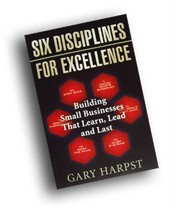
Maybe you're looking for that special gift - something that will really make a difference in someone's business life - and perhaps their life in general.
Here's a gift suggestion. One that has changed peoples lives - in a lasting way.
Join the thousands of passionate professionals (CEOs, presidents, owners, leaders, founders) who have purchased and read the book "Six Disciplines for Excellence: Building Small Businesses That Learn, Lead and Last" by Gary Harpst.
Want to read what the experts are saying about Six Disciplines for Excellence?
Available exclusively through Amazon - simply by clicking here.
Alternatives For The Holiday Office Party
We all get stuck in ruts, and the annual holiday party can be another one. But with some creative thinking, the holidays can be a time to bring everyone together and reward your team members for a job well done.
The NFIB offers these alternatives for creative thinking and alternatives to the annual holiday office party:
- Give team members time off or an extra paid day or two off
- Give team members a day off to do charitable work
- Take team members to a local children’s hospital or retirement home where they can volunteer their time for half a day
- Create a holiday suggestion box
- Write letters (not just Holiday cards) to your team member's families
- Consider offering team members a flex-time holiday plan
BOTTOMLINE: There are many alternatives to the holiday office party. It's not the event and what you give - it's what you give back.
Organizational Learning - Transforming to Knowledge

Chief Learning Officer offers this article "Enterprise Excellence: Transforming Learning Into Knowledge."
The premise?
"Do good ideas go unused in your organization? How many times do people withdraw or disengage because they think no one cares or is listening? What innovative ideas are going un-executed because no one knew about them?"
Increasingly, organizations are learning the value of harnessing the knowledge from within themselves to provide insight into marketplace trends, innovation and the identification of barriers to high performance. Agile organizations use employee intelligence to scan the environment, focus on the best strategy and shift their actions.
Chris Argyris and Peter Senge’s concept of “Learning Organizations” held that an organization could learn as well as an individual.
BOTTOMLINE: Integrated learning (also known as Organizational Learning) is one of the six best-practices upon which Six Disciplines is designed. Survey tools are built into the Six Disciplines Execution Management System to facilitate "pulsing" - obtaining data/feedback simultaneously, enabling a whole new platform for an interactive style of organizational learning and leadership for small and emerging businesses.
10 Mistakes Small Business Owners Need To Avoid
Daniel, over at Small-Biz Xpress, offers his 10 Mistakes Small Business Owners Need To Avoid
Here's a list of ten of the more common errors small business owners usually make:
Here's a list of ten of the more common errors small business owners usually make:
- They undercharge
- They concentrate exclusively on sales
- They extend credit too easily
- They think about taxes after the year is over
- They don't have a plan of attack
- They don't know how to hire and keep good employees
- They don't provide outstanding customer service
- They are economically dependent on a small group of customers
- They let emotions get in the way of sound business decisions
- They fail to develop as leaders and managers
BOTTOMLINE: Take a look at #2, 5, 6, 7, 9, and 10. Each is a strategy or execution issue.
Aligning Your Team Members for Organizational Learning
From Worthwhile Magazine - comes this article on "Why You Are Overworked.."
"Most organizations still order themselves into silos - departments, divisions, and units - with each person carrying a title and role within that silo.
Our workload, unfortunately, does not shift accordingly. We continue to fulfill the duties of our silo, while also taking on the incremental increase in duties outside the silo. The number of people from whom you need information, cooperation, or at a minimum who you need to keep in the loop, has mushroomed. The proliferation of tasks and reports puts individuals inside the system under considerable stress. It also creates organizational inefficiency.
Successful organizations will meet the challenge. They will shift their organizational structure away from silos and align their workforce toward networks."
Here are five practical guidelines:
"Most organizations still order themselves into silos - departments, divisions, and units - with each person carrying a title and role within that silo.
Our workload, unfortunately, does not shift accordingly. We continue to fulfill the duties of our silo, while also taking on the incremental increase in duties outside the silo. The number of people from whom you need information, cooperation, or at a minimum who you need to keep in the loop, has mushroomed. The proliferation of tasks and reports puts individuals inside the system under considerable stress. It also creates organizational inefficiency.
Successful organizations will meet the challenge. They will shift their organizational structure away from silos and align their workforce toward networks."
Here are five practical guidelines:
- Individuals inside the organization should be assigned tasks in relation to a project, and only provisionally in relation to a job title.
- Distinct silos within the same organization replicate tasks unnecessarily.
- Management must learn to trust more and exercise more consistent accountability.
- Hold meetings only when absolutely necessary.
- Managers should be recognized for cutting outmoded tasks as well as shaving expenses.
Tuesday, November 07, 2006
Accountability and Organizational Change
How far are you willing to go to facilitate change in your organization?
Management expert, David Maister, says you’ve got to be willing to go first. And he means all the way, even to the point of resigning if your change efforts fail.
Click here to visit the site.
Click here to read the manifesto.
Management expert, David Maister, says you’ve got to be willing to go first. And he means all the way, even to the point of resigning if your change efforts fail.
Click here to visit the site.
Click here to read the manifesto.
Small Business Challenges - Straight From The CEO
In Anita Campbell's post on, What Keeps You Awake At Night?, sixteen different small business CEOs shared with her directly ‘what keeps them awake at night’ and their ‘elevator pitches’ in this latest radio show.
Business owners and executives like Ken Hilty of Six Disciplines Leadership Center of Northeast Ohio (Cleveland) sometimes surprised us with what their top challenges were.
Go here to find out more and listen to: What Keeps You Awake At Night?
Business owners and executives like Ken Hilty of Six Disciplines Leadership Center of Northeast Ohio (Cleveland) sometimes surprised us with what their top challenges were.
Go here to find out more and listen to: What Keeps You Awake At Night?
Monday, November 06, 2006
Strategy Execution - Part IV
From the Wharton School comes this article on strategy formulation, from Michael E. Porter, director of Harvard's Institute for Strategy and Competitiveness."
His premise?
His premise?
- Errors in corporate strategy are often self-inflicted, and a singular focus on shareholder value is the "Bermuda Triangle" of strategy.
- Managers need to develop a clear strategy around their company's unique place in the market (and not worry as much about creating strategy to compete head-on with other companies.)
- Many, if not most, strategic errors come from within. The company does it to itself.
- "The worst error is to compete with your competition on the same things."
- "Strategy' is a word that gets used in so many ways with so many meanings that it can end up being meaningless. Often corporate executives will confuse strategy with aspiration.
- Companies hoping to build a successful strategy need to define the right industry and the right products and services. Bad strategy often flows from a bad definition of the business, said Porter.
- Continuity is critical to successful strategy. "If you don't do it often, it's not strategy,"
said Porter. "If you don't pursue a direction for two or three years, it's meaningless. - "Strategy is not something that is done in a bottom-up consensus process. The companies with really good strategy almost universally have a very strong CEO, somebody who is not afraid to lead, to make choices, to make decisions." Strategy is challenged every day, and only a strong leader can remain on course when confronted with well-intentioned ideas that would deviate from the company's strategy. "You need a leader with a lot of
confidence, a lot of conviction and a leader who is really good at communication."
BOTTOMLINE: "Years ago, corporate strategy was considered a secret known only by top executives for fear competitors might use the information to their advantage, said Porter. Now it is important for everyone in the organization to understand the strategy and align everything they do with that strategy every day."
Hmm...seems to me that is what Six Disciplines' "strategy-driven execution" ....is all about!
Sustainable Behavior Patterns and Habits
"Culture changes, strategy execution, performance improvement all require people to change existing behavior patterns - habits that have been supported in the past because they worked in a particular organizational environment."
According to Jerry Pound from Management Issues, changing behaviors is the key to breaking the motivational code within an organization.
The premise:
According to Jerry Pound from Management Issues, changing behaviors is the key to breaking the motivational code within an organization.
The premise:
- The specific employee behaviors and the performance results these behaviors collectively produce are observable and measurable, hence more accessible to influence once one understands something about behavior change technology.
But organizational change initiatives have poor success rates because they seldom take into consideration the fact that real people have to change behavior that has paid off for years.
To achieve sustained behavior change, consider some of the following recommendations:
- Train your supervisors in behavioral principles.
- Behavioralize performance language.
- Incorporate behavioral root-cause analysis into your formal and informal problem-solving tactics.
- Measure every intervention (initiative, training program, or seminar).
- Remove the barriers and constraints that dysfunctional systems and processes create for employees
- Involve your employees in systems and process improvement.
- Vertically align your strategic objectives into the results, tasks, and most importantly—the specific behaviors required from every employee to achieve those objectives.
Remember that the unstated purpose of employee motivational programs has always been to change employee behavior—to encourage employees to perform tasks more quickly, seek more tasks, put forth additional effort, and increase value-added behavior.
BOTTOMLINE: "These kinds of behavior changes cannot be sustained unless the work environment supports new behaviors. New behavior must have ongoing supportive consequences or else the extra effort brought about by any change initiative will be discouraged. "Friday, November 03, 2006
Focus Is The Key For Small Business Executives
In a recent worldwide survey by NFI Research of 246 managers and senior executives, focus was a big differentiator for executive skills.
Their premise:
Their premise:
- Every person has a set of 12 executive skills (self-restraint, working memory, emotion control, focus, task initiation, planning/prioritization, organization, time management, defining and achieving goals, flexibility, observation and stress tolerance).
- By company size, more of those high in focus are at large companies rather than small or medium. More of those low in focus are in medium companies, followed by small.
- By title and company size, the most who are high in focus are senior executives in small companies.
- The most who are low in focus also are senior executives in small companies.
- There were no senior executives in large companies who rated low in focus.
Thursday, November 02, 2006
Excellence Quotes for 11/02/06
"When a team outgrows individual performance and learns team confidence, excellence becomes a reality.” (Joe Paterno)
"Excellence is not an accomplishment. It is a spirit, a never-ending process." (Lawrence M. Miller)
"The secret of joy in work is contained in one word - excellence. To know how to do something well is to enjoy it." (Pearl Buck)
"Be a yardstick of quality. Some people aren't used to an environment where excellence is expected." (Steve Jobs)
"The quality of a person's life is in direct proportion to their commitment to excellence, regardless of their chosen field of endeavor." (Vince Lombardi)
"Excellence is not an accomplishment. It is a spirit, a never-ending process." (Lawrence M. Miller)
"The secret of joy in work is contained in one word - excellence. To know how to do something well is to enjoy it." (Pearl Buck)
"Be a yardstick of quality. Some people aren't used to an environment where excellence is expected." (Steve Jobs)
"The quality of a person's life is in direct proportion to their commitment to excellence, regardless of their chosen field of endeavor." (Vince Lombardi)
Wednesday, November 01, 2006
What is Accountability?
The BusinessPundit posted this (sponsored by the new firm PeerSight) "Holding Yourself Accountable."
"What is accountability?
What was common among all of the answers is that as humans there are many actions and behaviors that are foreign to our individual natures.
Whatever you don't like to do - but need to do - it takes intentional effort and discipline for us to do these things.
That's where accountability comes in. Accountability to ourselves or others can often provide the motivation needed to ensure we overcome our natural resistance."
BOTTOMLINE: One of the three barriers to sustainable business excellence is human factors. We usually know what to do, but the fact is, we don't always do it. That's why Six Disciplines is the first sustainable program for strategy-driven execution. It takes into account the human factors of accountability - and transforms individuals and organizations by addressing the accountability factor directly.
"What is accountability?
What was common among all of the answers is that as humans there are many actions and behaviors that are foreign to our individual natures.
Whatever you don't like to do - but need to do - it takes intentional effort and discipline for us to do these things.
That's where accountability comes in. Accountability to ourselves or others can often provide the motivation needed to ensure we overcome our natural resistance."
BOTTOMLINE: One of the three barriers to sustainable business excellence is human factors. We usually know what to do, but the fact is, we don't always do it. That's why Six Disciplines is the first sustainable program for strategy-driven execution. It takes into account the human factors of accountability - and transforms individuals and organizations by addressing the accountability factor directly.
Tuesday, October 31, 2006
Five Keys To Getting The Right Things Done Right
Improving execution is an ongoing process, but there are tangible things that can be done to ensure performance improvement - and make it sustainable.
Simply put:
Simply put:
- Adopt a method to help you bridge the strategy-to-execution gap.
- Use technology stategically to make the method practical.
- Engage an outside trusted advisor to help keep you accountable.
- Choose the right things to measure.
- Review and align the plans (individually - and organizationally)
- Assess performance frequently.
- Communicate regularly with every team member.
BOTTOMLINE: Need a handbook to help get you there? If not now, when?
Bridging The Strategy Execution Gap
Why is it so difficult to bridge the gap between strategy and execution?
- Execution represents a disciplined process that enables an organization to take a strategy and make it work.
Only recently have people started thinking,
"If we execute better, if we integrate long-term and short-term better, if we translate strategic objectives into short-term objectives, if we measure incentives and controls and feedback, we'll execute better, we'll perform better, and we might even gain a competitive advantage because very few people in other companies are so well-versed in execution."
"The biggest mistake managers make is trying to change culture. They try to convince people to change their attitudes. They tell people that something has changed, and they have to act differently. Well, this doesn't work. In order to change culture, don't focus on culture; focus on changing people, incentives, organizational structures and responsibilities, and controls, such as performance appraisals and feedback.
By changing the elements of execution, you're changing culture."
BOTTOMLINE: Sustainable business excellence demands a simultaneous view of strategy and execution.
Best 'How To' Book I Have Ever Read
This is a recent review posted on Amazon.com about "Six Disciplines for Excellence"
Best 'How To' Book I have ever Read....,
September 21, 2006
Reviewer: D. Schindler
"I have read hundreds of books on leadership, strategy, and management and have for years continued to struggle to 'operationalize' strategy & the management of strategy execution. This is the best book I have ever read to overcome my struggles and have bought copies for everyone on my leadership team. We will adopt the 'Six Disciplines' methodology and I know my business will be better for it."
Best 'How To' Book I have ever Read....,
September 21, 2006
Reviewer: D. Schindler
"I have read hundreds of books on leadership, strategy, and management and have for years continued to struggle to 'operationalize' strategy & the management of strategy execution. This is the best book I have ever read to overcome my struggles and have bought copies for everyone on my leadership team. We will adopt the 'Six Disciplines' methodology and I know my business will be better for it."
What Does It Take To Achieve Lasting Excellence?
What does it take to achieve lasting excellence?
A methodology to make performance improvement systematic, some integrated technology to make it practical, a coach to make individuals and your organization accountable, and an organization that is ready and able to make it happen.
Watch this 2 minute video of Gary Harpst, CEO and Founder of Six Disciplines Corporation - and author of Six Disciplines for Excellence.
A methodology to make performance improvement systematic, some integrated technology to make it practical, a coach to make individuals and your organization accountable, and an organization that is ready and able to make it happen.
Watch this 2 minute video of Gary Harpst, CEO and Founder of Six Disciplines Corporation - and author of Six Disciplines for Excellence.
Motivation and Change
Kathy over at Creating Passionate Users has a new post called "Motivating others: why "it's good for you" doesn't work."
Her premise?
Question 2: How do we motivate them to do it? (Answer: design an experience to help them motivate themselves)
Trying to motivate someone to action by telling them it's good for them doesn't... actually... work. So - what does motivate?
Her premise?
- What do we hope they'll do when they stop clicking/listening/reading? More importantly, how do we make it happen?
Question 2: How do we motivate them to do it? (Answer: design an experience to help them motivate themselves)
Trying to motivate someone to action by telling them it's good for them doesn't... actually... work. So - what does motivate?
- Joy is a more powerful motivator than fear. Focus on the positive.
BOTTOMLINE: "Even if you're not trying to get someone to take action for social change or to save their life--something Meaningful with a capital "M"--remember that meaningful with a lowercase "m" matters too. If your software, book, or service helps me learn more, spend more time in flow, .....or even just have fun playing a game...you're bringing a bit more joy into my day. And THAT is meaningful to me."
Monday, October 30, 2006
Six Disciplines Leadership Center of Northwest Ohio Names Business Coach
The Six Disciplines Leadership Center of Northwest Ohio today announced that it has named Scott Gray to take the leadership role of Business Coach for its operation located in Findlay, OH.
Scott will be responsible for ensuring the long-term continual performance improvement of Six Disciplines clients in the Northwest Ohio and Southeast Michigan areas. He will provide coaching and offer strategic advisory services to organizations that adopt Six Disciplines™, the first sustainable program for strategy-driven execution, optimized for small and emerging businesses.
"I'm excited about the opportunity to continue working with businesses using Six Disciplines," said Gray. "The Six Disciplines program will revolutionize the way businesses approach strategy and execution, as it takes proven best practices, combines them with practical tools and technologies, and supports on-going organizational change with local coaching.”
Read the entire announcement here.
Scott will be responsible for ensuring the long-term continual performance improvement of Six Disciplines clients in the Northwest Ohio and Southeast Michigan areas. He will provide coaching and offer strategic advisory services to organizations that adopt Six Disciplines™, the first sustainable program for strategy-driven execution, optimized for small and emerging businesses.
"I'm excited about the opportunity to continue working with businesses using Six Disciplines," said Gray. "The Six Disciplines program will revolutionize the way businesses approach strategy and execution, as it takes proven best practices, combines them with practical tools and technologies, and supports on-going organizational change with local coaching.”
Read the entire announcement here.
Friday, October 27, 2006
Managing Resistance To Change
"Why is it that most organizations struggle mightily to make real change?
Whether it is consolidating a merger, re-engineering business processes, restructuring, changing value propositions, introducing new IT systems, relocating premises, or any other type of change, all too often the process is derailed by the resistance of employees.
Resistance to change is one of the most powerful drivers of human behavior, and the key to dealing with it effectively is to understand both its physical and emotional components."
In this article on CEO Refresher, Anne Riches talks about our innate "fight or flight" ressponse, and reveals "It is the reason why all too often, human beings automatically react to change with resistance, even before they fully understand the nature of the change."
Our brains are hard wired to do three things:
What can be done to help manage resistance to change?
Whether it is consolidating a merger, re-engineering business processes, restructuring, changing value propositions, introducing new IT systems, relocating premises, or any other type of change, all too often the process is derailed by the resistance of employees.
Resistance to change is one of the most powerful drivers of human behavior, and the key to dealing with it effectively is to understand both its physical and emotional components."
In this article on CEO Refresher, Anne Riches talks about our innate "fight or flight" ressponse, and reveals "It is the reason why all too often, human beings automatically react to change with resistance, even before they fully understand the nature of the change."
Our brains are hard wired to do three things:
- match patterns,
- resist or fight any threats to survival,
- and respond first with emotion over logic.
What can be done to help manage resistance to change?
- Try focusing on shifting the emotional response. Show why the need for change is urgent and changing now will help ensure the survival of the company.
- Challenge pre-existing patterns and memories, address history, look at the good things that have occurred, validate them and then show why the patterns need to change.
- Build in ways to reinforce the new patterns. Milestones reached, goals kicked. Have celebrations - connect new patterns with good emotional memories not bad ones. But don't be surprised if this seems to take a long time.
Thursday, October 26, 2006
Practice Makes You ...Excellent
 Achieving lasting excellence is not a singular event - it is a long-term process:
Reporter: Mr. Casals, you're 95 and the greatest cellist that ever lived. Why do you still practice six hours a day?
Pablo Casals: Because I think I'm making progress.
Most people who are perceived as being talented started with very little talent. And a lot more perseverance. They practiced while the competition slept. And that has made all the difference for them.
"But Practice is Boring!"
BOTTOMLINE: Yes, practice can be very boring. It takes a lot of determination to practice everyday. Whether it is in music, sports or business - find a coach who will improve your accountability. The combination of talent and practice - will help you make progress.
Is Execution Overrated?
What would you rather have: an innovative product/service - or better execution on an existing product or service?
In The Power of Dumb Ideas, Randall Rothenberg argues that imitation across industries is a more effective and profitable strategy than the promotion of innovation and blue-sky creativity.
Rothenberg cites a Booz Allen study that argues that, between 1965 and 1995, 80% of break-out businesses were based on only four ideas:
In The Power of Dumb Ideas, Randall Rothenberg argues that imitation across industries is a more effective and profitable strategy than the promotion of innovation and blue-sky creativity.
Rothenberg cites a Booz Allen study that argues that, between 1965 and 1995, 80% of break-out businesses were based on only four ideas:
- power retailing,
- megabranding,
- focus/simplify/standardize,
- and the value chain bypass.
Companies using these strategies include Circuit City, Staples, and Home Depot. Regardless of your opinion on Rothenberg’s ultimate conclusions, you can’t quibble with his basic message that execution is a critical part of business success.
The Power of Dumb Ideas, by Randall Rothenberg, is excerpted in this article from Strategy + Business E-News.
What Will You Do Differently in 2007?
What will you do differently to take your business to the “next level” in 2007 ?
If you haven't already read the top-rated strategy-driven execution book, Six Disciplines for Excellence - start TODAY. Do it NOW.
This top-rated business handbook offers a systematic approach to EXECUTING your strategic plans more effectively -- and how to make 2007 more productive, more aligned and more performance-driven than you’ve ever experienced before.
SWOT Analysis Revisited
One of the most important elements of strategic planning is the facilitated session during which you guide participants through an exploration of their own experiences and knowledge about the issues at stake.
If your organization has a well-defined strategy, this process is relatively simple. What measures will support achieving the strategy? Define these from each of the four quadrants, and the resulting set of measures will become your "balanced scorecard."
The problem is that many organizations don't have a well-defined strategy. Some never get around to doing strategic planning at all. In that kind of organization, developing a balanced scorecard will prove challenging. Even when there's an existing strategy, it's often the result of "group think" or has little connection to the organization's practical requirements.
During these sessions, you'll want to guide the participants through a SWOT (strengths, weaknesses, opportunities and threats) analysis specifically focused on their functional areas. For example, participants in the customer and marketplace group will examine strengths, weaknesses, opportunities and threats through the eyes of their customers.
BOTTOMLINE: The resulting measures will seek to maximize strengths and opportunities, and minimize weaknesses and threats, as viewed through their customers' perceptions.
The full versions of these SWOT worksheets are available for download here.
(From Quality Digest, September 2005, Vol. 25, Issue 9)
If your organization has a well-defined strategy, this process is relatively simple. What measures will support achieving the strategy? Define these from each of the four quadrants, and the resulting set of measures will become your "balanced scorecard."
The problem is that many organizations don't have a well-defined strategy. Some never get around to doing strategic planning at all. In that kind of organization, developing a balanced scorecard will prove challenging. Even when there's an existing strategy, it's often the result of "group think" or has little connection to the organization's practical requirements.
During these sessions, you'll want to guide the participants through a SWOT (strengths, weaknesses, opportunities and threats) analysis specifically focused on their functional areas. For example, participants in the customer and marketplace group will examine strengths, weaknesses, opportunities and threats through the eyes of their customers.
BOTTOMLINE: The resulting measures will seek to maximize strengths and opportunities, and minimize weaknesses and threats, as viewed through their customers' perceptions.
The full versions of these SWOT worksheets are available for download here.
(From Quality Digest, September 2005, Vol. 25, Issue 9)
Strategy and Execution: What Works, What Doesn't
Achieving high performance levels in either product or service delivery requires:
- An understanding of where you are today (what is working, what is not)
- Where you want to be (when something is not working as planned)
- Deploying the disciplined processes required to achieve desired results - consistently.
To move ahead, start with the following questions:
- Are you getting the results you want?
- Are you getting the results you expect?
- Do you what is causing the results you're getting?
- Do you know you can change - to get the results you want?
BOTTOMLINE: High performing organizations have disciplined processes in place to ensure effective, consistent execution of their strategies. They understand what their goals are and how specific activities drive results. Achieving this same level of performance in your organization requires an understanding of where you are today, where you want to be, and developing a strategy to close the performance gap. (For a specific plan to follow, read Discipline IV - Step Back, Discipline I - Decide What's Important, and Discipline II - Set Goals That Lead from Six Disciplines for Excellence.
Tips for Effective Strategic Planning
To get the most out of your strategic planning process, here are some tips:
- Establish the strategic team. A small team (six to ten people) of company leaders and managers who represent every area of the company.
- Go off-site for your planning retreat. Minimize distractions and maximize focus by conducting your strategic planning session away from the office. A well-run strategic planning retreat should take two days, three at the most.
- Get commitment from your leadership team. If your senior leaders don't commit to the plan, it won't happen.
- Engage an outside facilitator to lead the planning meeting. To lead the strategic planning session, hire a trained professional who has no emotional investment in the outcome of the plan. An impartial facilitator can concentrate on the process rather than the end result and ask the tough questions that others might fear to ask.
- Include an action plan. To have any chance at implementation, the plan must clearly articulate goals, action steps, responsibilities, accountabilities and specific deadlines. The action plan should also state that the strategic plan is the beginning of implementation.
- Make the plan available to everyone. Good strategic plans are made available, yet they are also open to being changed and adaptive. While your goals won’t change very often, your inititatives and plans to reach those goals will.
- Write the strategic plan during the meeting. The team should write the plan during the meeting (not the facilitator.) The facilitator serves as the impartial guide.
- Get commitment in writing from the strategic planning team. Before closing the strategic planning session, have team members pledge their commitment in writing to the plan and its successful execution. When you walk out of the room everyone must fully support the plan—even though they may not agree with everything in it.
- Review the plan regularly. Review the strategic plan for performance achievement no less than quarterly and as often as monthly or weekly. Focus on accountability for results and have clear and compelling consequences for unapproved missed deadlines.
The Business Excellence Sustainability Model

To help organizations understand how sustainable their current performance is, Six Disciplines Leadership Centers use the Business Excellence Sustainability Model (BESM).
The rows in this model represent major categories of processes that most businesses need in order to function well. (In this summarized view, they also correspond to the Six Disciplines.)
The columns represent levels of capability within each of these process areas - the levels range from 0 to 5(0=Undefined, 1=Defined, 2=Aligned, 3=Measured, 4=Improvement, 5=Proven).
Even most high-performing organizations will score low on this model, because all too often, their success is based on the heroics of a handful of amazing people. However, such a mode of operation by "star performers" can't lead to the kind of excellence that is sustainable.
BOTTOMLINE: Another challenge is the interdependence between the rows and columns on the BESM. All of these processes are interrelated and you can't get to Level 5 in once process area and be at Level 0 on another. Therefore, progress in mastering one Discipline must be synchronized with progress in another.
For the complete explanation of the BESM, see Six Disciplines for Excellence, pages 48-54.
In Search of Excellence -- Revisited
The best-selling book "In Search of Excellence" by Tom Peters has been credited to have started the so-called "management guru" industry.
Written originally in 1982, it was one of the first books that aimed to explain company success in a popularized way.
Based on a major McKinsey study, In Search of Excellence identified eight characteristics common for excellent companies:
Written originally in 1982, it was one of the first books that aimed to explain company success in a popularized way.
Based on a major McKinsey study, In Search of Excellence identified eight characteristics common for excellent companies:
- A bias for action
- Close to the customer
- Autonomy and entrepreneurship
- Productivity through people
- Hands-on, value-driven
- Stick to the knitting
- Simple form, lean staff
- Simultaneous loose-tight properties
BOTTOMLINE: While the methodology and raw metrics used in the original research have since proven faked (or at least somewhat fudged, to the author's own admissions), it is interesting to note that the original premise is still the same: "excellent companies seems to have these characteristics in common, and if you focus on them, maybe your company will also become excellent."
Interesting, but not real useful. What small businesses need is not an explanation of WHAT and WHY - they need an explanation of HOW to get there. Read Six Disciplines for Excellence.
Excellence Quotes for 10/26/06
"Excellence is not an accomplishment. It is a spirit, a never-ending process."
(Lawrence M. Miller )
"The secret of joy in work is contained in one word - excellence. To know how to do something well is to enjoy it."
(Pearl Buck)
"Good is not good, where better is expected."
(Thomas Fuller)
"My parents always told me that people will never know how long it takes you to do something. They will only know how well it is done."
(Nancy Hanks)
"To enjoy the things we ought and to hate the things we ought has the greatest bearing on excellence of character."
(Aristotle)
"With regard to excellence, it is not enough to know, but we must try to have and use it."
(Aristotle)
"Sports serve society by providing vivid examples of excellence."
(George F. Will)
(Lawrence M. Miller )
"The secret of joy in work is contained in one word - excellence. To know how to do something well is to enjoy it."
(Pearl Buck)
"Good is not good, where better is expected."
(Thomas Fuller)
"My parents always told me that people will never know how long it takes you to do something. They will only know how well it is done."
(Nancy Hanks)
"To enjoy the things we ought and to hate the things we ought has the greatest bearing on excellence of character."
(Aristotle)
"With regard to excellence, it is not enough to know, but we must try to have and use it."
(Aristotle)
"Sports serve society by providing vivid examples of excellence."
(George F. Will)
Efficiency and Effectiveness
What makes a good process?
Most measures boil down to two E’s: Efficiency and Effectiveness.
Most measures boil down to two E’s: Efficiency and Effectiveness.
- Efficiency is about saving time, costs and otherwise removing waste. This is a traditional focus for quality professionals, and its history can be traced back to the days of Work Study, stopwatches and clipboards. (Efficiency is about doing things right.)
- Effectiveness means delivering what is wanted, effectively meeting stated and implied needs. In the traditional definition of quality, it is 'conformance to requirements'. (Effectiveness is about doing the right things)
By taking a stakeholder view of the organization, we can find the deeper purpose of what we are aiming to achieve with our processes, and find the third E.
3. Enjoyable. In our hurry to reengineer for business excellence, we often forget this third E, creating processes which are Effective and Efficient, but not very Enjoyable. (Enjoyable is doing the right things right - time after time.)
BOTTOMLINE: The challenge is to find the balance where Efficiency gains remove the boring parts, giving people a more interesting challenge (a real purpose), where Effectiveness leads to satisfied customers which feeds back to employee satisfaction, and where Enjoyable processes lead to happy people who work sincerely towards improving the other two Es.
(Thanks to David Straker at Quality Tools for this one.)
Execution - The Discipline of Getting Things Done
A few years ago, Larry Bossidy and Ram Charan published a book called "Execution: The Discipline of Getting Things Done."
Management guru Tom Peters offered this observation, having re-read the book recently:
"The extraordinary -- and accurate, as I see it -- hypothesis is that we inordinately pay attention to strategy, customers, innovation, and the like, but not the true discriminator between success and failure -- implementation!"
"Moreover, execution is the leader's Job #1, and execution is a "systematic and rigorous discipline" that can be learned and applied by one and all."
And this gem, as one of the comments: "We have a strategy. It's called getting things done."
Management guru Tom Peters offered this observation, having re-read the book recently:
"The extraordinary -- and accurate, as I see it -- hypothesis is that we inordinately pay attention to strategy, customers, innovation, and the like, but not the true discriminator between success and failure -- implementation!"
"Moreover, execution is the leader's Job #1, and execution is a "systematic and rigorous discipline" that can be learned and applied by one and all."
And this gem, as one of the comments: "We have a strategy. It's called getting things done."
Leadership Quotes of The Day - 10/26/06
"The leader has to be practical and a realist, yet must talk the language of the visionary and the idealist."
(Eric Hoffer)
"Life is change. Growth is optional. Choose wisely."
(Karen Kaiser Clark )
"Leadership is not so much about technique and methods as it is about opening the heart. Leadership is about inspiration—of oneself and of others. Great leadership is about human experiences, not processes. Leadership is not a formula or a program, it is a human activity that comes from the heart and considers the hearts of others. It is an attitude, not a routine."
(Lance Secretan)
"Leadership is action, not position."
(Donald H. McGannon)
"Effective leadership is not about making speeches or being liked; leadership is defined by results not attributes."
(Peter Drucker)
"Leadership and learning are indispensable to each other."
(John F. Kennedy)
"The first step to leadership is servanthood."
(John Maxwell)
(Eric Hoffer)
"Life is change. Growth is optional. Choose wisely."
(Karen Kaiser Clark )
"Leadership is not so much about technique and methods as it is about opening the heart. Leadership is about inspiration—of oneself and of others. Great leadership is about human experiences, not processes. Leadership is not a formula or a program, it is a human activity that comes from the heart and considers the hearts of others. It is an attitude, not a routine."
(Lance Secretan)
"Leadership is action, not position."
(Donald H. McGannon)
"Effective leadership is not about making speeches or being liked; leadership is defined by results not attributes."
(Peter Drucker)
"Leadership and learning are indispensable to each other."
(John F. Kennedy)
"The first step to leadership is servanthood."
(John Maxwell)
Benchmarking and Business Excellence
Benchmarking is the search for best practices, the ones that will lead to superior performance. Establishing operating targets based on the best possible industry practices is a critical component in the success of every organization.
The basic steps of benchmarking are:
The basic steps of benchmarking are:
- Know your operation. You need to accurately assess your strengths and weaknesses.
- Know your industry leaders or competitors. You must understand, and compare yourself to, the best practices in the industry and/or its leaders.
- Incorporate the best. Learn from industry leaders and your competition. If they are strong in given areas, uncover why and how they got that way. Find best practices wherever they exist and do not hesitate to copy or modify and incorporate them in your own operation. Emulate their strengths.
- Gain superiority. If careful investigations of best practices have been performed, and if the best of those best practices have been installed, then you will have incorporated the best of the best.
Barriers To Lasting Excellence: Organizational Entropy
One of barriers to lasting business excellence is what we refer to in Six Disciplines for Excellence as "organizational entropy." In essence, it's what happens when even the best performing businesses - lose their edge.
Gary Whitehair, over at High Performance Business, refers to the same challenge in his article "Don't Allow Your HPB to Drift."
The definition of entropy is "...a measure of the degree of disorder in a system."
BOTTOMLINE: "Businesses are subject to forces like entropy. Once a business makes plans, the chaos of everything around it gradually erodes those plans. An organization must have a systematic and ongoing way to offset these forces, or it will eventually become ineffective to the point that its survival will be at stake." (page 35, Six Disciplines for Excellence)
"The forces of (organizational) entropy will rapidly cause increasing amounts of time to be spent on low-priority activities, if not proactively addressed. The Six Disciplines Methodology is designed to continually refocus people on what's important, to offset the urgent forces that distract them." (page 57, Six Disciplines for Excellence)
Gary Whitehair, over at High Performance Business, refers to the same challenge in his article "Don't Allow Your HPB to Drift."
The definition of entropy is "...a measure of the degree of disorder in a system."
BOTTOMLINE: "Businesses are subject to forces like entropy. Once a business makes plans, the chaos of everything around it gradually erodes those plans. An organization must have a systematic and ongoing way to offset these forces, or it will eventually become ineffective to the point that its survival will be at stake." (page 35, Six Disciplines for Excellence)
"The forces of (organizational) entropy will rapidly cause increasing amounts of time to be spent on low-priority activities, if not proactively addressed. The Six Disciplines Methodology is designed to continually refocus people on what's important, to offset the urgent forces that distract them." (page 57, Six Disciplines for Excellence)
Wednesday, October 25, 2006
Assertive Behaviors and Leadership
Recent research from Stanford's Business School indicates that charisma, intelligence, drive, and conscientiousness are some of the characteristics that make a leader.
But what is it that can break a leader? Is it merely the lack of such qualities?
No, says organizational behavior expert Frank Flynn.
His research has found that the greatest identifiable trait that can hold someone back from becoming a great leader is being too assertive—or not assertive enough.
But what is it that can break a leader? Is it merely the lack of such qualities?
No, says organizational behavior expert Frank Flynn.
His research has found that the greatest identifiable trait that can hold someone back from becoming a great leader is being too assertive—or not assertive enough.
- Excessive or inadequate assertiveness was the No. 1 issue listed in the weakness column when it came to evaluating individuals’ leadership potential.
- It appeared as a clear factor in weakness comments more than lack of intelligence, conscientiousness, and charisma combined.
Executives Favor Consultation Over Education
A new research study from Penn State University's Smeal College of Business indicates that executives prefer long-term consultation over conventional executive education courses.
Instead of traditional classroom training, executives are now found to seek "deep partner relationships that include assessment and consultation with education as a by-product."
BOTTOMLINE: This research, while not very encouraging for traditional corporate education initiatives, bodes very well for the trend toward long-term coaching and strategic advisory services - like those offered by Six Disciplines Leadership Centers.
Instead of traditional classroom training, executives are now found to seek "deep partner relationships that include assessment and consultation with education as a by-product."
- Executives are looking for long-term partners who will analyze their individual needs, work with them to develop custom solutions and offer ongoing counsel.
BOTTOMLINE: This research, while not very encouraging for traditional corporate education initiatives, bodes very well for the trend toward long-term coaching and strategic advisory services - like those offered by Six Disciplines Leadership Centers.
Subscribe to:
Posts (Atom)