The Six Disciplines blog has moved!

You will be automatically redirected to our new home. If that does not occur, please visit:

Saturday, October 08, 2005

What Makes A Good Leader?

No one can argue that a great leader can boost an organization’s growth and performance in much the same way a poor leader can run one into the ground.

According to Jim Kouzes, lecturer and author of seven books on leadership, including the best-seller “The Leadership Challenge,” the qualities that make an effective leader have two distinct perspectives:
  1. What followers look for
  2. What research from the past few decades has shown
Kouzes lists three consistent characteristics that people most look for in a leader:

  1. People want a leader who’s honest, trustworthy and has integrity.
  2. People want a leader who's forward-looking, who has a vision of the future, foresight and thinks about the long term.
  3. People want a leader who is competent, has expertise, knows what they’re doing, and fourth is inspiring, dynamic, energetic, optimistic and positive about the future.”
Research on how leaders execute those qualities or how leaders put those attributes into action, has produced five practices that successfully leaders indulge.

  1. They model the way. They set an example with their own behavior, and they are clear about what their values and beliefs are, as well as the values and beliefs of the organization.
  2. They inspire a shared vision. They are forward-looking and envision an uplifting or ennobling future and then enlist others in that.
  3. They challenge the process. They search for opportunities to change and innovate, to grow and improve, and then they also experiment and take risks.
  4. They enable others to act. They support individual development, and they also foster collaboration.
  5. They recognize and reward individual achievements and they also celebrate team accomplishments.

Friday, October 07, 2005

The E's Have It

Mike R. Jay, Master Business Coach, published an article in his Leadership blog about the E's.

For Jack Welch at GE, here were his 4 E's:
  1. Positive ENERGY
  2. The ability to ENERGIZE others
  3. The 'EDGE that enables managers to take unpopular decisions
  4. The ability to EXECUTE decisions

For Bill Gates at Microsoft, here were his 5 E's:

  1. EMPOWER people to undertake tasks for which they are competent and to see those tasks through from start to finish.
  2. Adopt an EGALITARIAN attitude towards everybody, and insist that they do likewise.
  3. Place an extraordinary EMPHASIS on performance, first making clear precisely what is expected.
  4. Use E-MAIL to send and receive messages to and from anybody, maintain continuous, open, constructive debate on issues of interest importance.
  5. ENRICH people with rewards for success, using not only financial rewards but also praise and recognition.

Anyone have any additional E's?

Leadership in a High Performance Business

Gary, over at High Performance Business offers up these leadership requirements for a CEO of a High Performance Business (HPB):

  • Create a vision
  • Create opportunities for your team
  • Be the tie that binds
  • Develop dedication and self-assurance
  • Maintain your perspective

Thursday, October 06, 2005

Teleworkers - And The Pursuit Of Excellence

This just in from our friends in the U.K.: the number of people working full-time from home in Britain has more than doubled in eight years to almost 2.5 million.

The rapid rise in what are called "teleworkers" saw them accounting for 2.4 million people in spring 2005, some eight per cent of the UK workforce and double the figure in 1997. Most of these – 1.8 million in 2005 – work in different locations using their home as a base, whereas 603,000 work mainly at home.

Last month's Broadband User Survey from research firm Point Topic found that almost 5.5 million Britons now spend some or all of their week working remotely from home

BOTTOMLINE: Given the right tools and technologies, proper direction, individual planning and measures - why "wouldn't" more workers use remote connectivity (regardess of where they are....) to execute their Individual Plans? (He says, as he blogs from home...)

More on Mission Statements - and Mantras

Apple alum Guy Kawasaki offers his take on mission statements.

He advises his audience instead to make a mantra -- a three- or four-word description of why you exist.

His beef with mission statements? "A mission statement has to serve the needs of the customers, the employees, the shareholders, and—because it's all encompassing—the whales, dolphins, and everything. "

His example continues: "This is a $20,000 mission statement: 'We exist to professionally build long-term, high-impact sources so that we may endeavor'—I have to take a little breath here—'to synergistically leverage existing effective deliverables and stay competitive in tomorrow's world.'

BOTTOMLINE: At Six Disciplines - ours is quite simple: Be Excellent™.

What’s the Difference Between Mission and Vision?

Rosa Say, at Talking Story, discusses "What’s the Difference Between Mission and Vision?"

She comments: "At times I run across companies which don’t bother to distinguish them at all: They have a separate Values Statement (thank goodness), but if you ask them to tell you of their Vision, and then of their Mission, they’ll give you the same answer for both questions. So what is the difference?

Does it matter?"

BOTTOMLINE: The short answer is that it only matters if you use them. Make them both available and accessible to everyone in the organization - every day.


(Thanks to LifeHack.org for the tip)

Excellence in Sports - A Culture of Winning

Examples of excellence abound in literature, music, art - and sport.

In sport - excellence can be defined in many ways - however, it is frequently equated to winning - over a long period of time.

In the Wall Street Journal, the Atlanta Braves GM explains how and why the Braves have won 14 straight Divisional Titles.

The five tips for transforming a culture of losing - to a culture of winning:
  1. Gather everyone, communicate the plan and preach it daily.
  2. Constantly remind them it works.
  3. Don’t be afraid to get rid of people who don’t buy in.
  4. Make the lowest level employees feel as important to success as the top level executives.
  5. Show trust in everyone to do their jobs well.

Wednesday, October 05, 2005

Developing Capacity for Large-Scale Change

Todd over at 800-CEO-Reads reviews a new book, "Rapid Results: How 100-Day Projects Build Capacity for Large-Scale Change.

According to authors Robert Shaffer and Ronald Ashkensas, are small, quick projects that build into company-wide change. For this strategy to work, they are very specific about the qualities these "100-day projects" need to have:

  1. Focus on an Important Goal - Everyone from the CEO to the front line worker recognize the need.
  2. Produce a Measurable Stretch Result - Pushing for what many consider impossible creates a buzz when it is achieved.
  3. Works in the Short Term - Short term focus completely changes the dynamics of the project
  4. Pinpoint Clear Accountability - One person needs to be responsible for the success or failure of the project
  5. Drives Experimentation - The message needs to be that this is not going to be business as usual.
  6. Is Planned and Disciplined - This may seem counterintuitive, but with speed, you need a good plan and good communications.
  7. Make Learning a Deliberate Outcome - The project should be a springboard for more projects and more change.

Tuesday, October 04, 2005

Learning From Napster - What Went Right / Wrong


Don Dodge, (On The Next Big Thing) who is now with my former employer (Microsoft) - formerly with "bad-boy" Napster, offers this detailed description of what Napster did right - and wrong.

Lots to be learned here:


  • Never get too far ahead of the market.
  • Understand who your customer is, what problem you solve, and how much they are willing to pay for it.
  • Never start a business focused on solving a big company’s problem.
  • Test your assumptions before spending lots of money.

BOTTOMLINE: Good luck on your search for The Next Big Thing.

Transforming The Annual Performance Review Process

With Q3 over, I've heard lots of people talking about the "dreaded" Q3 review.

There is a way to transform the process.

Taking time now to note the accomplishments and problems of each person who reports to you will save time later. Instead of starting from scratch in January when you have to write a year-long review, you'll have your Q3 summary ready for cutting and pasting.

BOTTOMLINE: If you make weekly performance reviews a habit, your quarterly reviews will be a snap. With quarterly reviews in hand, your annual performance review writing session will be a snap instead of a long, drawn out ordeal.

With the Six Disciplines People Suite, each team member's Individual Plans are updated and reviewed each week (no more than 30 minutes), making the Quarterly Review seamless, and the Annual Review - automatically documented.

The Seven Key Principles of Effective Leadership Development

A new book, "How to Grow Leaders: The Seven Key Principles of Effective Leadership Development" has been released and reviewed by the Harvard Business School -Working Knowledge group.

The seven key principles referred to in the subtitle are:

  1. Training
  2. Selection
  3. Mentoring
  4. Gaining the chance to lead
  5. Education
  6. Strategy for development
  7. The chief executive

John Adair's authored close to fifty books, and How to Grow Leaders serves as a fine entry point because it encapsulates his many observations.

Branding - Is Common Sense Strategy (Rebranded)

With all the hype about branding, it's important to remember that branding is really just a restatement of the obvious. It's common sense strategy - revisited.

This new Fast Company article focuses on branding, and comes away with this gem:

"To successfully build a brand, says INSEAD marketing professor Amitava Chattopadhyay, "is to communicate your key value proposition to the key customer segment, and do so in an integrated and consistent way."

BOTTOMLINE: Once your organization takes the time to craft your mission, vision, values, strategic position - you're in a better position to understand what it takes to conduct branding. It's all about common sense strategy.

Monday, October 03, 2005

Perception of Leadership Leads to Customer Retention

According to results of new ISR employee opinion study, U.S. companies that place an emphasis on nurturing strong leaders are reaping benefits through improved customer retention and an improved bottom line.

These findings support an earlier ISR study which revealed the relationship between improved business results and employee engagement. Employee engagement is defined as the extent to which employees believe in the values of a company, feel pride in working for the company, are motivated to go the extra mile and are committed.

The study of 41 companies revealed that high engagement companies realized a difference in operating margin and a difference in net profit margin versus low engagement companies, offering further proof that companies that are able to strengthen the engagement of their employees will realize a direct or indirect influence on business performance.

BOTTOMLINE: From Six Disciplines' Discipline II-D, Engage the Team, "...the ultimate core competency for any organization is realized when 'all individuals make strategy (execution) their everyday job."

Small Business Facts for 2005

Small businesses continue to drive the U.S. economy, according to the updated 2005 Small Business FAQ, released by the Office of Advocacy at the U.S. Small Business Administration.

Small business statistics highlighted in the 2005 Small Business FAQ include:

  • Small businesses represent 99.7 percent of all employer firms.
  • Over the past decade, small business net job creation fluctuated between 60 and 80 percent.
  • Two-thirds of new employer establishments survive at least two years after start-up, and 44 percent survive at least four years.
  • Small businesses employ half of all private sector employees
  • Minorities own 4.1 million firms that generate $694.1 billion in revenues and employ 4.8 million workers.
  • Women own 6.5 million businesses that generate $950.6 billion in revenues, and employ 7.2 million workers.

BOTTOMLINE: Small businesses have distinct advantages over larger enterprises. Three key advantages are the connecting of people to purpose, more effective communication, and timely decision making. "Those who take this stewardship seriously (of owning and running a small business) truly are heroes!" (Six Disciplines for Excellence, pages 39-45)

(Thanks to Dr. Jeff Cornwall, at The Entrepreneurial Mind)

Strategic Planning for 2006 - Start It NOW

Kevin Myer (Evolving Excellence) and Bud Bilanich (

Sunday, October 02, 2005

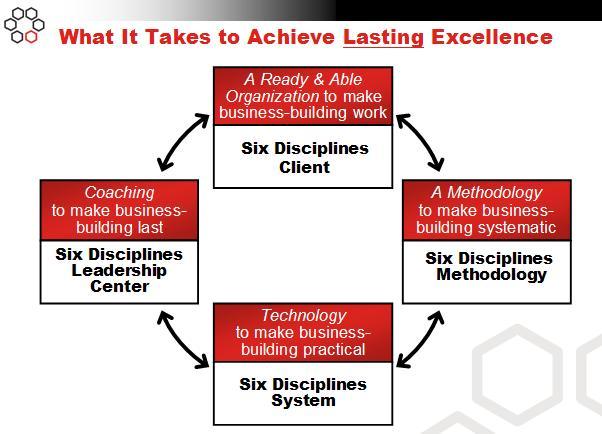
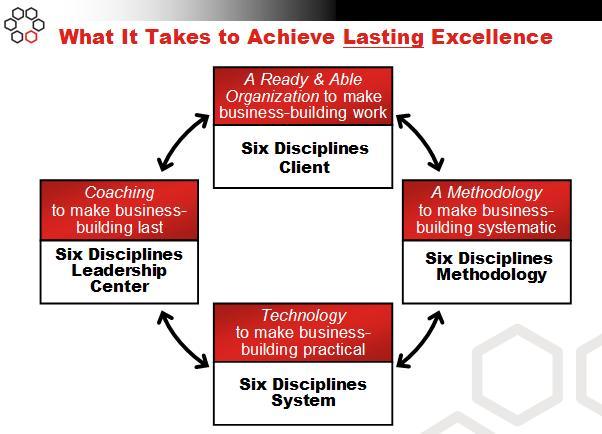
What Does It Take To Achieve Lasting Excellence?


By integrating the proven, time-tested principles of strategic planning, quality management, organizational learning, automated business processes, people performance management and measure-driven improvement, Six Disciplines is a method to help the best performing organizations make the transition from product-building to "business-building" using an approach that includes four essential elements:

  1. A Methodology to make business-building systematic.
  2. Technology to make business-building practical.
  3. Coaching to make business-building last.
  4. A Ready & Able Organization to make business-building work.

BOTTOMLINE: No matter what method is used for business improvement (what we call "business-building), if you leave out any one of these essential elements, the likelihood of lasting - sustainable -business excellence, is significantly diminished.

Friday, September 30, 2005

Corporations Woo Baby Boomers - Is That So?

Wow...here's a shocker! With more than 1 in 4 workers eyeing retirement, companies are scrambling to keep valued employees.

According to this CNN/Money Magazine article:


  • "Corporate America is finally waking up to the extensive experience mature employees bring to the table and placing value on the benefits of retaining older workers."

  • "Firms are actively seeking to keep their baby boomer employees, enticing individuals with flex hours, part-time, telecommuting consulting -- exhausting every known resource to accommodate their employees."

  • "More corporations are choosing to "rehire" older employees by involving them in mentoring programs, giving them access to coaching, strategy development and research programs.

BOTTOMLINE: Older employees, younger employees...it's not age that's in demand. It's the level of knowledge, experience, maturity, and passion that is really in demand.

For Franchises, Growing Rapidly Isn't Always Best

Dane, over at Business Opportunities Weblog, links to a Wall Street Journal article "For Franchises, Growing Rapidly Isn't Always Best"

The key take-aways:

  • "We outgrew ourselves," says Ralph Rubio, founder of Rubio's Restaurants and current chairman. "We thought we had a prototype such that we could just franchise it, but it wasn't working." Recently the chain decided to start franchising efforts again -- this time with a more disciplined approach.

  • "When growing quickly trumps other goals, such as grooming competent leaders, controlling costs, picking prime locations or building a customer base, the company's operations can turn sloppy."

  • "The problem (with Boston Markets) , experts say, was the company became so obsessed with growth that it overlooked principles of good business like grooming good managers and building relations in the community.


BOTTOMLINE: Were you aware that Six Disciplines is much more than a just top-selling business improvement book? We've also invested more than 50-man years of R&D and more than $10 million dollars to develop Internet technologies that make the Six Disciplines Methodology practical.

We deliver the Methodology and Internet technologies through our growing nationwide network of Six Disciplines Leadership Center franchises. Our goal is to launch 70 Six Disciplines Leadership Centers throughout the U.S. - over the next 10 years. Interested? Here's more on the Six Disciplines Leadership Center franchise opportunity.

Monday, September 26, 2005

BizJournals.com Recognizes Six Disciplines Leadership Centers

According to BizJournals.com, "The Internet and computer technology impact nearly every aspect of our business and personal lives, especially with regard to co mmunications, finance, entertainment and retail. Companies that provide these vital services need not be international conglomerates - the market is huge, and franchisors are able to offer many of the same products and services previously available only from industry giants."

BOTTOMLINE: BizJournals.com recognizes Six Disciplines Leadership Centers as the showcase entry in the "Business Management Technologies" category.

On Creating A High-Performance Organization

What can small businesses learn from larger enterprises? Plenty - if you look in the right places.

In this issue of McKinsey Quarterly, strong financial results at Barclays Bank masked an underlying malaise, according to CEO John Varley. In some areas of the business, employee engagement and customer satisfaction—areas for future growth—were weak. Barclays has shifted its attention beyond immediate shareholder concerns, focusing instead on long-term performance and the development of measures to track the bank's health.

"If you concentrate first on creating a high-performance, healthy organization that has everything your customers are looking for, your shareholders will be just fine over time."

The full article is here. (Free subscription required!)