The Six Disciplines blog has moved!

You will be automatically redirected to our new home. If that does not occur, please visit:

Monday, October 05, 2009

Strategic Planning - 'Tis the Season (Already?)

The following article was written by Eric Kurjan, President of Six Disciplines Northwest Ohio. Six Disciplines brings “big company” process improvement to organizations looking to break beyond the status quo. For more information visit www.SixDisciplines.com/Toledo, or call 419-348-1897.


----

In an article earlier this year, I wrote about the fact that setting strategy is a year-round opportunity. The message being, don’t wait to take action. For those of you who waited it is definitely time to get moving. The end of the calendar and perhaps fiscal year is rapidly approaching and planning for next year needs to begin.

So what does an effective strategic planning process look like?

Strategic planning is actually the easy part of the two-part process for business success – strategy and execution. Let’s discuss a couple of key thoughts about strategic planning starting with; it needs to be a repeatable process. This process should be one that can be used continually, without changing major elements based on management whims or MBS (Management by Best Seller).

Here are the key steps in strategic planning:

1) Step Back – Take a look around. We need to look at where we have been before we can decide where we want to go. Companies rarely track performance against long-term plans: less than 15% of companies make it a regular practice to go back and compare the business’s results with the performance forecast for each unit in its prior years’ strategic plans according to the Harvard Business Review. So the Step Back process should include a consistent method for reviewing external factors (i.e., economic influences, competitive trends, governmental requirements…etc.) as well as internal factors (i.e., achievement of current year goals, key performance measures, stakeholder satisfaction surveys, completion of a SWOT analysis) plus a process to prioritize a long list of actions into a reasonable, achievable list. I recommend using what we call the 100-Point Exercise to boil down the list to the top items. The 100-Point Exercise allows each participant in the planning meeting to apply up to 100-points (I like increments of 20 points) to the items on the SWOT or brainstorming list they see as the most impactful on the business or organization in the coming year. Then you add up the scores for each item across all participants and the highest scoring items are the winners. It makes a big list manageable and something you can actually work on and complete versus trying to work on a list of 10 or 15 items which is virtually impossible to complete.

2) Decide What’s Important - The process must include a predictable, repeatable method for assessing your organization’s mission, shared values, vision, strategic position, and vital few objectives (a.k.a. goals). In this step we are setting or renewing the vision. Vision is the picture of “where” we want the organization to go in the next ten years. It is defining our destination. It is also the step that helps us determine “what” we need to do to get to that destination. These are referred to as our Vital Few Objectives (VFOs). It does not happen by accident, well it might, but then that would be an accident.

3) Set Goals that Lead - Also important is a process to determine and set goals that are measureable, allowing us a way to develop clear targets and deadlines. Nothing loosey-goosey here – hard numbers, revenue dollars, margin percentage, dates, units. Real goals have real outcomes by which we can measure our progress. Also, this is where we need to define the projects or initiatives that will help us get to our goals. If our Vision (where) is to have “regional geographic presence” and our VFO (what) is to “open five offices in the next five years” then our initiative/project is “how” to open the first “new office in 2010”. These initiatives are intended to change the trajectory of the business. We do many things to run the business but what do we need to do to change the business. These are the items that drive activities of “every person, every day.” Now that I know “Where”, “What” and “How” the next is “Who” will do the work.

4) Work the Plan – This is the execution phase of the strategic plan. And this is the biggest failure point for organizations. The execution phase is setting the stage for “who” will do the work. This is where we must assign the work that needs to be done to help the organization achieve the goals to arrive at the destination. Set real tasks with real deadlines and real outcomes.

To recap, strategic planning is not an annual event – it is an on-going process. While most organizations conduct strategic planning annually, that’s not enough. It needs to be revisited on a quarterly basis in order to measure progress, align resources and implement necessary adjustments. If you are not measuring, observing, and adjusting, the likelihood for success decreases rapidly. Just like driving a car on the highway, you need to pay attention to the key dashboard indicators and look out the windshield. You must continually adjust based on various internal and external inputs like the speedometer, the roadway, traffic, visibility, etc.

Let’s not forget, however, that strategic planning is only HALF of the equation. While the CEO and leadership team “own” the strategic plan and are accountable for it, they cannot be completely responsible for its proper execution. Even the most well-crafted strategy is subservient to superior execution. And, most successful business leaders agree, they’d rather have a “B” strategy and an “A” execution, than the other way around. In fact 90% of organizations fail to execute their strategies successfully according to a survey by the BSC Collaborative.

The tougher, more critical side of the strategy/execution equation is making it work - getting it done, measuring progress along the way, finding what doesn’t work early enough to make course corrections and aligning resources (people, technology, policies, processes, and measures) continually so that initiatives can support the vital few objectives (VFOs).

It’s the delicate balance of both strategic planning and execution that separates good organizations from great organizations.

In my next article, I’ll focus on this other half of the equation: Execution.

Thursday, October 01, 2009

Deming's Fourteen Points of Quality Management

W. Edwards Deming was a supreme practitioner of quality management.

He summarized his ideas in these Fourteen Points of Quality Management:

  1. Create constancy of purpose towards improvement. That means short-term out, long-term in.
  2. Adopt the new philosophy. From top to bottom
  3. Cease dependence on inspection. You don’t inspect quality into products and services - you design it in.
  4. Move towards a single supplier for any one item. Playing many suppliers off against each other is wasteful.
  5. Improve constantly and forever. However good you are, you can always do better.
  6. Institute training on the job. The best place to learn.
  7. Institute leadership. Go well beyond supervision and its quotas and targets.
  8. Drive out fear. Makes for bad work - and bad management.
  9. Break down barriers between departments. No more “silos."
  10. Eliminate slogans. Non-meaningful slogans are counter-productive substitute for real management.
  11. Eliminate management by objectives. Relying on production and other targets is also counter-productive.
  12. Remove barriers to pride of workmanship. The key to superior quality lies here - and in the Fourteen Points, which all encourage performance.
  13. Institute education and self-improvement. Organizational learning.
  14. Transformation is everyone’s job. Everyone, from the bottom - and including the top.

BOTTOMLINE: Simple, straightforward, not easy, but absolutely worth the effort.

(Thanks to Thinking Managers for the tip!)

Wednesday, September 30, 2009

Executing Your Strategy: Avoiding The Epic Fail

With all the bad news bombarding us daily, it's time to get control over the things we can do, and do everything we can during times of uncertainty, to avoid the epic fail.

To wit, here's a short refresher on why companies fail:

Failure to understand the customer
• Why they buy, what they want (real need for the product/service)

Failure to understand the resources, time required to execute the strategy
• Can the staff, equipment, and processes handle the stated strategy?
• Failure to develop new employee and leadership skills

Failure to obtain senior leader commitment
• Failure to get management involved right from the start
• Failure to obtain sufficient company resources to accomplish task

Failure to obtain team member commitment
• The strategy is not well explained to employees
• No incentives given to workers to embrace the strategy

Failure to manage change
• Inadequate understanding of the internal resistance to change
• Lack of vision on the relationships between processes, technology and organization

Failure to focus
• Inability or unwillingness to make choices which are true to the strategic mission (i.e. to do fewer things, better), leads to mediocrity, inability to compete

Failure to execute the plan
• No follow-through after initial planning
• No tracking of progress against the plan
• No accountability / consequences for the above

BOTTOMLINE: Start today...resolve to focus and act on the things you DO have control over (internal issues), on the highest priority activities you can - you'll find they all revolve around executing your strategy.

Tuesday, September 29, 2009

Book Review: Six Disciplines Execution Revolution

Robert Morris, a top business book reviewer, has published his review of Gary Harpst's "Six Disciplines Execution Revolution".

The review begins:

"Harpst asserts that "excellence is the enduring pursuit of balanced strategy and execution. Strategy requires choosing what promises to make to all stakeholders and a roadmap for delivering on those promises. Execution requires getting there, while overcoming unending surprises. Of the two, execution is far more difficult to achieve, but it is fruitless without sold strategy. Learning how to balance these two is the key to excellence...."

Read the entire review published in the Columbus Examiner here.

Thursday, September 24, 2009

Creating A Culture of Execution

Creating organizational cultures don't just happen by chance.

Indeed, the innovative folks over at 37 Signals argue that "You Don't Create A Culture" at all.

According to the article: "You don’t create a culture. Culture happens. It’s the by-product of consistent behavior. If you encourage people to share, and you give them the freedom to share, then sharing will be built into your culture. If you reward trust then trust will be built into your culture."

So, if you encourage and reward something (for example, an attitude or behavior) - on a consistent basis - it gets build into your organization's culture.

Sharing, trust, cooperation, engagement - whatever your organization has as its core values - must be encourage, recognized and rewarded, in order for it to become built into your culture.

Same goes for execution. If you value "getting the right things done" - consistently, predictably and in a balanced way, you need to encourage it, recognize it and reward it consistently over time.

BOTTOMLINE: Start today by creating your own "culture of execution". Determine what shared core values your organization has relative to getting things done, align your resources to do so, and begin to recognize and reward attitudes and behaviors (results, not just activities) that reinforce the kind of execution culture you want your organization to have.

Strategy Execution and The Balanced Scorecard

Harvard Business School Working Knowledge offers up this interview with HBS professor Robert S. Kaplan, one of the original creators of the Balanced Scorecard in 1992.

Key take-aways from their latest research:
  • Companies often manage strategy in fits and starts.
  • Though executives may formulate an excellent strategy, it easily fades from memory as the organization tackles day-to-day operations issues, or what most think of as "fighting fires."
  • Strategy forumulation needs to be a continual process - not an annual event.
  • Senior management teams needs to have regular, probably monthly, meetings that focus only on strategy.
  • Companies need a formal process for using strategic objectives to set priorities for where operational improvements can have the largest impact on strategy execution.
  • A complete strategy execution system schedules strategy review meetings at a different time from operational review meetings, so that each meeting has its own frequency, agenda, information system, and participation.
  • Creating a strategy map and scorecard for that strategy is the logical and proven next step for putting the strategy into action.

Kaplan also reveals the "six strategy execution stages":

  1. Stage 1: The CEO leads the change agenda and drives it from the top to reinforce the mission, values and vision. Leadership sets the ambitious vision and stretch targets.
  2. Stage 2: The executive leader validates the strategy map as an expression of the strategy articulated in Stage 1 and challenges the organization with stretch targets that take all employees outside their comfort zones.
  3. Stage 3: Leadership drives alignment of organizational units and is essential for communicating vision, values, and strategy to all employees.
  4. Stage 4: Leadership supports the cross-organizational unit process improvements.
  5. Stage 5: the leader's openness and skill in running the strategy management review meeting determines its effectiveness for fine-tuning the strategy throughout the year.
  6. Stage 6: The leader must allow even a well-formulated and executed strategy to be challenged in light of new external circumstances, data collected about the performance of the existing strategy, and new suggestions from employees throughout the organization. Being willing to welcome and subject existing business strategies to fact-based challenges is one of the hallmarks of effective leadership.

Wednesday, September 23, 2009

Solving The One Problem That Makes Solving All Other Problems Easier

An organization that learns a systematic way of setting its priorities, that learns how to build detailed plans, that learns how to proactively manage those plans and communicate in an organized way is in a much better position.

In such an environment, goals are clearer and new employees can understand their role sooner. They learn how to communicate more effectively. Overall, the efficiency and effectiveness of the organization will be higher; it will have better capacity to respond to the demands of growth.

BOTTOMLINE:


  • Building an organization that can learn how to execute strategy and deal with the daily surprises of the business world is solving the one problem that makes solving all other problems easier.

  • Solving this one problem yields substantial long-term benefits for your business, including predictability, balance, managed growth and substantially increased market value. All of this promotes a better night’s sleep for you.

  • Solving this one problem also leads to the creation of an organization that is trusted both internally and externally. It enables an organization that learns how to develop its people to their fullest potential. It empowers an organization that can be successfully transitioned to the next generation, and so on.

  • The value of your business will be significantly higher if it has a predictable strategy
    execution history.

  • Any business that would adopt a systematic program for strategy execution two years before selling the business would get 30–40 percent more for the business when sold. Why? Because having an organization that knows how to plan and execute is rare. Those who achieve it set themselves apart and are worth more.
(Excerpted from Chapter 11, Six Disciplines Execution Revolution, by Gary Harpst)

The Importance of Shared Community Learning in Strategy Execution

A complete strategy execution program depends upon the power of a shared community learning. First, the power of community is required to change the economics for implementing such a program within small and midsized organizations. Second,learning is required to overcome the natural tendency of individuals and organizations to wander from the very disciplines that can deliver them from the status quo.

It’s a tall order to build a community that agrees to share these attributes. Even though it’s difficult, it’s worth the effort, because well-formed communities accelerate learning.

BOTTOMLINE:

The Execution Revolution will be built around communities with the following characteristics:


  • A belief that their ultimate core competence is the ability to execute their strategy.
  • A shared repeatable methodology that organizes their efforts to execute better.
  • Strategy execution coaches who are experts in the repeatable methodology they share.
  • Shared technology (an execution software system) to help integrate planning and
    activity alignment at all levels of the organization.
  • Active communities in the Execution Revolution consist of communities with these titles: coaches, leadership teams, initiative teams, team leader and team members and cross-company roles.
  • Among adult learners, the biggest barrier to fostering a learning community is pride. For senior leadership, the only way to remove this barrier is to display a passion for learning how to execute strategy effectively.
  • Of all the four components of a complete program – a repeatable methodology, strategy execution coaching, an execution software system and a shared learning community – the learning community has the most transforming power.

(Excerpted from Chapter 10, Six Disciplines Execution Revolution, by Gary Harpst)

The Importance of An Execution Software System in Strategy Execution

The primary role of the execution system component is to help organizations get the right things done. To do this requires identifying execution problems as early as possible and addressing them.

Think of an organization as a system for deciding what to do (a strategy, a plan) and the managing the execution of that plan. When the system (the business) makes an error, choosing to do the wrong thing or forgetting to do something that is required, the problem must be corrected. The longer it takes to detect the problem, the more it costs to fix. If the business has no system in place to set, manage and monitor strategy execution, the process is not only error-prone, it’s a huge disaster just waiting to happen.

Without such an execution software system, an organization becomes unpredictable at best and eventually declines in its ability to execute, especially as it grows. That is why it’s important that an execution software system enables an organization to focus on learning as early as possible.

BOTTOMLINE:


  • An execution software system enables an organization to focus on learning to identify
    execution problems as early as possible.

  • There are five primary types of organizational errors or causes for execution failure
    within an organization: change, clarity, dependency, estimation and availability.

  • An execution software system needs to include the following elements: methodology
    automation, time management, real-time activity alignment, weekly external review
    cycle, total organizational engagement and execution management.

(Excerpted from Chapter 9, Six Disciplines Execution Revolution, by Gary Harpst)

The Importance of Coaching In A Strategy Execution Program

Most leaders fail to understand the implication of the human nature barriers. Our natural tendency is to do what we like doing, not necessarily what we should. The topic of coaching offers the most insight into what it takes to deliver a complete strategy execution program.

Strategy execution coaching implies that an accountability model exists. Employees in organizations will learn to be accountable – that is, they’ll do what is needed and expected – proportionate to the extent in which three factors are present:

  • Expectations are clear.
  • These expectations are perceived as credible and reasonable because the employees
    were involved in setting them.
  • Employees understand the impact of success, or lack thereof, on the organization.

When these three factors aren’t in place, employees can’t achieve their potential, no matter what kind of people they are. A critical element for creating company-wide accountability is to put appropriate focus on results, not activities. For most employees, it’s more motivating to be told what needs to be done and why, but not how.

BOTTOMLINE: Being accountable to ourselves is not enough. We clearly need others, preferably outside of our organization, to hold us accountable and to help us accelerate our learning. We need others to help us fight the continual battles against our own human nature and our tendency to do what we want to do, rather than what we need to do. We need others to challenge our way of thinking and acting. We need others to help us increase our capability to manage the next challenge. We need others to learn how to do this faster than we can do it on our own. Finally, we need others to help make change last within our organizations, to make the new way of working “stick.” That’s what strategy execution coaching is all about.

(Excerpted from Chapter 8, Six Disciplines Execution Revolution, by Gary Harpst)

The Importance of A Repeatable Methodology for Strategy Execution

A methodology, or method, is another name for any step-by-step approach to getting something done. A business-building methodology must include the steps that are essential for an organization to build and sustain a healthy, growing business. It must define how the organization sets its goals and priorities and organizes its resources to best achieve these goals.

It must teach the organization how to stay focused on what’s important, while dealing with the inevitable surprises that occur regularly in life. It must provide ways to identify where the organization is on plan (or off) and do so in real-time.

A business-building methodology must provide a framework for an organization to learn and grow as its size and complexity grows – a way to increase its capability to learn and grow faster than its challenges. Another priority of the methodology is to connect long-term goals with daily decisions. To do this requires connecting people’s activities to the company’s strategy – from the top to the bottom of the organization. It requires a clear process for defining strategy and goals that are then translated into team and individual goals.

Another benefit of having a repeatable and documented business-building methodology is the accumulation of knowledge by individuals and teams. Defining a process and then documenting changes to that process reinforces the learning that occurs so that you don’t forget it. When many individuals use a common methodology, the rate of accumulated learning that is shared is accelerated.

BOTTOMLINE:

  • The goal of a complete strategy execution program is to enable organizations to spend an increasing amount of time in Quadrant II. Here, their performance is more predictable and sustainable and execution of strategy becomes balanced.

  • Achieving this goal requires thinking holistically about the business – how to make all the components, people, processes, policies, key measures, assets and strategies work together to meet the promises made to customers and other stakeholders and to repeat these in a predictable fashion.

  • Be aware that reading about each discipline separately doesn’t make your business perform better instantly any more than taking five golf lessons makes you a good golfer. In the end, you have to learn how to use all of the disciplines together and the only way to truly learn is by doing.

  • We are absolutely advocating this: every organization that is serious about excellence
    and execution must practice some defined methodology as the foundation of its efforts.

  • The absolute foundation of building an organization that is increasing its ability to execute is a repeatable methodology.

  • In addition, the disciplines must be used in conjunction with the other three required elements of a complete strategy execution program: strategy execution coaching, an execution software system and the benefits of community learning.

(Excerpted from Chapter 7, Six Disciplines Execution Revolution, by Gary Harpst)

The First Complete Strategy Execution Program (Summarized)

The critical question for every business leader is, “How do I build an organization that consistently executes its strategy?”

The answer: it takes a complete program. The reasons other approaches do not last is that they are missing key elements. Technology (i.e., performance mangement software) alone is not enough. Training, by itself, is not adequate. Simply reading best-selling books won’t do it. New leadership by itself is not the answer. Retaining better people won’t make the critical difference. Hiring an executive coach by itself will not overcome this challenge.

No, the answer lies in taking a more profoundly holistic approach.

BOTTOMLINE: Our field research has shown us that singular, piece-meal approaches just don’t last. Sustainability, the capacity of an organization to maintain the necessary balance between strategy and execution, and doing so while overcoming the hurdles, requires a complete program consisting of four tightly-integrated elements:

  • A Repeatable Methodology to drive organizational learning and understanding.

  • Strategy Execution Coaching to nurture and nudge to stay the course.

  • An Execution Software System to engage everyone, everyday in real-time alignment.

  • Community Learning to share and reinforce best practices and accelerate learning\

(Excerpted from Chapter 6, Six Disciplines Execution Revolution, by Gary Harpst)

Requirements Of A Next-Generation Strategy Execution Program (Summarized)

In researching how to build a sustainable strategy execution program, we’ve uncovered three major barriers that have to be overcome if the program is to be successful. They are insufficient expertise, prohibitive economics and simple human nature. We’ve determined that these three barriers are actually the major design requirements any truly effective strategy execution program must be able to address.

The Expertise Hurdle: To produce lasting results, any complete strategy execution program has to somehow help the organizations that use it to cope with the wide range of expertise required to employ the appropriate best practices that are available. It must also help these organizations recognize that this body of knowledge will keep growing and changing.

The Economics Hurdle: Clearly, any strategy execution program developed for small and midsized businesses must consider how to deliver the expertise and technology required at an economic level that these organizations can afford. The only way this can be achieved is by integrating these essential components of the program – in a complete solution – and deliver them using an innovative model.

The Human Nature Hurdle: Now, for the toughest hurdle of all: people. One of the most persistent challenges we face as humans is to narrow the gap between knowing what needs to be done, and actually doing what needs to be done. Another dimension of human nature that needs to be considered is resistance to change. Most of us resist change, unless it’s our own idea.

BOTTOMLINE:


  • In order to build a sustainable strategy execution program in small and midsized businesses, three major barriers or hurdles need to be overcome: insufficient expertise, prohibitive economics and simple human nature.

  • While larger companies have knowledgeable people with the necessary expertise in business improvement disciplines, small and midsized organizations don’t have equal
    access to such a wide array of expertise.

  • Developing mastery in even just one business improvement discipline requires a substantial investment. None of this comes cheap, and there are no shortcuts.

  • Any strategy execution program developed for small and midsized businesses must consider how to deliver the expertise and technology required in a way that makes sense economically for these enterprises. The only way this kind of change in economics can be achieved is by integrating the essential components of such a program into a complete solution and delivering them using an innovative distribution
    model.

  • One of the most persistent challenges we face as humans is to narrow the gap between knowing what needs to be done and actually doing what needs to be done.

  • Other human nature hurdles to overcome include our resistance to change, our unique differences, our need to communicate effectively and our need for purpose in our lives, including meaningful work.

(Excerpted from Chapter 5, Six Disciplines Execution Revolution, by Gary Harpst)

The Leapfrog Opportunity For Executing Strategy (Summarized)

Occasionally, circumstance and progress in seemingly unrelated areas combine to create an opportunity for solving old problems in new and exciting ways.

One of those breakthrough periods is upon us now, with regard to strategy execution.

This inflection point has developed primarily because large corporations have made huge investments developing best practices for effective management, strong leadership and strategy execution.

Built upon the results of these efforts, we believe the coming Execution Revolution will result in an order-of-magnitude change in cost that will allow small to midsized businesses not only to catch up, but to actually leapfrog, larger organizations in their execution management capabilities.

This is what the Execution Revolution is all about.

Leaders of small and mid-sized businesses now have an opportunity to go from almost no system to a new category in the excellence industry – a complete strategy execution program that puts everything needed for a balanced strategy execution together in one affordable combination.

The business excellence methodology component of this program is detailed in Gary Harpst's first book, Six Disciplines for Excellence: Building Small Businesses That Learn, Lead and Last.

BOTTOMLINE:
  • Conditions are currently right to approach strategy execution in a radical new way.
  • Seven key areas of business improvement advancements are fueling the Execution
    Revolution:
    1. Quality Programs
    2. Business Process Best Practices
    3. Personal Productivity Tools
    4. Business Intelligence
    5. Strategy Formulation
    6. Virtual Community Development
    7. Business Coaching

(Excerpted from Chapter 4, Six Disciplines Execution Revolution, by Gary Harpst)

Why Is Strategy Execution So Hard? (Summarized)

Why is strategy execution so difficult?

Why do we know what to do, but don’t always do it? Doing what we know we should requires someone who will keep us on track, to teach, direct and encourage us to do the things we know we should do – the difficult things that we rarely, if ever, follow through to the finish, if left to our own devices.

While the majority of us have one or more "specialties", the majority of us just don’t know how to put together all the key steps of strategy, planning, organizational alignment, execution management, innovation and measurement.

BOTTOMLINE: Strategy execution is hard for a variety of reasons, but it’s not "rocket surgery".
  • The majority of us don’t know how to put together all the key steps of strategy, planning, organizational alignment, execution management, innovation and measurement.
  • Often, we fall into the trap of outside-in thinking, and need to focus on internal things
    rather than worrying about issues outside of our control.
  • We need to keep in mind the control factor: regardless of how well we perform as a business, there are many factors to success we cannot control.
  • Sometimes, it’s easier not to do what we know we should do.
  • As ironic as it may seem, there is a growth paradox, the organization that’s good at
    solving today’s challenges will create a new and bigger set of challenges for itself tomorrow.
  • It’s critical that organizations continually work on increasing their capacity to execute.

(Excerpted from Chapter 3, Six Disciplines Execution Revolution, by Gary Harpst)

The Biggest Problem in Business (Summarized)

What most business leaders think their greatest challenge is, isn’t.

And whatever their problems are today, they’ll be different tomorrow and they will be bigger too.

There is one business problem that if solved, will make solving all other problems easier.

This foundational challenge is executing strategy.

In other words, building an organization that has the ability to plan and execute, while at the same time, overcoming the inevitable surprises in business. This is the biggest and toughest challenge in business.

BOTTOMLINE:

  • The biggest problem in business is not what most business leaders think it is.
  • The biggest challenge is not the issue at hand. Planning and execution while at the same time dealing with the unknowns of the real world, is the biggest challenge in business.
  • Focus on solving the problem that makes all the other problems soluble.
  • Developing and executing a strategy that’s balance in growth and profitability is extremely difficult and is therefore rare.
  • Execution is considered by most business leaders and researchers as a universal
    challenge.

(Excerpted from Chapter 2, Six Disciplines Execution Revolution, by Gary Harpst)

Tuesday, September 22, 2009

The Four Quadrants of the Business Excellence Model


Simply put, the focus and capability of an organization can be understood in two dimensions: strategy (deciding what to do) and execution (getting it done). Leaders who build organizations with strong execution over long periods of time achieve enduring excellence. The combination of strategy (the choices of what we do versus what not to do) and execution (how well the choices are carried out) becomes the field upon which the Execution Revolution occurs in any given company.

The figure above shows a model of these dimensions using four quadrants of performance:

Quadrant I: Strong Strategy/Weak Execution: In this quadrant, a business has a strong strategy, which typically means a competitive advantage. This advantage can come from offering premium products or services, availability or price. It can be rooted in technology, distribution channels, manufacturing expertise or current customer base. Regardless of whether a company is a start-up or a seasoned business, strong strategy usually leads to growth in sales. A key point to understand is that success and the results of growth start the journey – but this often leads an organization (and its leadership) into Quadrant IV.

Quadrant IV: Strong Execution/Weak Strategy: A company in Quadrant IV usually gets there because it is experiencing the pains of growth. Quite often, sales have outpaced capacity, so leadership becomes focused on strengthening internal operations to address quality, scheduling, hiring, training, customer service, order processing and other issues. In other words, the movement into Quadrant IV is a natural reaction to success in Quadrant I.

Quadrant III: Weak Strategy/Weak Execution: It’s easy for a company to operate in Quadrant III for quite a while before leadership really accepts they are there. The shift into this state of weakness results from gradual decline in growth and profitability, caused by decisions made (or not made) a year or two earlier. In Quadrant III businesses are usually overworked, confused and eventually have a feeling of hopelessness if the issues are not addressed. Typically, the best exit plan for moving out of Quadrant III is to aggressively reallocate resources from low-profitability areas to the growth areas. This sounds easy, but most organizations don’t have the framework, the will or the persistence to make the hard choices it requires.

Quadrant II: Strong Strategy/Strong Execution: Quadrant II is all about balancing growth with profitability and performing predictably. This requires a disciplined organization, one that’s able to execute well enough to address the needs of today and build for tomorrow at the same time. Admittedly, Quadrant II performance is difficult to sustain. Few companies are able to
achieve this kind of performance for long periods of time.

BOTTOMLINE: This is what the Execution Revolution is all about: the process of changing the game with regard to enduring excellence by focusing on how to plan and execute strategy more effectively while successfully managing the surprises along the way.

Monday, September 21, 2009

Five Key Steps In Strategy Formulation - And Two For Execution

Creating a strong strategy for an organization is not an easy task. It takes several of the organization's leaders to articulate and agree on vision and direction.

Yet, of the two, execution is much harder, as it requires the activity of every person, every day.

Here are five tips for strategy formulation:

  1. Analyze the current situation. Determining where your organization stands is an important first step that some leaders take for granted. Ask yourself, “Where are we now?” At a bare minumum, conduct a SWOT analysis.
  2. Set a clear strategic direction. Use mission and vision statements to articulate goals, then set out an action plan for how to reach them.
  3. Develop a small set of initiatives. Outline 3-5 key initiatives or projects that support the organization's goals and assign them to key employees to execute.
  4. Establish a detailed action plan - for everyone. An individual plan for every employee, one that is reviewed between employee and team leaders weekly, gives everyone status updates and enough time for corrective action in the case that goals are at risk. Include measures for monitoring progress.
  5. Align the organization. Execution of strategy requires every person, every day. Make sure you disseminate the strategy to all employees. How can they execute on it, if they're not continually aware of what's really important?

Now that strategy has been formulated, two key tips for executing the strategy:

  1. Execute relentlessly. The individual plan for each person needs to be reviewed daily, time needs to be spent on activities that support the initiatives, and corrective measures need to take place as early as possible, so you can course-correct quickly.
  2. Monitor, measure and learn. Monitor key measures along the way, find and correct errors early and quickly, and learn from your mistakes.

Thursday, September 17, 2009

Execution - The Greatest Challenge in Business

To quote former Notre Dame football coach Lou Holtz, "When it's all said and done, more is said, than done."

Likewise, execution is critical to an organization's success, yet it's much easier said than done.

In their book Execution: The Discipline of Getting Things Done, authors Larry Bossidy and Ram Charan strongly support strategy execution as a critical leadership role, making three clear statements:
  1. Execution is a discipline, and it's integral to strategy formulation.
  2. Execution is the major job of the business leader.
  3. Execution must be a core element of an organization’s culture.

However, execution appears to be the greatest challenge.

In his book, Making Strategy Work: Leading Effective Execution and Change, Professor Lawrence G. Hrebiniak from the Wharton Business School identified the following issues related to the challenge of execution.

Notice that all four of the problems mentioned below are people-related issues:

  1. Managers are trained to plan, not execute.
  2. Some top executives do not see themselves as responsible for executing the strategies they formulate.
  3. Strategy execution happens over a much longer time frame than strategy formulation.
  4. Strategy execution involves more people than strategy formulation.

In his best-selling book, Six Disciplines Execution Revolution, author, veteran CEO and strategy execution expert Gary Harpst identified that the balance of both strategy and execution is the key to lasting excellence. Excellence is a journey that never ends. It's an enduring pursuit that requires and enduring approach.

BOTTOMLINE: According to Harpst, "Planning and executing, while at the same time managing the unknowns of the real world is the biggest challenge in business. Overcoming this challenge is what we mean by solving the one problem that makes solving all other problems easier. It builds an organization that is preparing for an ever-increasing set of future challenges, which are the natural result of overcoming today's challenges."

Wednesday, September 16, 2009

Building Organization-Wide Accountability

Building company-wide accountability is a key element to making a business sustainable over a long period of time. Not surprisingly, all high-performing organizations are moving toward more empowerment, enlightenment -- and building their own organizational accountability.

So what is accountability? To some, it’s something you make people do, as in “making people accountable.” But as long as you think accountability can be purchased, mandated, or motivated, you’re trapped in trying to create accountability -- where it may not be possible.

Let’s consider what accountability is, and how we can build an organizational culture that encourages it.

Be definition, accountability is being answerable or responsible for something. Accountability opens the door to ownership – not necessarily financial ownership -- but certainly emotional ownership, where someone acknowledges they’re responsible for some aspect of the organization.

Accountability is not something you “make” people do. It has to be chosen, accepted or agreed upon by people within your organization. People must “buy into” being accountable and responsible. For many, this is a new, unfamiliar, and sometimes, uncomfortable way to work. Most importantly: individual purpose and meaning comes from accepting responsibility and learning to be accountable.

To learn to be accountable means coming to grips with an element of discipline. Accountability is the opposite of permissiveness. Holding people accountable is really about the distribution of power and choice. When people have more choice, they are more responsible. When they become more responsible, they can have more freedom. When they are more accountable, they understand their purpose and role within the organization and are committed to making things happen.

So, how do you build company-wide accountability?

Only organizations that can clearly identify, articulate, and execute their strategic goals are well-positioned to be able to build company-wide accountability. To effectively achieve these goals, companies must measure and manage actual business performance against these goals in a highly coordinated manner.

A six-step framework to build company-wide accountability is to:

  1. Decide What’s Important (develop an authentic mission, vision, values, strategic position)
  2. Set Goals That Lead (planning that includes measures, targets, projects)
  3. Align Systems (streamline processes and resources so all resources support the goals)
  4. Work the Plan (assure and measure so that each employee’s plans and activities support the goals)
  5. Innovate Purposefully (get to root causes quicker, make quicker and more informed decisions)
  6. Step Back (assess strengths, weaknesses, opportunities, threats, appraise performance results)

Building company-wide accountability requires not only a systematic method based on proven best-practices. It also requires technologies that make the framework practical to use and implement on a daily, weekly, monthly quarterly and annual basis. In addition, it takes an external coach or strategic advisor to hold you and your organization accountable and to help these cultural changes to “stick” – to make it last. In the end, it takes an organization that is ready and able to accept accountability, and to benefit from the ownership and the freedom that comes with organizational accountability.

Accountability and positive organizational change come through a new set of conversations. You can start having these conversations in your organization today.

Monday, September 14, 2009

Communicating Your Strategic Plan

The Lord's Prayer has 50 words.

The Ten Commandments have 297 words.

The Constitution of the United States of America has 4,500 words.

How many words does your organization's operations manual have? How about your mission, vision, values statement? How about your strategic position?

Perhaps even more importantly - how many of your organization's team members have ever even read your mission, vision, values, and strategic position?

Do they even know where to find it?

BOTTOMLINE: It's not enough to simplify and make every word count when it comes to your organization's mission, vision, values and strategic position. Make them available to everyone in your organization - constantly. Make your mission, vision, values, and strategic position always available on every team member's desktop. It's a great way to continually remind and align team members to your organization's strategy. And to execute accordingly.

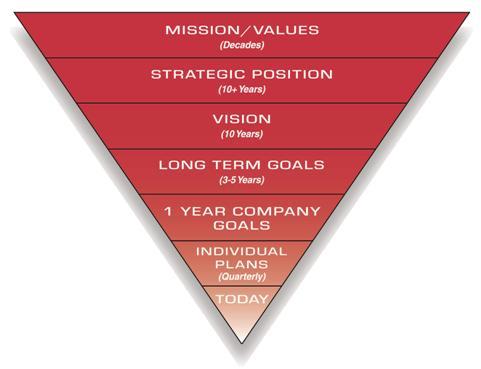
The Strategic Planning Horizon


At Six Disciplines, we encourage business leaders and all team members to look at business planning horizons using this inverted pyramid chart.

Beginning with Mission and Values, which should be decided upon early in the strategic planning process - and should be designed to last for decades.

Next is the organization's Strategic Position, which should be the articulated as the ability to build and sustain a product or service offering that is different than that of your competition, and should be designed to last 10+ years.

Similarly, the Vision should be designed to describe how your organization will look like in 10 years, in pursuing the mission and strategic position.

Next, the Long-Term Goals of the organization (also known as the "Vital Few Objectives") look out 3-5 years, and 1-Year Company Goals are expressed in a balanced scorecard-like fashion (with specific measures, deadlines, assigned accountability) in the categories of financial, customer, production and people.

Individual Plans are created on a quarterly basis, indicating projects, tasks and activities that each person will do in order to support the company goals.

BOTTOMLINE: It all comes down to Today....what are you doing - TODAY - to support the organization's goals, in order to fulfill its Long-Term Goals, Vision, Mission and Values?

Thursday, September 10, 2009

An Interview with CEO and Strategy Execution Expert Gary Harpst

Gary Tomlinson is an entrepreneur and founder of five successful businesses. Today, he is an accountability consultant and professional speaker based in North Carolina.

Here’s an excerpt of an interview Tomlinson did with Gary Harpst, discussing his newest best-selling book, Six Disciplines Execution Revolution.

Tomlinson: “Your first book, Six Disciplines for Excellence, is a highly regarded strategy execution methodology. Why did you write Execution Revolution”?

Harpst: “When I wrote Six Disciplines for Excellence we were trying to help businesses understand a basic step by step methodology to create an environment of lasting excellence. A lot of businesses are able to have a period of good growth and good profitability but not many are able to sustain it.”

“The mission of our company was to document basic step-by-step methodologies to help organizations achieve and sustain lasting change. The purpose of Execution Revolution was to help business leaders understand that their biggest problem isn’t the problem that’s right in front of them — it’s building an organization that knows how to draft a plan and execute it. A company that knows how to do that can solve any problem. It’s a perspective change.”

Read the entire interview here.

CEO Profiling – Part II: The CEO Effectiveness Exam

The following Part II article was written by Eric Kurjan, President of Six Disciplines Northwest Ohio. Six Disciplines brings “big company” process improvement to organizations looking to break beyond the status quo. For more information visit www.SixDisciplines.com/Toledo, or call 419-348-1897.


In my last article, "CEO Profiling - The Four Kinds of CEOs", I described the four different kinds of CEOs and their ability or inability to run, build or grow their business ventures.

In this article, the focus is on your own organization and your self-evaluation. The CEO Effectiveness Exam is simple and quick, yet illuminating. Although the tendency is to be lenient, I ask that you be honest with yourself and score each question with a truthful answer. Approach it from the perspective of what you are today, not what you want to be. The outcome of this self-evaluation will not do anything by itself. However, with an action plan it may change your perspective, habits, performance and ultimately your long-term results.

Let me recap the four CEO types from the previous article.

CEO #1 – The True Leader – they are solid leaders and run top notch organizations. They set clear goals, measure results, hold people accountable and communicate consistently to the organization. They will have the highest scores on CEO Effectiveness Exam.

CEO# 2 – The Know-it-All – they are too smart for their own good. They are the bully or they are the shrinking violet. They often misunderstand the key elements of leading an organization although the financial results can sometimes be surprisingly good but at a huge cost to the employees, clients and vendors. They will have the lowest scores on the CEO Effectiveness Exam.

CEO# 3- The Heart Attack – they are running scared. Something undesirable has happened to their business and now they are frantically trying to find a way to save the enterprise. A major client has left, product quality has slipped, or maybe sales fell well short of projections, or profits have melted away. Could those people have been right about having a plan and executing on that plan? They will have a low overall CEO Effectiveness Exam score but may be “good” in a few category areas.

CEO #4 – The Humble Leader – they are hard workers. They have built a very good organization and are not satisfied with the status quo. They want more for their organization and are doing something about it. They will score well above “good” in most every category.

Your CEO Effectiveness score is based on the six category areas: Leadership/Culture, Strategy, Customer Focus, Measurement, People and Process. Each one is of equal importance and contributes to the whole. The scores in each section will indicate strengths or shortcomings in an area; however each area must be developed, managed and fully implemented for a CEO to build a truly successful organization.

So now that you “know” what you are, what do you do about it? That is the biggest question you will need to answer. As Gary Harpst, founder of Six Disciplines, says: “the problem for most of us isn’t knowing what to do; it’s doing it”.

Unless you have earned the coveted “CEO#1” score, seek professional help, seriously. Whether it is from Six Disciplines or another qualified business advisor, look for professional assistance in developing a plan to raise your scores and produce better results.

Click here to download the CEO Effectiveness Exam.

Wednesday, September 09, 2009

Aligning People To Execute Strategy

The execution of strategy most often fails because leaders do not focus on the critical issue of aligning their people to execute the strategy.

The essential steps are:
  1. Formulate the strategy
  2. Communicate the strategy
  3. Align people to ensure strategy execution
  4. Monitor and measure the results
  5. Learn and repeat
Consequently, managers at every layer are abandoning the idea that "good management" is about planning their people’s work. People increasingly must plan their own work, make their own decisions and learn to self-manage.

BOTTOMLINE: The key to executing strategy begins with communicating and getting buy-in to the strategy, and in making sure that the decisions and activities people do on a daily basis are in alignment with the strategic direction of the organization.

Tuesday, September 08, 2009

Communicating Organizational Change

Although always important, communication is absolutely critical when deciding to adopt a strategy execution program like Six Disciplines.

It’s challenging to manage the transition ("if nothing changes, nothing changes...") if people have no sense of where the changes are headed. Painting a picture for them can be difficult.

The truth is that many organizations head into a transition state with nothing more than some basic ideas, some lofty goals and cherished values to guide them on their journey.

It’s crucial for leaders to develop and widely communicate a compelling “case for change.” The end product–a well-articulated and persuasive argument for change–becomes, in effect, the mantra of the upcoming change for the organization.

When communicating organizational change to your employees, include:

  • Reason for the change ("if nothing changes, nothing changes...")
  • Vision of the future (renewing your organization's mission, vision)
  • Plan for getting there (persistent, consistent and repeatable plan)
  • Belief that change is achievable (so that people can understand how they contribute)
  • Expectations (of where we're headed, how it's going to be while we journey there)

BOTTOMLINE: The reasons for change need to be communicated early, clearly, often and in delivered in many different ways.

Wednesday, September 02, 2009

Revolutionizing How Organizations Execute Their Strategies


Six Disciplines for Excellence
The One Book That Is Revolutionizing How Organizations Execute Their Strategies


Read about the breakthrough strategy execution program that’s designed specifically to be implemented and embraced by everyone in your company, in an ongoing, systematic way.


Unlike the academic and theoretical books, this top-rated book is the definitive "how-to" guide for leaders who want to take their organizations beyond temporary success to pursue enduring business excellence.


A finalist in USA Book News' 2007 National "Best Book" Awards, Six Disciplines for Excellence is consistently rated in the Top 10 of Amazon's "Organizational Learning" category.


The author of Six Disciplines for Excellence, Gary Harpst, is the CEO and founder of Six Disciplines. Harpst has been the founder of three successful companies and his most recent venture integrates proven best practices from over 25 years of field experience, resulting in the Six Disciplines strategy execution coaching program.

Tuesday, September 01, 2009

Top 5 Fundamental Traits of Organizational Effectiveness

"The Secrets to Successful Strategy Execution" was published in the June 2008 issue of Harvard Business Review, based on a survey of 26,000 people in 31 companies.

In the article, the authors defined execution as "...the result of thousands of decisions made every day by employees acting according to the information they have and their own self-interest."

They also identified the top 17 fundamental traits of organizational effectiveness. Here's a quick look at the top five:


  1. Everyone has a good idea of the decision and actions for which he or she is responsible.
  2. Important information about the competitive environment gets to headquarters quickly.
  3. Once made, decisions are rarely second-guessed.
  4. Information flows freely across organizational boundaries.
  5. Field and line employees usually have the information they need to understand the bottom-line impact of their day-to-day choices.

BOTTOMLINE: The decision-making processes and information flow in every organization are critical. Raise the importance of these factors through recognition and reward are easy ways to improve organizational effectiveness, leading to better strategy execution.

Monday, August 31, 2009

Consultants Adopting A Strategy Execution Practice Have The Competitive Advantage

The newest research from Kennedy Consulting Research & Advisory indicates that execution and implementation are now such integral parts of clients' consulting requirements that service providers have little choice but to develop Operations Management consulting capabilities and credibility.

According to Kennedy: "In an effort to effectively capitalize on today's financial constraints, more consulting practices than ever before are arranging their services around such 'execution' and 'implementation' imperatives."

And, management consultants are better positioned than any other professional service to seize the ever-growing strategy execution market.

To remain competitive, how will you incorporate strategy execution into your consulting practice?

Adding a strategy execution program can generate additional revenue streams, providing you with new service that can attract new clients, which can substantially increase the market value of your existing professional service business.

Want proof? The first management consulting firm that adopted our strategy execution coaching program (Six Disciplines) closed six clients in three months and increased their billable time for more specialized projects, which were discovered as a result of following our strategy execution methodology.

Now’s the time to step up and find out more – register to attend one of the next webcasts, presented by veteran CEO and strategy execution expert, Gary Harpst.

Register here:

September 8 http://sdsept8webcast.eventbrite.com/
September 22 http://sdsept22webcast.eventbrite.com/

Thursday, August 27, 2009

Types of Organizational Misalignment

The cumulative effects of misalignment are a significant constraint on the ability of an organization to execute its strategy.

In fact, research has shown that up to 50% of the resources of a typical organization are not being effectively applied to the mission and vision of the company.

There are two types of organizational alignment: creeping and strategic.

Creeping misalignment occurs gradually every day, often in very small ways as the organization changes. In every day processes, as the organization changes, the "current" approach to doing things becomes less aligned with the goals of the company. As a result, it becomes an increasing drag on the success of the company until corrected.

Strategic misalignment occurs suddenly, when the leadership sets a strategic VFO (vital few objective) -- but the systems and resources of the organization are not deployed to support it. This type of misalignment surfaces suddenly as a barrier to implementing new strategies.

BOTTOMLINE: If your leadership does not learn how to align resources with goals, the free market will.

Tuesday, August 25, 2009

Knowing What NOT To Do


In this Fast Company blog entry, on "Leading Ideas: Know What NOT To Do:

"A client of mine uses a powerful tool to help his executive team decide what not to do with their time. He has each member keep a pie chart of where his/her energy is focused. When new projects come along, they discuss how sections and percentages should shift. "You've got to know where your energy should and shouldn't go each day," he explains. "Sometimes it's obvious and sometimes it's not. We've found explicitly talking about it every few months helps. Team members tend to feel more empowered in what they're doing and are more successful as a result."

BOTTOMLINE: From an organizational perspective, Discipline I-F, Agree What To Stop (Six Disciplines for Excellence, pages 76-79) helps each Team Member to understand what projects/initiatives to stop applying energy / resources to.

More importantly however, is Discipline IV-D, Prioritize Daily (pages 161-163). If you wait to do it "every few months" as suggested above, performance goes unchecked and alignment deteriorates rapidly.

Six Steps to Ensure Organizational Alignment

Marshall Goldsmith is a world authority in helping successful leaders achieve positive, lasting change in behavior.

In a Harvard Business Online article "Six Steps to Ensure Alignment" Goldsmith suggests having a quarterly one-on-one meetings with each of your direct reports. In each of these meetings, address the following six key questions. Ideally, each question will result in a two-way dialogue that helps clarify priorities, ensures alignment, and promotes mutual understanding:

  1. Where are we going?
  2. Where are you going?
  3. What are you doing well?
  4. What changes can lead to improvement?
  5. How can I help?
  6. What suggestions do you have for me?

BOTTOMLINE: "In between each quarterly six questions dialogue, establish your mutual responsibility for continued alignment. Let your team members be responsible for immediately contacting you if they are ever uncertain about priorities or need feedback. You areresponsible for contacting and updating your team members, if the business situation changes and you need to re-set priorities."

Monday, August 24, 2009

Strategy Execution - The Un-Idea

In 2005, Rosabeth Moss Kanter wrote a short - but profound piece - about execution for strategy & business magazine entitled Execution: The Un-Idea. Below are excerpts from the article:


  • "Twenty-five years ago, management meant control. Managers put in controls, handed workers specifications, and established formal structures that ensured that people did what they were told. Companies operated alone, rather than being part of partner networks or plugging their people into informal relationships. It was an ineffective way to operate, especially after the information technology revolution took place, and to break out of it, companies needed management ideas.

  • Innovation and intrapreneurship, Total Quality Management, Six Sigma, reengineering, networked organizations — these were all conceptual handles that allowed executives to justify and develop new breakthrough practices.

  • Today, companies don’t need new ideas in the same way they did 25 years ago (although they still need new business strategies). They’ve been through the paradigm shift. They have sustained tremendous improvement in productivity, effectiveness, and attentiveness to opportunities. That doesn’t mean they’ve been successful; indeed, as they’ve explored new ways of working, we have all learned how hard it is to put these ideas into practice.

  • That’s why execution, or ‘making it happen,’ is so important. Execution is the un-idea; it means having the mental and organizational flexibility to put new business models into practice, even if they counter what you’re currently doing. That ability is central to running a company right now.
  • So rather than chasing another new management fad, or expecting still another ‘magic bullet’ to come along, companies should focus on execution to effectively use the organizational tools we already have.”

Thursday, August 20, 2009

Seven Rules To Close The Strategy To Execution Gap

According to the consultants at Marakon, companies typically realize only about 60% of their strategies’ potential value because of defects and breakdowns in planning and execution. Yet, by following seven simple rules, you can get a lot more than that.

Marakon found that the processes companies use to develop plans and monitor performance make it difficult to discern whether the strategy-to-performance gap stems from poor planning, poor execution, both, or neither.

Here's what they found:

  • Companies rarely track performance against long-term plans.
  • Multi-year results rarely meet projections.
  • A lot of value is lost in translation.
  • Performance bottlenecks are frequently invisible to top management.
  • The strategy-to-performance gap fosters a culture of underperformance.

To help close the strategy-to-execution gap, Marakon recommends the following seven steps:

  1. Keep it simple, make it concrete.
  2. Debate assumptions, not forecasts.
  3. Use a rigorous framework, speak a common language.
  4. Discuss resource deployments early.
  5. Clearly identify priorities.
  6. Continuously monitor performance.
  7. Reward and develop execution capabilities.

Wednesday, August 19, 2009

Consultants Flock Toward Strategy Execution Practices

New research from Kennedy Consulting Research & Advisory (a division of Kennedy Information) indicates that execution and implementation are now such integral parts of clients' consulting requirements that service providers have little choice but to develop Operations Management consulting capabilities and credibility.

According to Kennedy: "In an effort to effectively capitalize on today's financial constraints, more consulting practices than ever before are arranging their services around such "execution" and "implementation" imperatives."

###

To remain competitive, how will you incorporate strategy execution into your consulting practice?

Register and attend an exclusive webcast: "Establishing a Strategy Execution Practice" presented by veteran CEO and strategy execution expert, Gary Harpst.

To Register:

August 25 http://sdaugust25webcast.eventbrite.com/
September 8 http://sdsept8webcast.eventbrite.com/
September 22 http://sdsept22webcast.eventbrite.com/

Tuesday, August 18, 2009

What Are The Six Disciplines for Excellence?

We're often asked - what are these Six Disciplines for Excellence?

We simplify to six core areas of business discipline:

  • Discipline I. Decide What's Important (STRATEGY)
  • Discipline II. Set Goals That Lead (PLANNING)
  • Discipline III. Align Systems (ORGANIZATION)
  • Discipline IV. Work The Plan (EXECUTION)
  • Discipline V. Innovate Purposefully (INNOVATION)
  • Disciplines VI. Step Back (LEARNING)

BOTTOMLINE: OK, so you've read business improvement books that told you "what" other organizations did to become excellent, or "why" they became top-performing companies. But most books don't tell you HOW you can make these changes happen in your own organization!

Time to read the award-winning business handbook Six Disciplines for Excellence, by veteran CEO and strategy execution expert, Gary Harpst.

Monday, August 17, 2009

Barriers to Strategy Execution

Strategy execution is the single hardest challenge in business.

What makes it so tough?

Here's a list of the primary execution challenges, based on surveys of organizational leaders:

  • Inability to manage change effectively or overcome internal resistance to change.
  • Strategy conflicts with the existing organizational structure.
  • Poor or inadequate information sharing among individuals or business units responsible for strategy execution.
  • Unclear communication of responsibility and/or accountability for execution decisions or actions.
  • Employees' lack of feeling of ownership of a strategy or execution plan.
  • Lack of guidelines or a model to guide strategy execution.
  • Lack of understanding of the role of organizational structure and design in the execution process.
  • Inability to generate buy-in or agreement on critical execution steps or actions.
  • Lack of incentives or inappropriate incentives to support execution objectives

BOTTOMLINE: "Poor or vague strategy" is also listed, but it's relatively low on the list.

Looking for a breakthrough vision for how to overcome these challenges? Read the best-seller: Six Disciplines® Execution Revolution: Solving The One Business Problem That Makes Solving All Other Problems Easier by Gary Harpst.

Establishing a Strategy Execution Practice Webcast

If you missed our most recent “Establishing a Strategy Execution Practice” webcast – you’re missing out on a significant opportunity to grow your consulting practice.

Consulting firms are now are extending their growth, competitive differentiation, and market presence by building a complimentary consulting practice focused on strategy execution.

Adding a strategy execution practice not only generates an additional revenue stream from current clients, it provides you with a complimentary consulting service that will attract new clients, and one that will substantially increase the market value of your professional consulting firm.

What’s the best way to get started? Attend a free webcast – presented by the leader in strategy execution coaching - Six Disciplines.

The momentum of consulting firms adding Six Disciplines continues at a very rapid pace. In fact, during the past two weeks, two more management consulting firms have signed on to become licensed affiliates for Six Disciplines. One is a management consulting firm in Kansas City; the other is a for-profit business development arm of one of the largest Chambers of Commerce in the U.S. (they’ll be training six coaches on Six Disciplines!)

Now’s the time to find out more – register to attend one of the next webcasts, presented by veteran CEO, strategy execution expert, and best-selling author Gary Harpst.

To Register:

August 25 http://sdaugust25webcast.eventbrite.com/
September 8 http://sdsept8webcast.eventbrite.com/
September 22 http://sdsept22webcast.eventbrite.com/

Thursday, August 13, 2009

Balancing Strategy and Execution: Five Domains To Consider

Remember when we could simply distinguish between strategy creation as "thinking" (analysis, planning, setting goals, etc.) and strategy execution as "doin"g (follow-through, top-to-bottom, operational, goal achieving, etc.)?

Today's challenge is how to balance both strategy and execution - or how to build execution into strategy.

How do you build execution into strategy? It starts with a recognition that all parts of the organization - and people at all levels - need to be involved in the process of setting goals, since it's "all people" that are responsible for executing the strategy.

New research shows that the "many are smarter than the few" philosophy of management is catching on.

Organizations can unleash the power of collective judgment by consulting broad groups of employees in the planning process; this approach has the added benefit of creating support for change, which is required for successful execution.

As the discipline of strategy execution evolves and organizations seek to improve the link between strategy and execution, five major domains stand out as critical for any organization

  1. Focus. The focus is about ensuring organizational commitment and alignment to the strategy.
  2. Resources. The resources domain involves allocating financial and other resources required to fund strategy and operations, and monitoring those resources continuously to ensure goal achievement.
  3. Operations. The operations domain entails analyzing the drivers of business performance and linking operational processes to the execution of strategy.
  4. People. The people domain is about ensuring employee readiness and personal goal alignment, and aligning HR processes and systems to support the strategy.
  5. Information. The information domain involves developing a technology platform to enable core processes and support the analytic needs of the enterprise.

(Excerpts from a column published in DM Review MagazineFebruary 2007 Issue by Barnaby S. Donlon)

Wednesday, August 12, 2009

Barriers To Enduring Business Excellence

The barriers that keep us from achieving the kind of business excellence that lasts are deeply rooted and won't be removed by "quick fixes."

At Six Disciplines, our research shows that there are six fundamental barriers to enduring business excellence:

1. Poorly Understood Strategy. While most organizations have a strategy, most people do not understand it. One research report revelad that 85% of leadership teams spend less than 1 hour a month discussing strategy. The barrier isn't usually the strategy itself -- 90% of strategies fail due to execution. Write the strategy down (3-4 pages max), share it with all team members and give them an opportunity to react and engage.

2. Weak Strategy Execution. One of the major barriers to lasting excellence is how little formal effort organizations put into learning how to execute strategy. The most vital core competence of all is the ability to execute strategy. Understand that there is a big difference between working in the business, and working on the business.

3. Unchecked Organizational Entropy. Small businesses are "systems," and once a small business makes plans, the chaos of everything changing around it gradually erodes those plans. Be aware of change, apply forces to counteract it, make time for planning, set expectations and hold team members accountable.

4. Lack of a Systematic Approach. Thinking holistically about your business - how to make all of the components, people, processes, policies, key measures, assets and strategies work together to meet the promises made to your customers and other stakeholders -- in a repeatable and predicatable fashion -- is key to achieving lasting excellence.

5. Impractical Implementation Methods. Choose wisely when deciding to implement improvement methods and systems, and focus on "goodness of fit" - rather than form, or bells and whistles. Whatever choices you make, they must be practical and take a long-term view -not cumbersome, complex, and a "quick fix" that solves everything at once.

6. People Are Not Engaged. Your employees need to be personally committed to your company's goals - not just compliant. To engage them, connect their work to the purpose of the company. Set appropriate expectations, communicate your strategies, share short and long term thinking, and hire people who are aligned with your mission and values.

Management Consultants Are Adopting a Strategy Execution Practice

If you missed today’s “Establishing a Strategy Execution Practice” webcast – you missed out on a significant opportunity to grow your consulting practice!

If you’re interested in building a complimentary consulting practice focused on strategy execution, one that can generate an additional revenue stream, a service that can attract new clients, and one that can substantially increase the market value of your existing professional service business, then you need to take a look at Six Disciplines.

….and the momentum continues to build!

In fact, during the past two weeks, two more management consulting firms have signed on to become licensed affiliates for Six Disciplines.

One is a management consulting firm in Kansas City; the other is a for-profit business development arm of one of the largest Chambers of Commerce in the U.S. (they’ll be training six coaches on Six Disciplines!) We’ll be announcing details about these new Six Disciplines affiliates over the next several weeks.

Now’s the time to step up and find out more – register to attend one of the next webcasts, presented by veteran CEO and best-selling author Gary Harpst.

August 25 http://sdaugust25webcast.eventbrite.com/
September 8 http://sdsept8webcast.eventbrite.com/
September 22 http://sdsept22webcast.eventbrite.com/

Tuesday, August 11, 2009

Strategy and Execution - Two Of The Top Three Lessons Learned

In a recent Harvard Business Publishing article "Lessons Learned from 30 Years of Leadership", Dick Harrington, former CEO of Thomson Reuters discussed the three most significant lessons learned over his very successful 25+ year career as a Fortune 250 executive.

Harrington's top three:

  1. First, you have to have an "approximately correct" strategy -- you have to know where you are going, but directionally correct is the key.
  2. Second, you have to be highly focused and intensely execute that strategy by motivating and aligning the troops you have.
  3. Third it always comes back to the customers and the fact that you have to manically know your customers and drive everything from that.

What is an "approximately correct" strategy? "You want to be approximately correct instead of precisely incorrect. There is a point at which additional information or research will not change the basics of your strategy. When you get your strategy there, you have to "Nike it" - you just do it. If you continue to refine and refine, you'll never get into action, and the incremental value of research just won't be worth the time and money. Schedule time frames and be religious about them to launch, get feedback, and see if the strategy is acceptable to the customer or if you need to adjust."

What about the execution focus? "What's the best way to rally people and spread that intensity? "First, you have to communicate what you are trying to accomplish. And you need to know the team members who are going to make it happen and those who are going to keep it from happening. It's important to have time with them so they have an opportunity to discuss and debate what's critical. At the same time, you have to draw the line at some point and say "Okay, we have everyone's input. These are the five most important things we need to accomplish and they are the only things we are going to work on." You want everyone - probably 4-5 key people, maybe 10-15 at larger organizations -- in the same boat so you can accomplish those things on a timely basis."


Annual Performance Reviews? Why Wait? Try Once A Week

Integrated Project Management, a Burr Ridge, Ill., project-management firm with 80 employees takes a unique approach to employee reviews.

Instead of just banging out written reviews once a year, managers sit down with each direct report individually every week to discuss performance and how the employee can improve.

In this Wall Street Journal interview, Integrated Project Management's Chief Executive Richard Panico talks about what makes the company’s review process special.

Actually, the practice is more common than it might appear.

In the award-winning book Six Disciplines for Excellence, (by veteran CEO Gary Harpst) a step in Discipline IV. Work The Plan is called "Review Individual Plans (IPs) Weekly."

This step in the Six Disciplines methodology is designed to encourage every team member AND team leader to review progress toward quarterly goals on a regular basis, preferably weekly.

This process (a standard templated report that takes less than 15 minutes to complete, and can be reviewed in 5 minutes) makes it clear whether the team member is focusing their daily activities on the agreed-upon goals.

This process leads to much better communication and understanding, and perhaps most importantly, identifies problems/errors early, allows for course-correction early, reduces risk and increases alignment.

Monday, August 10, 2009

Best Practices For A Strategic Planning Retreat

Based on years of experience, here's what we see the typical small or mid-sized business go through when they're planning a strategic planning off-site retreat:

Scenario: The CEO wants to get his/her team working together to build a plan for the coming year or two. The senior leadership team is buzzing about the excitement. Everyone is looking forward to having some input on the plan.

The planning retreat is held off-site during a two day session, which everyone finds rewarding and exhausting. They come out of the session with a clear set of goals and an action plan. Everyone has talked about what they are going to do differently to make sure it does. The team feels energized and looks forward to getting back to work.

Then what happens?

The senior leadership team goes back to work and they face the chaos that attacks their everyday lives and business once again.

  • An important customer calls with special requests.
  • A key employee decides to leave.
  • An unexpected product problem emerges.
  • The auditor tells you that you need better controls.
  • Your kid brings home a poor report card and needs more help with their homework.
  • That charity you got involved with needs help fundraising.
  • That industry committee you agreed to chair needs more attention.

The strategies, goals and action plan you put in place seem to fade into the background.

You keep an eye on the financial statements occasionally, and hope it works out. At some point, the financial statements take a turn for the worse, and you jump back in, trying to figure out what’s going on and what you need to change.

Unfortunately, if you don’t know how to execute, strategic planning off-sites don’t work.

Before you commit to conducting one more strategic planning retreat, ask yourself:

  • Does your senior leadership team know how to make a real commitment, not just a “yes I’m on board” commitment, but a “yes I will get this done and I will stake my bonus on it” commitment?
  • Does your organization have the skills it needs to execute?
  • Can you focus?
  • Can you communicate the mission, vision, values and strategic direction of the company?
  • Can you drive active accountability - with everyone in the organization?
  • Are you willing to dedicate time - not only to the strategic planning process, but communicating it so your team members are able to execute your strategy?

BOTTOMLINE: Execution is hard work. It requires a relentless focus, commitment and discipline. Before you invest a lot in developing strategy, invest in the skills and resources required to execute strategy. If you’re not ready or capable of executing, a strategic planning retreat offsite is most likely -- another waste of time.

Thursday, August 06, 2009

Creating A Sense of Urgency

Change management guru, John Kotter, has released his latest book, A Sense of Urgency, published by Harvard Business School Press.

Kotter has written about urgency before. Raising urgency is the first of his eight-steps for successful organizational change, a topic we talk about a lot here at Six Disciplines.

For a quick review, here's Kotters "Eight Steps To Transform Your Organization":

  1. Establish a Sense of Urgency
  2. Form a Powerful Guiding Coalition
  3. Create a Vision
  4. Communicate the Vision
  5. Empower Others to Act on the Vision
  6. Plan for and Create Short-Term Wins
  7. Consolidate Improvements and Produce Still More Change
  8. Create a New Culture.

In his latest book, Kotter reminds us that "70 percent of large scale initiatives in companies failed or were not fully launched. Only 10 percent of the cases achieved what they set out to do--and in some cases overshot their expectations."

"In those ten, a similar formula was used in virtually all instances, and they all began by creating a sufficiently high sense of urgency among enough people to set the stage for making a challenging leap into some new direction."

BOTTOMLINE: How do you create a heightened sense of urgency and then sustain it? Do it by appealing to individuals heads - and hearts. Within that heart-head strategy there seem to be four sets of tactics that work best:

  1. Use a variety of methods to help people better see the hazards and opportunities that are all around them--and incredibly, people don't often see them.
  2. Become an urgency-beacon in the way you behave each and every day. The vast majority of people do not.
  3. Always look to see if there is an opportunity in a crisis to help increase urgency.
  4. Confront those people who hate change and are remarkably skilled at fostering both complacency and false urgency.

(Hat tip to Todd at 800-CEO-Read)

Wednesday, August 05, 2009

Ten Golden Rules of Continuous Improvement

  1. Problems create opportunities
  2. The impossible is a paradigm - Change your mind to change your performance
  3. Ask why five times to get to the real answer
  4. Eliminate excuses - do it right the first time
  5. Correct errors immediately
  6. Involve everyone - we are smarter as a group than a single individual
  7. Reconsider rigid thoughts, situations change
  8. Think simple, not perfect solutions
  9. Use your mind more than your money
  10. The goal: continuous improvement over delayed perfection
(Hat tip to @JohnPotterMPE)

Tuesday, August 04, 2009

The Consultant's Next Frontier - Strategy Execution Consulting

If your consulting firm offers management consulting services such as strategic planning, operations management, human resources consulting, or business advisory services, now is the time to investigate the competitive advantages of offering the most transformational next generation service for your clients: strategy execution consulting.

Find out why consulting firms throughout the country are becoming licensed affiliates for a revolutionary consulting and coaching service based on proven best practices -- called Six Disciplines.

Management consulting firms are becoming Six Disciplines licensed affiliates at a quickly increasing rate -- so NOW is the time for you to get involved.

Register to attend the next exclusive webcast "Establishing a Strategy Execution Practice" on Tuesday August 11, from 12:00-1:00 PM EST.

This live webcast will be conducted by veteran CEO, strategy execution expert, and best-selling business author, Gary Harpst.

Don't miss out - register for the webcast here.

Monday, August 03, 2009

CEO Profiling – the Four Kinds of CEOs

(The following article was written by Eric Kurjan, President of Six Disciplines Northwest Ohio. Six Disciplines brings “big company” process improvement to organizations looking to break beyond the status quo. For more information visit http://www.SixDisciplines.com/Toledo, or call 419-348-1897.)
###

In my line of work I see all kinds of CEO’s. Young and old, male and female, decision makers and decision avoiders, leaders and shrinking violets. The bottom line is that the personalities, skills, abilities and success factors vary by CEO just like they vary in their shapes and sizes.

My experience has shown me that you can group CEOs into four basic categories. Call it “profiling” if you like, but as I look at the businesses that are truly successful and those that need help (and more importantly, those who will accept it) the differences in CEOs becomes clear.

CEO #1 The True Leader – this CEO gets it. He or she has a clear vision for where they want the company to grow. They have communicated it effectively. They set the expectations, they measure the results, and they hold their people accountable. They demonstrate compassion for their people and have built a culture of earned trust. This CEO is open, honest and transparent. They know they will gain more by sharing information than by withholding it. Their employees, or in these cases, “Associates” or “Team Members”, work diligently toward the goals of the company. There is an uncompromising, mutual respect being exhibited. Their goals and plans are pursued with passion, and the results are strong and consistent. Unfortunately, this is a rare breed. I have only met a handful of these CEOs.

CEO#2 The Know-It-All – this CEO thinks he/she gets it. This group is too smart for its own good. These are the CEOs who pride themselves on having never asked anyone for help, guidance or assistance. They tend to be ego-driven, arrogant, controlling and intimidating. They “rule” with the iron fist and make “employees” or subordinates nervous. They may or may not be quick to solve problems with staff. Some will fire with the swiftness of a hit squad in the dark of night with or without justification, while others can’t confront issues and only demonstrate chest-beating and bluster, leaving the problem “employee” in place to continue to contaminate the work environment. There are some who really are more fear-driven and put on the “tough guy/gal” mask. They fear making a bad choice and in most cases are lacking the leadership skills needed to truly run or change the business. They surround themselves with weak, low-horsepower leadership teams in an effort to make themselves appear “smarter”. Unfortunately, this is a common breed. There are tons of these CEOs out there. Many actually run, reasonably successful (based on revenue and/or profit measures) organizations in spite of their behavior, style and methods. But think how successful they could really be with goals, a plan and a defined process for getting things done.

CEO#3 The Heart Attack – this CEO has had one. Hopefully just in the figurative sense. They have been running the business and they are seeing things get worse and worse. They don’t work to change the behaviors, actions or direction -- they just fret as the business begins to tailspin. Then, some sort of major catastrophe hits, loss of a major client or two, the bank calls in the note or the line of credit is gone and they determine the need to make a change. This is much like the individual who ignored all the warning signs of an impending heart attack: high blood pressure, overweight, high cholesterol. They’re sure the bathroom scale is wrong. The heart attack is a big “surprise” but now they are going to straighten out their lives. Under a doctor’s supervision they begin to manage their diet, start working out and change the behaviors that led to the heart attack. There are lots of lessons learned (by the CEO and the company) if they survive the heart attack. They realize that the ways they have “led” the business were ineffective and that they need to get help from the outside to get them back on course for survival and fitness. By the way, no surprise here: CEO#3 almost always started out as a CEO#2 Know-It-All.

CEO#4 The Humble Leader – another fairly rare breed. He or she is actually a good leader. They’ve built a successful business and possess many of the same traits and behaviors as the “true leader”. They have not honed their skills to the degree of CEO#1, but they aspire for more. They are not satisfied with the status quo and are looking for every advantage to build a better team, to grow their business, to deliver higher, bigger and better. They look to outside resources and advisors to aid them in their journey toward their vision. They work to develop better and more effective processes and better alignment across the company. They are looking for help to manage the challenges of growth and all the thrills and challenges that come with it. They are hungry and open to learning. They are on the journey to become a CEO#1 True Leader.

So, which CEO type are you? If you can’t see it yourself, look for the "CEO Effectiveness Exam" in next month’s article. The numbers rarely lie.