Anita Campbell, our good friend over at SMB Trend Wire, has added a link to "Set Goals That Lead," one of the 1-minute “Tip of the Day” segments, recorded by Gary Harpst, CEO and Founder of Six Disciplines Corporation.
Regular listeners of Anita's Small Business Trends Radio program on Voice America will recognize them from the show.
Here's a complete index of Anita's guests from the show -- spend some time and listen to these podcasts!
For more about the show - link here.
Friday, January 13, 2006
Wednesday, January 11, 2006
And The Winner Is....
Tom Asacker, who focuses on business, brand and marketplace success in his well-respected "A Clear Eye" blog, recently had a guitar recognition trivia contest - cleverly disguised within one of his marketing podcasts.
The winner? Take a look here....
Want even more on "rock stars?" Check out Lisa Haneberg's "How Many Rock Stars Does it Take to Change a Culture?"
The winner? Take a look here....
Want even more on "rock stars?" Check out Lisa Haneberg's "How Many Rock Stars Does it Take to Change a Culture?"
Business 2.0 - Content Is Excellent - and FREE
For those of you looking to find great business improvement content, it's hard to beat the successful magazine Business 2.0.
Now, Business 2.0 content is FREE. Check it out here at CNN/Money
(Hats off to Rob May at BusinessPundit for the tip)
Now, Business 2.0 content is FREE. Check it out here at CNN/Money
(Hats off to Rob May at BusinessPundit for the tip)
Tuesday, January 10, 2006
FastCompany's The Rules of Business
In The Rules of Business, the writers and editors of Fast Company distill the major ideas and principles of the world of business into fifty-five essential rules. These rules are elaborated on and enhanced by quotes and insights from over 200 business leaders, practitioners, and thinkers into what is sure to be an essential desk reference for managers, professionals, and executives-to-be.
Published on the tenth anniversary of the magazine, Fast Company's The Rules of Business features the essential principles behind today’s most important business topics, from customer service to innovation, from strategic thinking to leadership and management.
Some great ones included here:
Rule #1 The first rule of business is the same as the first rule of life: Adapt or die.“What gets measured, gets done.”—Peter Drucker
Rule #8 Nothing is more overrated than a new idea. Ideas by themselves are worthless. It’s what you do with them that matters.“Bet on the jockey, not on the horse.”—Malcolm Forbes
Rule #49 If it is not right, don’t do it; if it is not true, don’t say it.
Published on the tenth anniversary of the magazine, Fast Company's The Rules of Business features the essential principles behind today’s most important business topics, from customer service to innovation, from strategic thinking to leadership and management.
Some great ones included here:
Rule #1 The first rule of business is the same as the first rule of life: Adapt or die.“What gets measured, gets done.”—Peter Drucker
Rule #8 Nothing is more overrated than a new idea. Ideas by themselves are worthless. It’s what you do with them that matters.“Bet on the jockey, not on the horse.”—Malcolm Forbes
Rule #49 If it is not right, don’t do it; if it is not true, don’t say it.
Leadership Forecast for 2005-2006
DDI has just published their "Leadership Forecast 2005-2006: Best Practices For Tomorrow's Global Leaders"
Download the Executive Summary here.
Download the Executive Summary here.
Six Disciplines Corporation Expands Leadership Centers Throughout Ohio
Six Disciplines Corporation Expands Leadership Centers Throughout Ohio
YHY Group Signs Multi-Site Agreement to Launch Six Disciplines Leadership Centers in Cleveland, Cincinnati/Dayton
FINDLAY, OHIO, January 9, 2005 — Six Disciplines Corporation today announced that Mike Yammine, Co-President & CTO of YHY Group, a local investment consortium, has signed a multi-site franchise agreement to launch Six Disciplines Leadership Centers in both Cleveland and Cincinnati/Dayton. The agreement also provides the option for the YHY Group to launch future additional Leadership Center franchise operations in other Ohio regions including Columbus and Akron/Canton/Youngstown.
Read the entire press release here.
YHY Group Signs Multi-Site Agreement to Launch Six Disciplines Leadership Centers in Cleveland, Cincinnati/Dayton
FINDLAY, OHIO, January 9, 2005 — Six Disciplines Corporation today announced that Mike Yammine, Co-President & CTO of YHY Group, a local investment consortium, has signed a multi-site franchise agreement to launch Six Disciplines Leadership Centers in both Cleveland and Cincinnati/Dayton. The agreement also provides the option for the YHY Group to launch future additional Leadership Center franchise operations in other Ohio regions including Columbus and Akron/Canton/Youngstown.
Read the entire press release here.
The Common Sense Guy To Interview Gary Harpst
Bud Bilanich, our friend over at The Common Sense Guy, will be interviewing Six Disciplines Corporation founder and CEO, Gary Harpst.
Bud will be hosting the interview on Tuesday, January 17, from 2:00 - 3:00 PM EST on Voice America Business. (http://business.voiceamerica.com)
Check out Bud and Gary's conversation next Tuesday, and all of Bud's other guests!
Bud will be hosting the interview on Tuesday, January 17, from 2:00 - 3:00 PM EST on Voice America Business. (http://business.voiceamerica.com)
Check out Bud and Gary's conversation next Tuesday, and all of Bud's other guests!
Monday, January 09, 2006
Be Excellent™ Included in Carnival of Lean Leadership #5
Kevin Meyer, over at Evolving Excellence, posted his first Carnival of Lean Leadership for 2006, and includes a post from Be Excellent.
BOTTOMLINE: Kevin's blog is an incredible resource for anyone interested in lean manufacturing - take some well-spent time and learn!
BOTTOMLINE: Kevin's blog is an incredible resource for anyone interested in lean manufacturing - take some well-spent time and learn!
Friday, January 06, 2006
Genuine Curiosity Gives Six Disciplines for Excellence Honorable Mention
Dwayne Melancon, good friend over at Genuine Curiosity, has given Six Disciplines for Excellence an Honorable Mention for "My favorite books from 2005."
Also on Dwayne's list:
We're humbled to be mentioned among this list of well-respected authors.
Also on Dwayne's list:
We're humbled to be mentioned among this list of well-respected authors.
Alignment Through Planning
Lisa Haneberg, over at Management Craft, offers her thoughts on Alignment Through Planning.
Her assertions?
Her assertions?
- "A work plan may seem like something that encourages control freaks, but it is the opposite. With a good and well understood plan, employment and engagement comes easier." (Editor's Note: It's a lot like discipline: people think it's all about rules, structure and rigor - well, it is, but it's also about offering freedom to think outside the box.)
What is a work plan?
- "A work plan involves task lists, process improvement, time-frames covered, resource management, deadlines, milestones, deliverables, links to goals and expectation." (Editor's Note: At Six Discioplines, we call this the Individual Plan, and it is the central-most important tool for team member effectiveness.
Read the rest of Lisa's article here where she goes into more depth about why create a work plan, and how to go about doing it.
Thursday, January 05, 2006
CEO Executive Breakfasts To Be Held In Tampa Area

The Six Disciplines Leadership Center of Central West Florida will be holding four CEO Executive Breakfasts in the Greater Tampa area during February and March.
Join General Manager Sean Burke for one of these eye-opening CEO Executive Breakfast events, where you’ll see a systematic, practical and lasting approach to strategy, planning and continuous improvement. In 2 short hours, you’ll discover why business leaders in Tampa are raving about Six Disciplines.
Sean will show you a systematic approach to EXECUTING your strategic plans more effectively -- and how to make 2006 more productive, more aligned and more performance-driven than you’ve ever experienced before.
CEO Executive Breakfasts will be held in Westshore on Feb 7, New Tampa on Feb 23, St. Petersburg on March 9, and in Clearwater on March 23.
To register, call Sean Burke at 813.281.5471 or email Sean Burke.
Wednesday, January 04, 2006
Best Business Books of 2005
Strategy+Business publishes a great business book list every year.
Here's their 2005 Best Business Book list, by category.
Here's their 2005 Best Business Book list, by category.
Tuesday, January 03, 2006
Defining Excellence for Your Organization
Excellence, like beauty, is in the eye of the beholder....If you're serious about pursuing (and achieving) excellence, you must decide what excellence means for your organization.
Skip Angel, our good friend over at Random Thoughts of a CTO, is doing just that.
Take a look, then make a list and decide what excellence means to you and YOUR organization.
Skip Angel, our good friend over at Random Thoughts of a CTO, is doing just that.
Take a look, then make a list and decide what excellence means to you and YOUR organization.
Organizational Learning: How Executives Stay Informed
Books24x7, announced the availability of a new research report, “How Executives Stay Informed: A Study of Resources Used and Time Spent Locating Critical Business Information.”
Interesting findings:
Interesting findings:
- 37% of senior-level executives spend more four or more hours each week searching the Internet in frustration for business-related information that will help them stay informed and current.
- 91% of executives routinely use the Internet when searching for business-related information. Respondents relied on the Internet more than any other source, including trade journals, books, newspapers, and webinars.
- 67.5% of respondents said they don’t read books or articles in entirety but read summaries, skim, or read specific sections.
- 14.4% read seven to ten business books a year, 21.4% read four to six books, and 45.8% read one to three books. 74.9% of respondents said they’d like to read more, but are limited because of time.
Kauffman Foundation Resources
For a wealth of excellent entrepreneurial resources, you must visit the Kauffman Foundation site - and make sure to check out all of their related sites:
Six Disciplines Leadership Center News!
Six Disciplines Franchising Corporation is pleased to announce the signing of two new franchise agreements with the YHY Group, Inc.
YHY Group has signed an agreement to launch Six Disciplines Leadership Centers in the Cleveland and Cincinnati/Dayton (Ohio) areas, with an option to purchase the Columbus and Akron/Canton territories later in 2006.
Welcome YHY Group to the network of Six Disciplines Leadership Center franchised organizations.
For information about starting a Six Disciplines Leadership Center franchise in your area, contact Scott May.
YHY Group has signed an agreement to launch Six Disciplines Leadership Centers in the Cleveland and Cincinnati/Dayton (Ohio) areas, with an option to purchase the Columbus and Akron/Canton territories later in 2006.
Welcome YHY Group to the network of Six Disciplines Leadership Center franchised organizations.
For information about starting a Six Disciplines Leadership Center franchise in your area, contact Scott May.
Inspiration for 2006
This entry from Kris Morrison at Management Speak offers up some key considerations before we all get wrapped up in the details of the New Year.
"Before you get caught back in the frenetic motion of the day-to-day, take a few minutes to step back and refocus.
"Before you get caught back in the frenetic motion of the day-to-day, take a few minutes to step back and refocus.
- Think about what is important in your life. Remember the joys and sorrows that defined your year; the accomplishments and challenges that crossed your path.
- Be thankful for all that you have. Consider what you can give to others.
- Think about what worked and what didn’t.
- Now look to the year ahead. How will you define 2006? What do you need to continue your journey toward health, happiness and success? What will keep your business moving in the right direction?"
The Kawasaki Rules of PowerPoint
Welcome to 2006!
Our first entry comes from a former Apple alumni, Guy Kawasaki, who brings us his view on the "The 10/20/30 Rule of PowerPoint"
According to Guy (who's a venture capitalist now), it’s quite simple: "a PowerPoint presentation should have ten slides, last no more than twenty minutes, and contain no font smaller than thirty points."
Our first entry comes from a former Apple alumni, Guy Kawasaki, who brings us his view on the "The 10/20/30 Rule of PowerPoint"
According to Guy (who's a venture capitalist now), it’s quite simple: "a PowerPoint presentation should have ten slides, last no more than twenty minutes, and contain no font smaller than thirty points."
- Ten is the optimal number of slides in a PowerPoint presentation because a normal human being cannot comprehend more than ten concepts in a meeting.
- Give your ten slides in twenty minutes.
BOTTOMLINE: For a brief short outline of a presentation, read Guy's article here.
Saturday, December 24, 2005
Happy Holidays from Be Excellent™

With over over 350 posts since we started in July, and over 6,000 visitors worldwide later.....we'd like to thank everyone -- and extend to you a Happy Holiday season - wherever you are.
Let's take time this Holiday season to reflect on what is good in the world, and how we can all help to make it even better.
Looking forward to sharing even more with you all in 2006!
My challenge to all: Be Excellent™
Thursday, December 22, 2005
The Vision Thing Reviews Six Disciplines for Excellence
Ethan Johnson, over at The Vision Thing, offers his book review of "Six Disciplines for Excellence."
First, let me tell you that Ethan is one very sharp individual. His specialty? Business Process Management.
He's also a very tough business process management critic - as shown here, in his "All of Your Business Books Are Meaningless: Archive."
So....what did Ethan think of Six Disciplines for Excellence?
A few excerpts:
First, let me tell you that Ethan is one very sharp individual. His specialty? Business Process Management.
He's also a very tough business process management critic - as shown here, in his "All of Your Business Books Are Meaningless: Archive."
So....what did Ethan think of Six Disciplines for Excellence?
A few excerpts:
- "We interrupt our coverage of meaningless business books to review a book that made the cut: Six Disciplines for Excellence by Gary Harpst."
- "And that is indeed what sets this book apart from more typical business book fare: Gone are the grandiose declarations and cheeky labels. Instead, this is meant to read more as a how-to manual. Not so much “read”, as “used”."
Read the entire review here - at The Vision Thing.
Year End Questions for Leaders
Bud Bilanich, good friend over at The Common Sense Guy, offers his last post of 2005, called "Year End Questions for Leaders."
All of the questions are spot on, but I've selected a few from Bud's list that I think are critical for small business leaders to consider:
Read the entire list of Bud's Questions for Leaders here.
All of the questions are spot on, but I've selected a few from Bud's list that I think are critical for small business leaders to consider:
- Have I communicated a clear and compelling vision for the part of the business I lead?
- Do I think strategically everyday?
- Have I communicated my values as a leader?
- Are they consistent with my company’s values?
- Do I live these values?
- Do I help others understand and buy into my company’s values?
- Do I provide the people I lead with clear performance objectives and feedback on their performance?
Read the entire list of Bud's Questions for Leaders here.
Wednesday, December 21, 2005
Franchise Forecasts for 2006
Entrepreneur Magazine's article In the Know offers a franchise forecast, where, "your search ends here, as we predict what will break on franchising's horizon in 2006."
Some interesting observations:
Some interesting observations:
- Undeniably, 2005 is the year that franchising itself became a trend.
- In fact, the total number of franchise units for all Franchise 500® companies grew 11 percent from 2004 to 2005.
- That's an impressive jump compared to the 4 percent increase that occurred from 2003 to 2004, not to mention the previous year's drop in franchise units.
So what's spurring this amazing growth?
More people are recognizing franchising as a viable means to turn entrepreneurial dreams into reality.
This article "uncovered eight growing categories we predict will sweep the franchising world in 2006." One of those eight growing categories? Business Services. The entire business services category, ranging from tech consulting to advertising, experienced steady growth.
BOTTOMLINE: For those of you who are intrigued with Be Excellent, Six Disciplines or franchising, take a look here for a franchise business opportunity that combines all three: Six Disciplines Leadership Centers.
Business Pundit Adds Six Disciplines for Excellence to Bonus Book List
Rob May, over at Business Pundit, offers his list of the "Ten Business Books (+5) For Your Christmas List"
His list is "simply ten business books that I have gotten a lot out of."
In addition, he adds five bonus books, that he "would recomend for specific situations."
On the short list?
"If small business is your thing, Six Disciplines for Excellence is, well, excellent."
Thanks Rob!
His list is "simply ten business books that I have gotten a lot out of."
In addition, he adds five bonus books, that he "would recomend for specific situations."
On the short list?
"If small business is your thing, Six Disciplines for Excellence is, well, excellent."
Thanks Rob!
Six Disciplines for Excellence - A Best Book of 2005
We're proud to announce that CEO Refresher, has included "Six Disciplines for Excellence" in their listing of "Best Books of 2005."
It is an honor and a humbling achievement to be included on their list of top business books, by such respected authors and management experts as Jack Welch, Malcolm Gladwell, Philip Kotler, and Larry Bossidy.
The CEO Refresher is "brain food for business." It covers leadership - strategy - leading change - performance - insight - words and wisdom - mindfulness - interestingness - learning - and learning faster.
It is an honor and a humbling achievement to be included on their list of top business books, by such respected authors and management experts as Jack Welch, Malcolm Gladwell, Philip Kotler, and Larry Bossidy.
The CEO Refresher is "brain food for business." It covers leadership - strategy - leading change - performance - insight - words and wisdom - mindfulness - interestingness - learning - and learning faster.
Tuesday, December 20, 2005
Open For Business: Six Disciplines Leadership Center of Central West Florida

Six Disciplines is proud to announce that the Six Disciplines Leadership Center of Central West Florida is "open for business."
The Six Disciplines Leadership Center of Central West Florida, located in Tampa, is headed by Sean Burke, General Manager. Drop Sean an email or give him a call - and welcome him to Tampa!
Sean's Six Disciplines Leadership Center services the best performing businesses in the regional Tampa Area on the North, South through Naples; extending from the Gulf east through the center of the State.
3001 North Rocky Point Drive East Suite 200 Tampa, FL 33607
Phone: 813.281.5471
Mobile: 813.469.0038
Podcast: Discipline IV. Work The Plan

One of the greatest organizational learning tools ever invented is the quarterly individual plan.
While working within Discipline IV. Work The Plan, every person in the organization works with his/her team leader to develop Individual Plans (IPs) for the upcoming quarter. The activities within these plans are checked for alignment with company goals. This quarterly Individual Plan is a time-saving template for weekly IP Status reviews.
The net result is that every individual in the organization learns to set goals, understand company priorities, take responsibilities for their own goals/activities, report progress and use their innate, innovative capability to solve problems.
Watch this streaming video podcast of Gary Harpst, CEO and Founder of Six Disciplines Corporation, as he describes Discipline IV. Work The Plan.
(NOTE: Video is in Windows Media Format )
Thursday, December 15, 2005
Linking Strong Moral Principles to Business Success
From the good folks at Emory comes this book review on "Moral Intelligence: Enhancing Business Performance & Leadership Success."
Using original research, the authors show how the best performing companies have leaders who are able to promote moral intelligence throughout their organizations, despite the fact that the business world all too often seems to reward bad behavior, at least in the short run.
BOTTOMLINE: Moral intelligence is new to the playing field. This book focuses on four principles that are vital for sustained personal and organizational success: Integrity, Responsibility, Compassion and Forgiveness. Moral intelligence isn't the only determinant of sustainable business performance. But you need it to stay in business over the long haul.
Using original research, the authors show how the best performing companies have leaders who are able to promote moral intelligence throughout their organizations, despite the fact that the business world all too often seems to reward bad behavior, at least in the short run.
BOTTOMLINE: Moral intelligence is new to the playing field. This book focuses on four principles that are vital for sustained personal and organizational success: Integrity, Responsibility, Compassion and Forgiveness. Moral intelligence isn't the only determinant of sustainable business performance. But you need it to stay in business over the long haul.
Wednesday, December 14, 2005
Most Admired CEO Characteristics
A new global study conducted by Burson-Marsteller with the Economist Intelligence Unit (EIU) asked more than 600 global business influentials in 65 countries to write in which CEO or chairman they admire most in the business world today.
Bill Gates, Microsoft’s chairman and chief software architect, was ranked as the the world’s most admired business leader, followed by Steve Jobs (Apple), etc.
More important than the rankings were the reasons and characteristics for being included on the list:
Bill Gates, Microsoft’s chairman and chief software architect, was ranked as the the world’s most admired business leader, followed by Steve Jobs (Apple), etc.
More important than the rankings were the reasons and characteristics for being included on the list:
- Recognition for ongoing stewardship at the company they founded (Eight of the top 15 leaders (53 %) are company founders.)
- Business decision-makers clearly voted for long-term performance and proven track records over fleeting success.
- The tenures of these top-ranking CEOs are not short-lived. They had an average tenure of 21 years to repeatedly prove themselves.”
Read the summary of the rankings here.
Feeling Good And Business Performance
Economists are becoming increasingly interested in the question of happiness and how it affects business performance.
Gallup Management Journal recently published some rather intuitive research, indicating happy employees are better equipped to handle workplace relationships, stress, and change.
Also published here are definitions (and percentages) of engaged, not engaged, and actively disengaged employees.
BOTTOMLINE: 77% of engaged workers strongly agreed with the statement "My supervisor focuses on my strengths or positive characteristics." 86% of engaged employees said their interactions with coworkers were always positive or mostly positive. A majority of engaged workers (61%) said they feel challenged very often. Almost 4 in 10 engaged employees (39%) indicated that they rarely or never feel frustrated at work. 54% of engaged workers felt more secure at work than they did a year ago.
Gallup Management Journal recently published some rather intuitive research, indicating happy employees are better equipped to handle workplace relationships, stress, and change.
Also published here are definitions (and percentages) of engaged, not engaged, and actively disengaged employees.
BOTTOMLINE: 77% of engaged workers strongly agreed with the statement "My supervisor focuses on my strengths or positive characteristics." 86% of engaged employees said their interactions with coworkers were always positive or mostly positive. A majority of engaged workers (61%) said they feel challenged very often. Almost 4 in 10 engaged employees (39%) indicated that they rarely or never feel frustrated at work. 54% of engaged workers felt more secure at work than they did a year ago.
Most Frequently Used Words in Six Disciplines for Excellence
Amazon just added a new "feature" on its web site called concordance, in which they scan the book, and report on the 100 most frequently used words in this book.
Concordance is an alphabetized list of the most frequently occurring words in a book, excluding common words such as "of" and "it." The font size of a word is proportional to the number of times it occurs in the book. Hover your mouse over a word to see how many times it occurs, or click on a word to see a list of book excerpts containing that word.
Click here to see what words are used most frequently in Six Disciplines for Excellence.
Integrity - Word of The Year
With all of our attention on best practices of strategy, planning, streamlining, execution, learning, and leadership, this just in from USA Today:
In a year filled with political wrangling, natural disasters and pop culture curiosities, Americans turned to Integrity
BOTTOMLINE: The fact that "Integrity" is the most frequently looked-up word - is a double edged sword. The bad news? People don't really understand what it means. The good news? They want to understand what it really means.
In a year filled with political wrangling, natural disasters and pop culture curiosities, Americans turned to Integrity
BOTTOMLINE: The fact that "Integrity" is the most frequently looked-up word - is a double edged sword. The bad news? People don't really understand what it means. The good news? They want to understand what it really means.
Top 10 Rules for Entrepreneurs
Barry Moltz, an author and fellow blogger, posts his Top 10 Rules for Entrepreneurs (which he teaches in his Introduction to Entrepreneurship course at Illinois Institute of Technology.
Some real pearls of wisdom he shares:
Some real pearls of wisdom he shares:
- Every Business is About Solving Pain. Find the People that will Pay For It.
- Ideas are Meaningless. Many Think It, Few Actually Do It.
- People and Effective Managers that Execute are the Only Thing Business is All About.
- Sorry, There are Absolutely No Right Answers In Business: It Always Depends on Your Point of View!
- Having Your Own Business Takes Resiliency. It’s A Rollercoaster That isn’t Fairly Built.
- As an Entrepreneur, You can make a Difference in This World: Create Jobs, Products, and Markets.
- Know the Numbers, and that they Lie. Follow only the Metrics.
- Cash is King. You go out of Business when You Run out of Money.
- Focus. Focus. Morph. Focus on a Competitive Sustainable Advantage
- Go Forth and Sell. Every Business’ Strength is their Customers
Good stuff!
(Thanks to Rob May at Business Pundit for the tip!)
Monday, December 12, 2005
25 Characteristics of The Ideal Startup
Sam Decker, over at Decker Marketing, posts his comprehensive list of "25 Characteristics of The Ideal Startup."
As always, Sam's insights are invaluable. Here's his list:
As always, Sam's insights are invaluable. Here's his list:
- Defendable and differentiated
- Competitive cost structure
- Attractive partnership opportunities
- Repeat customers
- Word of mouth opportunity
- Memorable product and name
- Potential for PR
- Attractive to be bought or merged
- Scaleable staff and systems
- Scaleable product -- build once, sell many times
- Uncomplicated
- Focus
- Niche market or fragmented industry
- High velocity and large market / industry
- High perceived value
- Product can be accessorized – revenue synergies
- Healthy cash flow –> margin x velocity
- Demonstrable felt need, demand – does it hit a primal chord?
- Business can be measured for improvement
- Can claim leadership
- Sales model is scaleable and predictable
- Product evokes emotion
- Can make big wins – big customers
- Limited exposure to legal issues
- Own relationship with and information about customers
Be Excellent™ Included in Carnival of Lean Leadership #4
Kevin Meyer, over at Evolving Excellence, has pulled together his Carnival of Lean Leadership #4, and includes mention of Be Excellent.
BOTTOMLINE: If you're into Lean Manufacturing, or want to take a look at other important aspects of Quality Management, Evolving Excellence is the place to go.
BOTTOMLINE: If you're into Lean Manufacturing, or want to take a look at other important aspects of Quality Management, Evolving Excellence is the place to go.
Friday, December 09, 2005
The Difference Between Customer and Business Excellence
Gary Whitehair, over at High Performance Business, offered a tip about this article on View from the Mountain, titled "Finding the right balance in the workplace."
The essence:
At Six Disciplines, our research shows that to build a great company -- one that will lead, learn and last -- you need to understand the difference between customer excellence and business excellence.
BOTTOMLINE: Your organization puts into place a number of processes to ensure a degree of customer excellence (great products or services.) For lasting business excellence, you need to make the transition to building an organization that learns how to make great products or services. It's what we call "business-building" - that's what Six Disciplines is all about.
The essence:
- Building a great company is not an easy challenge.
- The balance that a leader has to strike is the real challenge in creating a great company.
At Six Disciplines, our research shows that to build a great company -- one that will lead, learn and last -- you need to understand the difference between customer excellence and business excellence.
- Customer excellence looks at attributes that the qualities that are important to customers (e.g., taste, finish, response time, quality, price, atmosphere, service, etc.)
- Business excellence looks at a different set of attributes (e.g., sales growth, profitability, predictability, leadership, etc.)
BOTTOMLINE: Your organization puts into place a number of processes to ensure a degree of customer excellence (great products or services.) For lasting business excellence, you need to make the transition to building an organization that learns how to make great products or services. It's what we call "business-building" - that's what Six Disciplines is all about.
Thursday, December 08, 2005
The Value of Surveys
LinkedIn, (an online network that professionals can use to find new clients or pick up leads on jobs) has 3.5 million registered users.
To keep track of their needs, they poll or survey 20,000 to 30,000 of them each month using an online service called Zoomerang. The price: $599 a year.
Surveys used to be a slow arduous process, with limited results. By optimizing for the Internet, online survey companies like Zoomerang provide value to small (and much larger) organizations that want to stay in touch with their stakeholders (employees, customers, suppliers, etc.)
The value of survey engines cannot be underestimated.
BOTTOMLINE: The Six Disciplines Business System has a built-in, web-based survey engine that enables organizations to quickly produced web-based surveys, send invitations via email to participate in the surveys, and enables you to track results and trends over time. You can develop any number of surveys for stakeholders, get their opinions and views, take action on their feedback, and execute accordingly.
To keep track of their needs, they poll or survey 20,000 to 30,000 of them each month using an online service called Zoomerang. The price: $599 a year.
Surveys used to be a slow arduous process, with limited results. By optimizing for the Internet, online survey companies like Zoomerang provide value to small (and much larger) organizations that want to stay in touch with their stakeholders (employees, customers, suppliers, etc.)
The value of survey engines cannot be underestimated.
BOTTOMLINE: The Six Disciplines Business System has a built-in, web-based survey engine that enables organizations to quickly produced web-based surveys, send invitations via email to participate in the surveys, and enables you to track results and trends over time. You can develop any number of surveys for stakeholders, get their opinions and views, take action on their feedback, and execute accordingly.
2006 Workforce Trends
Anita Campbell, our good friend with Small Business Trends, shares her report on workforce trends, courtesy of the Herman Group.
Themes that stand out in this 2006 Workforce Trends forecast include:
Themes that stand out in this 2006 Workforce Trends forecast include:
- Intensifying competition for qualified workers.
- Gradually increasing attention to employee retention.
- Increasing investment in older workers.
- Shift in retirement plans to lifetime lifestyle funding.
- Continued off-shoring of some work, coupled with return of other work.
- Larger investment in corporate training.
- Growth in telecommuting.
- Expansion of staffing industry.
- Heightened flexibility in work arrangements.
- Employer dissatisfaction with product of schools.
Read all the details in this new 2006 workforce trends research - here.
(Thanks to Anita for the tip!)
Wednesday, December 07, 2005
Clarity of Purpose - And Strategy
Tom Asacker, a brilliant brand expert over at A Clear Eye, refers to David Allen's two key points on CLARITY:
"So in order to achieve clarity and be fully and positively engaged in what you're doing, you must:
"So in order to achieve clarity and be fully and positively engaged in what you're doing, you must:
- know the goal or outcome you're intending and
- decide and take the next physical move to propel you in that direction."
Even more to the point, Tom offers a brief, but very articulate 2-page white paper titled Clarity: Marketing's New Task.
BOTTOMLINE: Tom's white paper is brilliant - and it's not just about marketing's new task. It's about strategy. His entire web site is "an unobstructed view on business and brands with an occasional rant on the power of imagination, integrity and passion!"
Tuesday, December 06, 2005
Roadmap for Achieving Outstanding Organizational Performance
Andy Parsley, over at Management-Issues, offers his "Road Map for Employee Engagement."
His premise?
In short: Effective Communications create Engaged Employees create Loyal Customers who in turn create Bigger Profits.
BOTTOMLINE: "It is clear, therefore, that employee engagement is a major driver of organisational performance. And effective organisational communication is a significant driver of employee engagement."
His premise?
- Enhance leadership
- Involve your people and value their input
- Look after your reputation
In short: Effective Communications create Engaged Employees create Loyal Customers who in turn create Bigger Profits.
BOTTOMLINE: "It is clear, therefore, that employee engagement is a major driver of organisational performance. And effective organisational communication is a significant driver of employee engagement."
Best Business Books 2005?

Strategy+Business just released their "Best Business Books of 2005" list.
What?
Six Disciplines for Excellence is NOT on the list?
Not to worry: the book was actually released in 2004.
Here are two quick quotes from experts who have read the book:
“This hands-on book goes beyond the fluff that many other business books serve up, and offers a real world business plan.. I recommend this book for anyone who is serious about a better business.” (Sarah Bosch, Business Opportunities Weblog)
“The Six Disciplines book is a must-have addition to the small business owner’s library." (Gary Whitehair, High Performance Business)
BOTTOMLINE: Want to know what the experts are saying about Six Disciplines for Excellence? Download their comments here.
Trust: One of the Most Important CEO Traits
Gary Whitehair, over at High Performance Business, brings to the forefront the importance of Trust.
According to Gary, "as one of the more important character traits required of a CEO of a High Performance Business (HPB), trust can take many forms:"
According to Gary, "as one of the more important character traits required of a CEO of a High Performance Business (HPB), trust can take many forms:"
- Your suppliers need to trust you
- Your investors, bankers, etc, need to trust your business plan
- Your business partners and the companies that you do business with need to trust that you are a person of conviction
- Your employees must trust you when you say that you will do something that you will actually do it
"Trust is a delicate thing. It builds slowly, overtime. However it can be shattered in a moment, so guard it carefully. The hallmark of a HPB is trust. Trust in the CEO and trust of each member of the team."
BOTTOMLINE: At Six Disciplines, our research shows that top-performing organizations, or what we refer to as "ready & able" organizations, have a high trust culture. People believe and respect the leadership and each other. The Six Disciplines Methodology (or ANY business improvement methodology) is not designed for organizations with radically broken cultures, where team members are suspicious of leaders. Key piece of evidence for a high trust culture? The ability of the organization to attract and retain high-quality people.
Monday, December 05, 2005
Strategic Innovation
So many bright ideas fade away at the execution stage—but it doesn’t have to be that way.
A new Harvard Business School Press book, "10 Rules for Strategic Innovators" looks at four categories of innovation:
A new Harvard Business School Press book, "10 Rules for Strategic Innovators" looks at four categories of innovation:
- Continuous process improvement
- Process revolutions
- Product or service innovations
- Strategic innovations
Their major premise?
"Management theory has evolved rapidly over the past few decades. For example, the once-popular notion that the essence of strategy is to maintain stability has given way to acceptance that stability is illusory. Instead, strategists recognize that to stay ahead, corporations must always look for new markets and new sources of competitive advantage."
BOTTOMLINE: "Through cycles of boom and bust, a fundamental truth endures: Change is constant and often nonlinear. Financial markets are misleading, because change does not alternate between periods of hyperactivity and inertness. Through strategic innovation, corporations can not only stay ahead of change, they can create change. They can pile new successes on existing ones. They can consistently create, grow, and profit from new business models."
Chief Learning Officer
If you've not experienced this kind of innovative "book-like" imagery, I highly suggest spending a few minutes to view the latest digital issue of "Chief Learning Officer."
While the content targets much larger enterprises, there are excellent articles within, and the presentation is very unique.
While the content targets much larger enterprises, there are excellent articles within, and the presentation is very unique.
Google's Ten Golden Rules for Productivity
Getting the most out of knowledge workers will be the key to business success for the next quarter century. Here's how they do it at Google, according to their CEO - Eric Schmidt:
- Hire by committee
- Cater to their every need
- Pack them in
- Make coordination easy
- Eat your own dog food
- Encourage creativity
- Strive to reach consensus
- Don't be evil
- Data drive decisions
- Communicate effectively
BOTTOMLINE: Read all the details in this very insightful article from Newsweek here.
Friday, December 02, 2005
Porter Becomes The Most Influential Management Guru
With the recent passing of Peter Drucker, comes a new "king" of management thinking. According to The Times UK rankings of The Thinkers 50 2005, Michael Porter is now tops.
The Thinkers 50 ranking is based on the votes of 1,200 business people, consultants, academics, MBA students and visitors to the project’s website.
With 18 books and a host of influential articles to his name, his status in the world of management thinking is legendary. As well as teaching and writing, he consults widely with the Monitor Group, the consulting firm he helped to establish.
BOTTOMLINE: At Six Disciplines, we refer often to Michael Porter's works. His focus on strategy is timeless - and extremely beneficial to anyone who wants to plan for the long-term. He's best known for an insightful article entitled "What is Strategy?," - which is excerpted here.
The Thinkers 50 ranking is based on the votes of 1,200 business people, consultants, academics, MBA students and visitors to the project’s website.
With 18 books and a host of influential articles to his name, his status in the world of management thinking is legendary. As well as teaching and writing, he consults widely with the Monitor Group, the consulting firm he helped to establish.
BOTTOMLINE: At Six Disciplines, we refer often to Michael Porter's works. His focus on strategy is timeless - and extremely beneficial to anyone who wants to plan for the long-term. He's best known for an insightful article entitled "What is Strategy?," - which is excerpted here.
Thursday, December 01, 2005
Leading Leaders
Harvard Business School Working Knowledge has a review of a new book called, "Leading Leaders: How to Manage Smart, Talented, Rich, and Powerful People," by Jeswald W. Salacuse.
Leading Leaders tackles the topic: how to drive change when you lack compelling authority over other leaders.
The key issue?
"...many of the people you are supposed to lead are smarter, more talented, richer, or more powerful than you are. . . . Many of the people you lead, whether you like it or not, are themselves leaders.”
Salacuse's solution is to break the challenge down into “seven daily tasks,” each of which merits a chapter in this book:
Leading Leaders tackles the topic: how to drive change when you lack compelling authority over other leaders.
The key issue?
"...many of the people you are supposed to lead are smarter, more talented, richer, or more powerful than you are. . . . Many of the people you lead, whether you like it or not, are themselves leaders.”
Salacuse's solution is to break the challenge down into “seven daily tasks,” each of which merits a chapter in this book:
- Negotiate the vision
- Make stars a team
- Settle leadership conflicts
- Teach the educated
- Motivate other leaders
- Lead outside the organization
- Create trust and capitalize on your leadership
Innovate - Or Find Somewhere Else
In this New York Times article "Attention All Employees: Ford Is Serious About Change," (subscription required), Ford's chief executive, William Clay Ford, Jr., told employees that those who could not support the company's drive for innovation -- should find something else to do.
In an e-mail message sent to employees on Monday, the chief executive, William Clay Ford Jr., said those who could not support the company's drive for innovation should find something else to do.
"Anyone who thinks or attempts to convince you that it's business as usual at Ford is wrong and would best serve us all by pursuing their interests elsewhere," Mr. Ford said in the message.
In the message, Mr. Ford stressed that the company's efforts were not a case where it would "quickly declare victory and move on." Nor was the effort simply a marketing campaign, said Mr. Ford, who talks about the push to be innovative in the company's latest television ads.
BOTTOMLINE: Will innovation be enough....to transform Ford...again?
In an e-mail message sent to employees on Monday, the chief executive, William Clay Ford Jr., said those who could not support the company's drive for innovation should find something else to do.
"Anyone who thinks or attempts to convince you that it's business as usual at Ford is wrong and would best serve us all by pursuing their interests elsewhere," Mr. Ford said in the message.
In the message, Mr. Ford stressed that the company's efforts were not a case where it would "quickly declare victory and move on." Nor was the effort simply a marketing campaign, said Mr. Ford, who talks about the push to be innovative in the company's latest television ads.
BOTTOMLINE: Will innovation be enough....to transform Ford...again?
Wednesday, November 30, 2005
The Power of Passion in Business
Tom Asacker, over at A Clear Eye, offers his perspective on both passion - and compassion.
In addition to his stroll through the Rock & Roll Hall of Fame (a major passion of yours truly), Tom also boils it down for us:
"I have always wondered which attribute was more important to success in business: passion or compassion? I’ve gone back and forth on this one for years. But I’m finally done flip-flopping. Here is what I discovered from the emotion-filled, twisted faces and colorful outfits of the early blues shouters through the most current teen idols: passion sells! Passion not only sells, it creates! It busts paradigms; it inspires; it attracts; it stirs; it rejuvenates."
His key takeaway?
"What I’ve finally realized is that passion and compassion are simply opposite sides of a successful business coin. It works like this: when communicating one-to-many, passion rules! When communicating one-to-one, compassion rules!
BOTTOMLINE: "This rule applies to everything from advertising, selling, PR, speeches, customer service, employee communication, negotiation, etc. Think about it. And then let me know what you think. And by all means . . . stay passionate!"
Tuesday, November 29, 2005
How Google Stays On Track - The 70% Solution
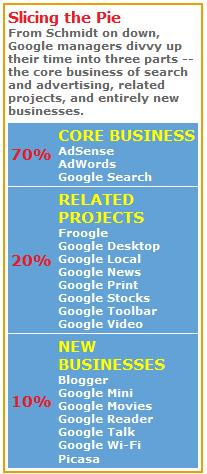
Business 2.0 posts an interview with Google CEO Eric Schmidt, on the formula he uses to stay on track while innovating:
"Spend 70 percent of your time on the core business, 20 percent on related projects, and 10 percent on unrelated new businesses."
BOTTOMLINE: How are you spending your time?
Introduction to the Six Disciplines Concept - Short Video
Ever wonder how a business idea gets started?
Take a look at this short video, as Gary Harpst, CEO and Founder of Six Disciplines Corporation, and author of Six Disciplines for Excellence, gives you the insight on how the concept of Six Disciplines was started.
Take a look at this short video, as Gary Harpst, CEO and Founder of Six Disciplines Corporation, and author of Six Disciplines for Excellence, gives you the insight on how the concept of Six Disciplines was started.
Six Disciplines Leadership Centers - Upcoming Webcasts
If you're a regular reader of Be Excellent™, you're aware that it takes four key elements for lasting business excellence:
- A Methodology - to make business-building systematic
- Technologies - to make the Methodology practical
- Local Coaching - to make the Methodology and Technologies work together
- Ready & Able Client - to make it all work, and to achieve business excellence that lasts
We deliver #3, Local Coaching, through a franchise business model called "Six Disciplines Leadership Centers."
We will be offering a series of FREE webcasts to discuss this business opportunity with passionate professionals. The webcasts will be conducted on:
- Friday Dec 2nd 12:00 – 1:00 EST
- Thursday Dec 8th 12:00 – 1:00 EST
- Thursday Dec 15th 12:00 – 1:00 EST
- Tuesday Dec 20th 12:00 – 1:00 EST
- Thursday Dec 29th 12:00 – 1:00 EST
To register and attend one of the Six Disciplines Leadership Center Franchise Opportunity webcasts, call Scott May at 419.581.2821 or email Scott.
A Refresh for Leaders
Lisa Haneberg is one of the the top professional management and leadership trainers, coaches, and organization development consultants in the country. She authors Management Craft.
Lisa is kind enough to share her process for establishing, fine tuning, and executing on goals in a free 19-page ebook called "New Year's Resolutions for Leaders."
Read about this ebook here and download her PDF.
Lisa is kind enough to share her process for establishing, fine tuning, and executing on goals in a free 19-page ebook called "New Year's Resolutions for Leaders."
Read about this ebook here and download her PDF.
Basketball and Lessons of Leadership

Basketball is an intricate, high-speed game filled with split-second, spontaneous decisions.
But that spontaneity is possible only when everyone first engages in hours of highly repetitive and structured practice and agrees to play a carefully defined role on the court.
Great basketball coaches, military commanders and business leaders know that practice of the rules of engagement coupled with split-second decisions in execution by their team can make the difference between winning and losing.
Great leaders know that if you can create the right framework (by everyone knowing the rules and practicing them), when it comes time to perform, your players will engage in fluid, effortless, spur-of-the-moment dialogue and action. The leader provides the overall guidance and intent to the team, coaches them in mastering tools and general techniques through practice and then allows them to use their own initiative and be innovative as they move forward.
BOTTOMLINE: Placing a lot of trust in your team members has an overwhelming advantage:
Allowing people to operate without having to explain themselves within the rules of engagement, focuses their energy and opens the possibility for extraordinary leaps of insight and instinct in decision-making. When the team is "in the flow," split-second decisions are unconscious flashes of insight that drive extraordinary performance on the basketball court, battlefield, professional service office or shop floor.
Orchestral Maneuvers and Leadership
Adrian Savage, over at Slow Leadership, has posted one of the best analogies, comparing leaders in two different arenas: business leaders and orchestra conductors.
The best quote that sums it up?
"One of the images I like best for Slow Leaders is the conductor of an orchestra. Not the leader. The leader of the orchestra isn't the conductor, it's the principal violin player. The conductor's there to set the right tempo and manage the interpretation of the piece the orchestra's playing. The conductor must also keep a close watch on the balance of sound between the various instruments..."
BOTTOMLINE: And so it is in business. The conductor (the business leader - the CEO, president, owner, founder ...or just leader) is there to set the right tempo, manage the interpretation of the mission, vision, values, strategic position of the organization, set goals that lead, and align the team members continually, as they play the company's "music" every day.
The best quote that sums it up?
"One of the images I like best for Slow Leaders is the conductor of an orchestra. Not the leader. The leader of the orchestra isn't the conductor, it's the principal violin player. The conductor's there to set the right tempo and manage the interpretation of the piece the orchestra's playing. The conductor must also keep a close watch on the balance of sound between the various instruments..."
BOTTOMLINE: And so it is in business. The conductor (the business leader - the CEO, president, owner, founder ...or just leader) is there to set the right tempo, manage the interpretation of the mission, vision, values, strategic position of the organization, set goals that lead, and align the team members continually, as they play the company's "music" every day.
Monday, November 28, 2005
Be Excellent™ Readers - Unite !
OK..here's the lastest "mashup" using Google Maps.
- Go here
- Click the "Add Yourself" link
- Supply your name, location, and your picture
- You'll be asked to sign up for Frappr! (it's free....)
- That's it!
BOTTOMLINE: You'll be able to see (and message with) other "like-minded" people who enjoy reading Be Excellent™.
(Thanks to Skip Angel and others for this fun one...)
Thursday, November 24, 2005
Be Excellent™ Included in Carnival of Lean Leadership #3
Good friend Kevin Meyer, over at Evolving Excellence, publishes his third Carnival of Lean Leadership, and includes (humbly) an entry from Be Excellent™.
Kevin does an amazing job scouring the blogosphere to bring you the best in lean manufacturing updates.....Check it out at Evolving Excellence.
Kevin does an amazing job scouring the blogosphere to bring you the best in lean manufacturing updates.....Check it out at Evolving Excellence.
Encouraging - An Essential of Leadership
In a 2003 book entitled: "Encouraging the Heart: A Leaders Guide to Rewarding and Encouraging Others," authors James M. Kouzes and Barry Z. Pozner say that the task of leaders is to continually, perpetually, encourage the hearts of the people they lead.
This story is a constant reminder to us of the power of a very simple principles of human performance: people like to be recognized for doing their best.
The seven essentials of encouraging:
(Thanks to Patsi at BizBook Nuggets for the tip!)
This story is a constant reminder to us of the power of a very simple principles of human performance: people like to be recognized for doing their best.
The seven essentials of encouraging:
- Set clear standards
- Expect the best
- Pay attention
- Personalize recognition
- Tell the story
- Celebrate together
- Set the example
BOTTOMLINE: Read the entire review and more detail about the book here.
(Thanks to Patsi at BizBook Nuggets for the tip!)
Tuesday, November 22, 2005
10 Most Influential Business Writers or Management Gurus of 2005
The Financial Times recently ranked the people who had the most influence in business theory and practice in the past year.
10 Most Influential Business Writers or Management Gurus of 2005
10 Most Influential Business Writers or Management Gurus of 2005
- Peter Drucker
- Bill Gates
- Jack Welsh
- Philip Kotler
- Michael Porter
- Jim Collins
- Richard Branson
- Warren Buffet
- Tom Peters
- Stephen Covey
Non-Traditional Measures of Performance
Fastcompany Magazine chronicles the recent activities of "Good To Great" author, Jim Collins, specifically dealing with non-traditional measures of performance.
The article, which originally appeared in yesterday's Wall Street Journal (subscription required), Collins has recently turned his attention to non-profit organizations, such as museums, orchestras and hospitals.
"A breakthrough came when he spoke to leaders of the Cleveland Orchestra, They weren't trying to increase earnings per share or return on equity; instead, they tracked standing ovations, invitations to perform in Europe, and the number of orchestras copying the Cleveland style."
BOTTOMLINE: What non-traditional metrics and measurements of performance might you apply to your work?
The article, which originally appeared in yesterday's Wall Street Journal (subscription required), Collins has recently turned his attention to non-profit organizations, such as museums, orchestras and hospitals.
"A breakthrough came when he spoke to leaders of the Cleveland Orchestra, They weren't trying to increase earnings per share or return on equity; instead, they tracked standing ovations, invitations to perform in Europe, and the number of orchestras copying the Cleveland style."
BOTTOMLINE: What non-traditional metrics and measurements of performance might you apply to your work?
Monday, November 21, 2005
Team Member Loyalty On The Rise
Employee loyalty is on the rise, according to a recent survey of U.S. workers by Walker Information.
Some key findings:
- 34% of workers committed to their company - that's up from 30% in a 2003 survey and only 24% in 2001
- only 55% of those surveyed said companies treat employees well
- only 41% felt their employer views staff as its most important asset
- Information technology saw the biggest jump, with 36% feeling truly loyal, up from only 19% in 2003
Words To Live By - for a Monday
George Ambler, over at posts this quote from Eknath Easwaran, "Words to Live By":
"We all need warm, deep, personal relationships to thrive, but modern life seems to place such a small value on them compared with the high value placed on money and prestige and pleasure. It is so easy to be distracted and to fritter our attention away in countless ways, until we find we have nothing left for family and friends. By simplifying our lives, dropping less important activities, we allow more time for what matters most. But it is also essential to slow down our pace of living, so that we can free ourselves from the grip of time-driven thinking and behavior."
BOTTOMLINE: Something we should all consider during this Thanksgiving week.
"We all need warm, deep, personal relationships to thrive, but modern life seems to place such a small value on them compared with the high value placed on money and prestige and pleasure. It is so easy to be distracted and to fritter our attention away in countless ways, until we find we have nothing left for family and friends. By simplifying our lives, dropping less important activities, we allow more time for what matters most. But it is also essential to slow down our pace of living, so that we can free ourselves from the grip of time-driven thinking and behavior."
BOTTOMLINE: Something we should all consider during this Thanksgiving week.
Sunday, November 20, 2005
More on Peter Drucker
Kate, over at 800-CEO-Read, posts "a few more links to various Drucker tributes and articles."
Some really great pieces here in tribute to the top management thought-leader of all time.
BOTTOMLINE: So many good ones here...spend some quality time reading - absorbing - doing.
Some really great pieces here in tribute to the top management thought-leader of all time.
BOTTOMLINE: So many good ones here...spend some quality time reading - absorbing - doing.
Friday, November 18, 2005
Pitching Your Business Plan To An Investor
Dave Cowen has an experienced entry on "How To NOT Write A Business Plan " where he states:
"Entrepreneurs often ask me for a sample business plan they can use as a model for their fundraising efforts. They are surprised when I send them a PowerPoint file. "
Dave's take?
Create a 10-slide Powerpoint:
"Entrepreneurs often ask me for a sample business plan they can use as a model for their fundraising efforts. They are surprised when I send them a PowerPoint file. "
Dave's take?
Create a 10-slide Powerpoint:
- Contact, logo, tagline
- Mission statement
- Introduce the team
- Nature of the problem
- Introduce your product/service - and its benefits
- Why your approach is unique
- Show off early wins (customers, distribution, accolades)
- Sales strategy (how you will get customers/clients)
- Competitive landscape
- Current financial situation
BOTTOMLINE: Read this entire discussion, specifically if you want to pitch a new business idea to an investor (of any type.)
(Thanks to bBlog for the tip!)
Thursday, November 17, 2005
Kaufmann eVenturing for Entrepreneurs
Brad Feld, one of the top VC/industry pundits at Feld Thoughts, offers this tip on the newly relaunched Kauffman eVenturing web site and blog.
Kauffman eVenturing is ready for its public coming out party! The site is designed for busy entrepreneurs, and is well on its way to being packed with relevant, practical and timely information on how to manage and expand your business.
The Kauffman Foundation has always been a huge resource to the entrepreneurial community.
(Thanks to Brad for the tip!)
Kauffman eVenturing is ready for its public coming out party! The site is designed for busy entrepreneurs, and is well on its way to being packed with relevant, practical and timely information on how to manage and expand your business.
The Kauffman Foundation has always been a huge resource to the entrepreneurial community.
(Thanks to Brad for the tip!)
Six Disciplines Business System: An Introduction
OK, by now, perhaps you've read the book "Six Disciplines for Excellence."
Perhaps most intriguing to most readers, the book is just the tip of the Six Disciplines "iceberg."
Where most business improvement authors drop the ball is writing a decent book -- and stopping there -- leaving it up to its readers to implement the ideas and hope for the best.
That's where Six Disciplines is unique.
Behind the book is Six Disciplines Corporation, supported by more than $10 million dollars of funding and 50 man-years of R&D, developing practical Internet-based technologies that make the Six Disciplines™ Methodology practical.
Want to see an introduction to the Six Disciplines Business System?
Go to www.SixDisciplines.com
Login with
Username: Be Excellent (with a space - case sensitive)
Password: BeExcellent (no space - case sensitive)
Under My Account, select "My Courses" , and select one of the Introduction Courses listed. Then select "Launch Course."
HINT: Check out the Business System Introduction first, then perhaps the Methdology Introduction.
Perhaps most intriguing to most readers, the book is just the tip of the Six Disciplines "iceberg."
Where most business improvement authors drop the ball is writing a decent book -- and stopping there -- leaving it up to its readers to implement the ideas and hope for the best.
That's where Six Disciplines is unique.
Behind the book is Six Disciplines Corporation, supported by more than $10 million dollars of funding and 50 man-years of R&D, developing practical Internet-based technologies that make the Six Disciplines™ Methodology practical.
Want to see an introduction to the Six Disciplines Business System?
Go to www.SixDisciplines.com
Login with
Username: Be Excellent (with a space - case sensitive)
Password: BeExcellent (no space - case sensitive)
Under My Account, select "My Courses" , and select one of the Introduction Courses listed. Then select "Launch Course."
HINT: Check out the Business System Introduction first, then perhaps the Methdology Introduction.
Servant Leadership: Leadership With A Lasting Difference
A lot is being written now about Servant Leadership.
The Servant Leadership approach described by leading authority Robert K. Greenleaf, can be described like this:
"The servant-leader is servant first. It begins with the natural feeling that one wants to serve. The conscious choice begins one to aspire to lead."
The best test of Servant Leadership?
"Do those served grow as persons; do they, while being served, become healthier, wiser, freer, more autonomous, more likely themselves -- to become servants?”
One of the best sites to learn more is to read Trevor Hall's Servant-Leadership.
The Servant Leadership approach described by leading authority Robert K. Greenleaf, can be described like this:
"The servant-leader is servant first. It begins with the natural feeling that one wants to serve. The conscious choice begins one to aspire to lead."
The best test of Servant Leadership?
"Do those served grow as persons; do they, while being served, become healthier, wiser, freer, more autonomous, more likely themselves -- to become servants?”
One of the best sites to learn more is to read Trevor Hall's Servant-Leadership.
Good News For The "Aging" Workforce
Management-Issues reports on a new Hudson research report:
- 4 out of 10 U.S. workers say their organizations want to hold onto older workers because they are difficult to replace
- More than twice as many businesses encourage older workers to stay on the job than to retire early
- Only 1 in 10 organizations are promoting retirement for older workers
What's behind it all?
- More than a third told the Hudson survey that their firms offer formal mentoring programs to pair a younger worker with an older one for guidance and training. That number rises to half of companies with 250-500 employees.
BOTTOMLINE: "Organizations that go beyond accommodation to active engagement of older workers stand to benefit from a loyal, hardworking labor force that offers tremendous experience and institutional knowledge."
Business Opportunities Weblog Showcases Six Disciplines Podcast
Dane, over at Business Opportunities Weblog, showcases "Six Disciplines’ CEO on Small Business Trends Radio."
For those of you not familiar with Dane, he moderates/authors the top blog for business opportunities and entrepreneurs looking to improve their own businesses.
Speaking of Six Disciplines...and business opportunities...if you're a like-minded professional, feel free to check out the Six Disciplines Leadership Center opportunities here.
For those of you not familiar with Dane, he moderates/authors the top blog for business opportunities and entrepreneurs looking to improve their own businesses.
Speaking of Six Disciplines...and business opportunities...if you're a like-minded professional, feel free to check out the Six Disciplines Leadership Center opportunities here.
Wednesday, November 16, 2005
Business Pundit Showcases Six Disciplines Podcast
Rob, over at Business Pundit, showcases the podcast with Gary Harpst, CEO and Founder of Six Disciplines Corporation.
Rob's take?
"Small business owners should definitely check this out."
Rob's take?
"Small business owners should definitely check this out."
Tuesday, November 15, 2005
Business & Technology Reinvention Showcases Gary Harpst Podcast
David Daniels, our friend over at Business & Technology Reinvention, links to the podcast of Six Disciplines Corporation CEO and Founder Gary Harpst, as he was interviewed by Anita Campbell on the topic of "Why Most Businesses Lose Their Edge".
David also is close to finishing the book "Six Disciplines for Excellence" - authored by Gary Harpst.
His assessment so far:
"I'm almost finished reading it. The book is high value and I recommend it for all business people."
Looking forward to David's perspective on the book - and on Six Disciplines - coming soon.
David also is close to finishing the book "Six Disciplines for Excellence" - authored by Gary Harpst.
His assessment so far:
"I'm almost finished reading it. The book is high value and I recommend it for all business people."
Looking forward to David's perspective on the book - and on Six Disciplines - coming soon.
Six Disciplines' CEO on Small Business Trends Radio

Gary Harpst, Founder and CEO of Six Disciplines Corporation, was interviewed today by Anita Campbell, host of Small Business Trends Radio, as heard on VoiceAmerica Internet Radio.
Harpst, himself a successful entrepreneur (having been CEO and founder of Solomon Software,)discusses what small businesses need to do to build organizations that learn, lead and last., and why most businesses eventually lose their edge.
Go here to listen to the entire 60 minute podcast. (HINT: double click on the Windows Media Format, Real Format, or MP3 format)
(We will be segmenting the show into smaller chunks in the near future....)
How Can Start-Up Ventures Grow?
For new start-up ventures, a lack of resources makes growth difficult to come by—just ask those 9 our of 10 fledgling firms that fail.
Harvard Business School Professor Mukti Khaire says from her research the key may be in acquiring intangible resources such as legitimacy, status, and reputation.
So how do those 1 our of 10 firms grow into successful, sustained enterprises? Some of her key findings:
Harvard Business School Professor Mukti Khaire says from her research the key may be in acquiring intangible resources such as legitimacy, status, and reputation.
So how do those 1 our of 10 firms grow into successful, sustained enterprises? Some of her key findings:
- Only one out of every ten newly founded firms in the United States grows to a size of more than ten employees (Aldrich, 1999).
- One revelation was the strong positive effect that mimicking older organizations had on new venture growth. Mimicry is important - for new firms in established industries, there is value to doing some non-technical, symbolic things in the manner that is widely accepted, and to adhering to industry norms and culture.
- Entrepreneurs and managers should almost never shy away from stepping out of their comfort zone and taking on large jobs, since the payoff does arrive.
Trend Toward Software As Services For Small Business
Anita Campbell, over at Small Business Trends, hones in on the buzz about the "Trend Toward Software As Services For Small Business" which has received enormous play now that Microsoft has begun to legitimize it.
Anita offers two assertions that may be appropriate for readers of Be Excellent™:
Anita offers two assertions that may be appropriate for readers of Be Excellent™:
- If you are a small technology company, it (software as service) has the power to make your products cheaper to build, sell and deliver. You will need much less cash investment in such a business.
- If you are a small business that is a user of technology, your choices of affordable, easy-to-implement services are going to become much bigger. You will have access to ever more powerful software, without the need for involving your already-stretched — or non-existent — information technology staff.
Monday, November 14, 2005
Harpst To Be Guest on Small Business Trends Radio
Gary Harpst, CEO and Founder of Six Disciplines Corporation, will be the next guest on Anita Campbell's Small Business Trends Radio Program, broadcast by VoiceAmerica Internet Radio.
Gary's topic?
"Why Most Businesses Eventually Lose Their Edge"
The show will be aired on Tuesday November 15 from 1:00 - 2:00 Eastern time, and will be rebroadcast as an MP3 podcast 24 hours later.
To tune in, go to Business.VoiceAmerica.com
Here's the e-card showing all the details.
Gary's topic?
"Why Most Businesses Eventually Lose Their Edge"
The show will be aired on Tuesday November 15 from 1:00 - 2:00 Eastern time, and will be rebroadcast as an MP3 podcast 24 hours later.
To tune in, go to Business.VoiceAmerica.com
Here's the e-card showing all the details.
Be Excellent™ Mentioned in Carnival of Computing
David Daniels (fellow alum of Microsoft), was kind enough to mention a Be Excellent™ entry in his Carnival of Computing, along with a good number of entries, over at his Business & Technology Reinvention blog.
Check out the 5th installment of the Carnival of Computing here!
Check out the 5th installment of the Carnival of Computing here!
Friday, November 11, 2005
Drucker: One For The Ages
Peter Drucker, the organization consultant whose clear thinking and engaging analysis made him the leading management guru to many of the world's biggest companies, has died. He was 95.
In 1954, Peter Drucker said that the purpose of a business is to create a customer. It was true then and it's true now.
Throughout his career, Drucker made a point of working with charities and non-profit institutions, such as the Girl Scouts of America, hospitals, churches and universities, because he believed that good management is vital to all aspects of life. The Wall Street Journal reported that by 1987, Drucker was devoting half of his consulting hours without charge.
(Thank you Mr. Druck, you are an inspiration to more people....than you'll ever know.)
In 1954, Peter Drucker said that the purpose of a business is to create a customer. It was true then and it's true now.
Throughout his career, Drucker made a point of working with charities and non-profit institutions, such as the Girl Scouts of America, hospitals, churches and universities, because he believed that good management is vital to all aspects of life. The Wall Street Journal reported that by 1987, Drucker was devoting half of his consulting hours without charge.
(Thank you Mr. Druck, you are an inspiration to more people....than you'll ever know.)
Passion for Small Business
The 2005 Sage Software Business Minds Survey found that North American businesses are optimistic, carry a passion for the entrepreneurial life, and manage with a fluid nature befitting the fast pace necessary for growth.
Fully 68% of respondents have employees who work from home at least some of the time. They are "bootstrappers," the majority having self-financed the business. And they rely heavily on their accountants for advice on business issues.
Find out what small business owners, CEOs and presidents are thinking - view the key findings here.
Fully 68% of respondents have employees who work from home at least some of the time. They are "bootstrappers," the majority having self-financed the business. And they rely heavily on their accountants for advice on business issues.
Find out what small business owners, CEOs and presidents are thinking - view the key findings here.
The Importance of Reading - Continual Learning
Wilson Ng, the prolific moderator at Reflections of a BizDriven Life, offers his well-heeded advice to everyone about the power of reading.
In his recent entry, Your Most Important Job, he articulates why it is so important to establish an environment conducive to reading - for yourself, with your children, even with your team members.
BOTTOMLINE: An excellent piece on the fundamentals and importance of reading and continual learning - and how it can easily be translated into the foundation for organizational learning.
In his recent entry, Your Most Important Job, he articulates why it is so important to establish an environment conducive to reading - for yourself, with your children, even with your team members.
BOTTOMLINE: An excellent piece on the fundamentals and importance of reading and continual learning - and how it can easily be translated into the foundation for organizational learning.
Speak Softly - And The Power of Humility
If you're not familiar with ChangeThis, you need to be.
In particular, take a look at the new manifesto from Ira Williams, called "Speak Softly"
Go there now...take 10 minutes to read and reflect on the entire piece.
Enough said.
In particular, take a look at the new manifesto from Ira Williams, called "Speak Softly"
Go there now...take 10 minutes to read and reflect on the entire piece.
Enough said.
Be Excellent™ Mentioned in Carnival of Lean Leadership
If you and your organization are into lean manufacturing - run, don't walk - over to Evolving Excellence.
Kevin Meyer, the author/moderator, is one of the sharpest resources out there on "all things lean."
In the relatively new blogging tradition of Carnivals (definition: collections of best-practices blog entries on a particular topic of interest), Kevin posts his Carnival of Lean Leadership #2 here.
Kevin was even so kind as to reference Be Excellent™ in his review!
Kevin Meyer, the author/moderator, is one of the sharpest resources out there on "all things lean."
In the relatively new blogging tradition of Carnivals (definition: collections of best-practices blog entries on a particular topic of interest), Kevin posts his Carnival of Lean Leadership #2 here.
Kevin was even so kind as to reference Be Excellent™ in his review!
Is Mentoring Worthwhile?
The NFIB just posted this thought-provoking article on mentoring.
Their definition of mentoring?
Their definition of mentoring?
- Mentoring happens when a more experienced individual guides and nurtures a less experienced employee.
- Usually, the mentor is older and has more experience with the company as well as in the job field.
- Mentoring allows the older generation to guide the upcoming one through role modeling, counseling, instructing and working to advance younger employees’ skills and capabilities.
- A mentor must be a patient and friendly person with strong interpersonal skills and effective listening ability and, of course, sufficient organizational and operational knowledge.
- The mentor must demonstrate concern for the development of others and be credible within the company.
Qualities of a good mentee (or protoge'):
- The mentored employee most successful would be ambitious, enthusiastic, open to feedback and coaching, proactive, willing to learn and willing to assume responsibility for his or her growth.
The value of mentoring?
- Mentoring can thoroughly communicate a company’s culture, values and traditions much more rapidly and completely. Mentoring can serve as an economical development tool in your succession planning process. Proper mentoring can even increase your chances of retaining its more promising performers.
BOTTOMLINE: Use a formalized mentoring program within your organization. Have it be an integral part of your people-performance management process. Mentoring is a cross-culture, cross-age, cross-functional process for continual organizational learning and improvement.
Microsoft Live, Strategic Planning and Alignment
For those of us who cover Microsoft news, their most recent unveiling of Microsoft Windows Live and Office Live reveals not only new direction, new opportunities, and new markets for the software giant, it also reveals lessons in strategic planning and alignment.
When top execs at Microsoft craft key memos, things happen. Before the Microsoft "Live" announcement, Gates published in December of 1995 his now famous "Internet Tidal Wave" memo to the company, which ultimately (in fairly quick order....) described how the internet was going to forever change the landscape of computing, and ultimately changed the strategic direction of the organization.
With the Microsoft Live announcement, two key executive memos were made public on November 1 that give you insight into the strategic planning and alignment thinking within Microsoft.
First, is the Gates memo, where he informs Microsoft execs and team members that "the next sea change is upon us." In the memo he describes the need to shift to software as services model, the opportunities and implications of doing so - and, ramifications of NOT doing so.
Second, and perhaps even more insightful, is the Ray Ozzie memo. (For those of you not tracking Microsoft, Ozzie was the creator of Lotus Notes, now working as Chief Technology Advisor to Gates). Ozzie's assertions provide complementary content and depth to Gates' memo, and offers additional strategic implications of the need for change.
BOTTOMLINE: Late to the party as some analysts say? Perhaps. Better late than not changing direction. While your business may (or may not) become the next Microsoft, there are key strategic planning and alignment lessons to be learned from these memos. Read them - and read between the lines, as you put yourself and your business, in the same relative position. What is happening in your business? What shifts in competitive landscapes are occuring? What does your business need to do -- to be an organization that can Learn, Lead....and Last?
When top execs at Microsoft craft key memos, things happen. Before the Microsoft "Live" announcement, Gates published in December of 1995 his now famous "Internet Tidal Wave" memo to the company, which ultimately (in fairly quick order....) described how the internet was going to forever change the landscape of computing, and ultimately changed the strategic direction of the organization.
With the Microsoft Live announcement, two key executive memos were made public on November 1 that give you insight into the strategic planning and alignment thinking within Microsoft.
First, is the Gates memo, where he informs Microsoft execs and team members that "the next sea change is upon us." In the memo he describes the need to shift to software as services model, the opportunities and implications of doing so - and, ramifications of NOT doing so.
Second, and perhaps even more insightful, is the Ray Ozzie memo. (For those of you not tracking Microsoft, Ozzie was the creator of Lotus Notes, now working as Chief Technology Advisor to Gates). Ozzie's assertions provide complementary content and depth to Gates' memo, and offers additional strategic implications of the need for change.
BOTTOMLINE: Late to the party as some analysts say? Perhaps. Better late than not changing direction. While your business may (or may not) become the next Microsoft, there are key strategic planning and alignment lessons to be learned from these memos. Read them - and read between the lines, as you put yourself and your business, in the same relative position. What is happening in your business? What shifts in competitive landscapes are occuring? What does your business need to do -- to be an organization that can Learn, Lead....and Last?
Thursday, November 10, 2005
Entrepreneur Guidebook for Tech Startups
Joseph G. Hadzima, a senior lecturer at the MIT Sloan School of Management, offers a collection of articles he’s written for entrepreneurs on his website.
He also includes a link to an 89-page Guidebook for Technology Entrepreneurs along with some spreadsheet templates, all from PricewaterhouseCoopers.
BOTTOMLINE: It's not just about writing the perfect business plan, then pursuing VC funding until you get a boatload of money. Use the tools and experience from professionals who have been there-done that. Don't go it alone.
(Tip of the hat to Anthony Cerminaro)
Change Management - and Embracing Change
Skip Angel, over at Random Thoughts of a CTO, post this thought-provoking entry on "Embracing Change."
His assertions?
His assertions?
- You can't be a leader if you are unwilling to embrace change.
- To be a successful leader, you must be proactive and make changes now that will avoid the "break" in the future to be much more significant.
- Ease the change carefully and communicate constantly (including listening) to make sure that people can see the value and need for change but also to reduce conflicts and risks through the process.
Change presents itself in a variety of ways:
- People change (or leave), with them you lose skills and particularly knowledge that will need to be transferred to others. Sometimes that it is easy, sometimes it requires reorganization.
- Technologies change. Products can become discontinued, or support become limited because the company has moved to newer technologies. Therefore, the tools you use in your work would need to change.
- Markets and customers change. Whole new markets or different "players" because of mergers and acquistions. Therefore, you might see changes in your products and services that you didn't anticipate.
BOTTOMLINE: Skip's assertion: "Sticking with the status quo with all of these kinds of changes could not only stop working but could get you quickly off-course. Therefore, if you want things to keep flowing, you got to be one step ahead on where the flow is taking you and make course corrections as needed. Those that can successfully do that, without major impact to the organization, are considered great leaders."
Baby-Boomer Transitions: Part II
This just in from the recent Newsweek cover story on Boomers.
According to the Merrill Lynch New Retirement Survey, 81% of boomers expect to keep working past 65, but their professional goals will shift.
Says Ken Dychtwald, president of Age Wave:
"You have corporate CEOs who want to be schoolteachers, and marketing managers who'd really rather run a coffee shop, bookkeepers who want to join the Peace Corps. They'll work fewer hours or only eight months a year, and they won't be as concerned about having the biggest office or the most lucrative job. It will be more important to do something they enjoy."
BOTTOMLINE:
(Thanks to Evelyn at Worthwhile Magazine for the tip)
According to the Merrill Lynch New Retirement Survey, 81% of boomers expect to keep working past 65, but their professional goals will shift.
Says Ken Dychtwald, president of Age Wave:
"You have corporate CEOs who want to be schoolteachers, and marketing managers who'd really rather run a coffee shop, bookkeepers who want to join the Peace Corps. They'll work fewer hours or only eight months a year, and they won't be as concerned about having the biggest office or the most lucrative job. It will be more important to do something they enjoy."
BOTTOMLINE:
(Thanks to Evelyn at Worthwhile Magazine for the tip)
Monday, November 07, 2005
Seven Steps to Career Growth and Excellence
Anthony Cerminaro, strategic business and technology attorney who authors BizzBangBuzz (and a fellow native from Pittsburgh!) offers this entry on Seven Steps to Career Growth and Excellence.
1. Make a Commitment to Excellence...
2. Empower Yourself and Others by Continuing to Learn...
3. Multiply Your Efforts through Networking...
4. Communicate Powerfully...
5. Lead with Empathy...
6. Maintain Physical, Mental, and Spiritual Fitness...
7. Serve with Love, Faith, and Gratitude...
The entire article that Anthony references is located here.
1. Make a Commitment to Excellence...
2. Empower Yourself and Others by Continuing to Learn...
3. Multiply Your Efforts through Networking...
4. Communicate Powerfully...
5. Lead with Empathy...
6. Maintain Physical, Mental, and Spiritual Fitness...
7. Serve with Love, Faith, and Gratitude...
The entire article that Anthony references is located here.
Goal Setting And Extending SMART to SMARTER
Good friend Phil Gerbyshak over at MakeItGreat.Org offers a good extension to the the SMART principle of goal setting, making it even ....SMARTER.
Remember that SMART in goal setting means that all goals must be:
Remember that SMART in goal setting means that all goals must be:
- Specific
- Measurable
- Accountable
- Realistic
- Target
- Goals should be Exciting. Exciting goals will be met far sooner than boring, bland goals.
- Goals should be Recorded, in a place where you can look at it every day
Tip of the hat to Phil for this one!
Managing For The Upside
Accenture offers this free 38 page PDF through BetterManagement.com that discusses anorganization’s ability to learn, grow and refresh itself -- is critical to high performance.
Offered in the article are five contrarian principles for making it happen:
1. Reach beyond your grasp
2. Blaze your own trail
3. Create a strong emotional field
4. Spiral up
5. Use luck as an accelerator
Good reading here!
Offered in the article are five contrarian principles for making it happen:
1. Reach beyond your grasp
2. Blaze your own trail
3. Create a strong emotional field
4. Spiral up
5. Use luck as an accelerator
Good reading here!
Management Tools and Trends
Bain & Company is a global business management consulting firm, founded in 1973 on the principle that consultants should deliver results - not just reports - to their clients.
Since 1973, their 2,200 management consultants have worked for over 2,700 clients in virtually every industry, in 31 offices in 19 countries.
My point in all of this?
Take advantage of their global insights at Bain & Company's 2005 Management Tools & Trends
Bain's survey finds that the influence of technology on management tools choices is taking hold.
Check it out!
Since 1973, their 2,200 management consultants have worked for over 2,700 clients in virtually every industry, in 31 offices in 19 countries.
My point in all of this?
Take advantage of their global insights at Bain & Company's 2005 Management Tools & Trends
Bain's survey finds that the influence of technology on management tools choices is taking hold.
Check it out!
A Vision of Leadership
Interesting visual "eye-candy" here using an interactive graphic model that reconciles the leadership values of:
- Lead and follow
- Implement and innovate
The model also explores Leadership Practices and Outcomes
Good stuff here from Strategies for Leadership.Good To Great for Social Sectors
Todd over at 800-CEO-READ broke the news that management author Jim Collins is releasing a 42 page monograph titled Good To Great and Social Sectors.
This short piece is written to address questions that social sector organizations have asked since the GTG was released.
The monograph will start shipping November 15th. You can place your preorders now.
Read all about the details here.
(Thank to Todd for the tip!)
This short piece is written to address questions that social sector organizations have asked since the GTG was released.
The monograph will start shipping November 15th. You can place your preorders now.
Read all about the details here.
(Thank to Todd for the tip!)
Friday, November 04, 2005
Natural Advantages of Small Businesses
John Jantsch, over at the very useful "Duct Tape Marketing" site, offers his talking points for an upcoming presentation, titled the "10 Natural Marketing Advantages of Small Business. "
In it, he looks at leveraging the natural (competitive) advantages of small businesses.
In it, he looks at leveraging the natural (competitive) advantages of small businesses.
- Focus
- Reach
- Nurture
- Surprise
- Transform
- Partner
- Automate
- Educate
- Meaning
- Play
BOTTOMLINE: Acting like a small business, it seams, is the latest killer innovation. Think small.
A Season of Inspiration: Part II

Taking time once again...to make the connection between inspiration and excellence.
Take some time today..
...to be inspired...
...to take a fresh new approach
...to appreciate such natural brilliance and excellence
...to be in awe of it all
Perserverance and Persistance
In her entry called "True Grit," Lisa Haneberg over at Management Craft talks about an article in the December issue of Psychology Today, called "The Winning Edge."
The essence:
Grit. Good stuff. The article is available online, and definitely worth reading.
(Tip of the hat to Lisa!)
The essence:
- Perserverance and persistance - or grit, makes a significant difference in achievement.
- Grit can be developed
Ways to nurture grit include:
- Helping people find their passion
- Providing criticism lessons
- Be a model of gritiness
- Offer challenges
- Teach people to handle and learn from failure
- Don't worry about balance
Grit. Good stuff. The article is available online, and definitely worth reading.
(Tip of the hat to Lisa!)
Thursday, November 03, 2005
It All Starts With Passion
Our good friend Skip, over at Random Thoughts of a CTO, posts a great entry on a topic very near and dear to my professional and personal heart: passion.
Skip's main observation?
"Intensity, cause, implusion, quality of mind, purpose, and having a fixed resolution -- yep, that sounds like me and those kind of people who I most like to work with. It also sounds like the scenario for the perfect company that I would like to be a part of."
BOTTOMLINE: "It starts with you. Where is your passion? Can you use your passion in your current role within your current organization. If not, look for other places where you can. If there still is a potential fit with the organization, start getting others involved and triggering their passion. Sometimes passion has always been there, but never triggered. Other times, passion was there but need to be re-ignited. Find it! Use It! Help others do the same!"
Here! Here!
Skip's main observation?
"Intensity, cause, implusion, quality of mind, purpose, and having a fixed resolution -- yep, that sounds like me and those kind of people who I most like to work with. It also sounds like the scenario for the perfect company that I would like to be a part of."
BOTTOMLINE: "It starts with you. Where is your passion? Can you use your passion in your current role within your current organization. If not, look for other places where you can. If there still is a potential fit with the organization, start getting others involved and triggering their passion. Sometimes passion has always been there, but never triggered. Other times, passion was there but need to be re-ignited. Find it! Use It! Help others do the same!"
Here! Here!
Wednesday, November 02, 2005
Integrated Learning - And Knowledge Management
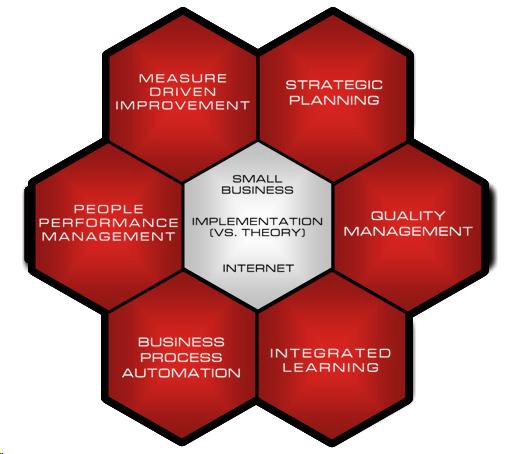
If you've been following "the overarching thread"...
... you've learned that the Six Disciplines Methodology of business-building is an integration of best practices of the following business tenets:
- Strategic Planning
- Quality Management
- Integrated Learning
- Business Process Automation
- People Performance Management
- Measure-Driven Improvement
Their assessment?
- It's all about learning - KM, information management, elearning, performance support, content management, etc.
- KM is not a thing to itself. It's a tool for organizational learning (and, as a by product, organizational effectiveness or capacity to achieve intended goals/strategies).
- Those who over-hyped KM (and made a valuable concept largely meaningless) fail to understand that KM was never about managing knowledge.
- It was, and still is, about achieving other goals. It's a means.
High-Performance Businesses: Timing is Everything
In an article entitled "The Right Place, The Right Time", the Accenture authors look into the key elements of high-performance business leaders and their timing.
High-performance businesses have remarkable clarity when it comes to setting strategic direction, especially regarding big decisions. They always seem to be in the right place at the right time.
High-performance businesses have remarkable clarity when it comes to setting strategic direction, especially regarding big decisions. They always seem to be in the right place at the right time.
- When one market matures, they’re ready with the next big thing;
- When buying trends send customers in a different direction, they’re waiting at the end of the path
- When they acquire new businesses, they do so wisely and tend to them well
High performers excel when it comes to their market focus and position—the “where and how to compete” aspects of business strategy and one of the three building blocks of high performance:
- How to manage for today and tomorrow
- How to best “parent” the businesses they operate
- How to compete through organization design
BOTTOMLINE: The ability of high-performance businesses to ride their decision making to better market focus and position does not mean they are infallible. High performers maintain their focus on consistently making good strategic component decisions. Above all, constancy (persistence) and diligence set high performers apart.
Read the entire Accenture article here.
Business Process Terms and Organizational Learning
For many organizations, the road to lasting business excellence means learning new things, new habits, new processes.
One aspect of that learning comes from within. It's often a matter of simply understanding new terms (definitions) of common business processes.
Perhaps you've heard of a term or business process, but weren't quite sure of its definition? The key to understanding is clarity.
Here's a great resources that you can use: The Dictionary of Small Business
BOTTOMLINE: Link to it, use it often, make sure all your Team Members know where it is - its all part of building a learning organization.
(Thanks to Steve over at Small Business CEO for the tip)
One aspect of that learning comes from within. It's often a matter of simply understanding new terms (definitions) of common business processes.
Perhaps you've heard of a term or business process, but weren't quite sure of its definition? The key to understanding is clarity.
Here's a great resources that you can use: The Dictionary of Small Business
BOTTOMLINE: Link to it, use it often, make sure all your Team Members know where it is - its all part of building a learning organization.
(Thanks to Steve over at Small Business CEO for the tip)
Process is Vital To Lasting Excellence
Our friend Gary, over at High Performance Business, offers his advice here in "You Need A System for Your Business" -talking about the virtues of having a "system" for your business.
In today's world of "strategic-initiative-of-the-day" and other equally insane knee-jerk reactions, having a system is the major difference between high-performing organizations, and ones that will never get there.
The key points of having a system are essentially a systematic way of thinking about and executing on your strategy. Gary's observation that "your system should be documented in an Operations Manual" -- is spot on.
Only by developing clear, concise business processes will you be able to document how your business works. Think of franchises: how is it that McDonald's is consistent, predictable, systematic - at every location? They've documented their processes. So that everyone in the organization know what, how and why they need to do their activities -- in order to be successful.
BOTTOMLINE: An operations manual has many benefits - execution, consistency, repeatability. The Six Disciplines Business System takes the use of creating and documenting your business processes in an "Operations Manual" to the next level. All of your business processes - from simple ones like ordering new phones or business cards for new Team Members -- to complex ones like setting up new project initiatives -- can be set up in the business system. All online (no paper here!) - exposed to everyone within the organization, searchable by any keyword in the process, with embedded links to actual business processes and on-line learning.
In today's world of "strategic-initiative-of-the-day" and other equally insane knee-jerk reactions, having a system is the major difference between high-performing organizations, and ones that will never get there.
The key points of having a system are essentially a systematic way of thinking about and executing on your strategy. Gary's observation that "your system should be documented in an Operations Manual" -- is spot on.
Only by developing clear, concise business processes will you be able to document how your business works. Think of franchises: how is it that McDonald's is consistent, predictable, systematic - at every location? They've documented their processes. So that everyone in the organization know what, how and why they need to do their activities -- in order to be successful.
BOTTOMLINE: An operations manual has many benefits - execution, consistency, repeatability. The Six Disciplines Business System takes the use of creating and documenting your business processes in an "Operations Manual" to the next level. All of your business processes - from simple ones like ordering new phones or business cards for new Team Members -- to complex ones like setting up new project initiatives -- can be set up in the business system. All online (no paper here!) - exposed to everyone within the organization, searchable by any keyword in the process, with embedded links to actual business processes and on-line learning.
Subscribe to:
Posts (Atom)