Forbes Magazine recently published their 200 Best Small Companies list.
As is typical for Forbes, their definition of "small" is more like "Wall Street small" - from $21 million up to $745 million in annual revenue.
According to Forbes, "If you're looking for a list of the hottest sensations of the moment--you've come to the wrong place. Our list of the 200 Best Small Companies doesn't do flashes in the pan. It does, however, feature solid and consistent hitters that have performed well when measured over the last 12 months and the past five years, and are poised for another growth spurt."
BOTTOMLINE: Want to be considered a "best" company - the keys: being a solid, consisten hitter that has performed well over several years. That is also part of the definition we use at Six Disciplines for a "top-performing" organization. It's all part of achieving lasting excellence.
Sunday, October 23, 2005
Business Performance Management (BPM)
Business performance management (BPM) is a set of processes that help organizations optimize business performance.
BPM is seen as the next generation of business intelligence (BI). BPM is focused on business processes such as planning and forecasting. It helps businesses discover efficient use of their business units, financial, human, and material resources.
BPM involves consolidation of data from various sources, querying, and analysis of the data, and putting the results into practice. BPM enhances processes by creating better feedback loops. Continuous and real-time reviews help to identify and eliminate problems before they grow.
BPM provides key performance indicators (KPI) that help companies monitor efficiency of projects and employees against operational targets.
BPM integrates the company's processes with CRM or ERP. Companies become able to gauge customer satisfaction, control customer trends and influence shareholder value.
BOTTOMLINE: Interesting to note throughout this definition that, while not explicit, BPM does not seem to address the most critcal element of performance management - execution.
Friday, October 21, 2005
Honesty and And Your Boss
OK....a bit of levity for a Friday..
Everyone know that honesty is a hallmark of a good manager, a good boss.
Here we have an interview with a very, honest boss.....well, enjoy...!
Everyone know that honesty is a hallmark of a good manager, a good boss.
Here we have an interview with a very, honest boss.....well, enjoy...!
Leadership and the 3 P's
Leadership must combine Passion with Patience and Professionalism.
Leading a company must be more than a hobby, and certainly more than fun. Leaders must demonstrate realism, maturity, knowledge, and a little wisdom.
"A distinguishing mark of a ripe human being is his sobriety," the sixth-century monk St. Benedict pointed out. He went on: 'Sober is the one who sees things as they really are, not as he would like them to be.' We can only hope that sobriety is now molding the thinking of future managers.'
BOTTOMLINE: In these times of consolidation, inflation, and scarce funds, nobody should underestimate the importance of combining passion with patience and professionalism."
Leading a company must be more than a hobby, and certainly more than fun. Leaders must demonstrate realism, maturity, knowledge, and a little wisdom.
"A distinguishing mark of a ripe human being is his sobriety," the sixth-century monk St. Benedict pointed out. He went on: 'Sober is the one who sees things as they really are, not as he would like them to be.' We can only hope that sobriety is now molding the thinking of future managers.'
BOTTOMLINE: In these times of consolidation, inflation, and scarce funds, nobody should underestimate the importance of combining passion with patience and professionalism."
Adventures in Entrepreneurship
Anita, over at Small Business Trends, has been blogging about the American Express-sponsored event in Florida on Entrepreneurship.
Anita and Rob May (Business Pundit) had the opportunity to interview entrepreneur and billionaire Sir Richard Branson, (famed CEO of Virgin Atlantic):
Here's a few of his comments/recommendations to entrepreneurs:
Anita and Rob May (Business Pundit) had the opportunity to interview entrepreneur and billionaire Sir Richard Branson, (famed CEO of Virgin Atlantic):
Here's a few of his comments/recommendations to entrepreneurs:
- On Branson's style of management: "I make sure that I spend most of my time out and about and experiencing my businesses...."
- On competition and striving to be the best: "Anyway, there were 12 other airlines and they were all much, much bigger than Virgin Atlantic and we were not out to topple them, we were out to survive. They toppled themselves and every single one of them disappeared. And I think the -- the thing to learn from that is the best -- you know, the best never -- never -- never disappear."
- Branson's views about the Internet: "I think if companies are not embracing it they're making a big mistake."
- On the advantages of choosing entrepreneurship very very young: "One of the advantages of leaving school at 15 or 16 is you don't have a steady relationship. You don't have a mortgage to pay. You've got nothing to lose."
Thursday, October 20, 2005
Seven Purpose Questions
An important element of personal excellence is understanding your purpose.
John Stanko offers these seven questions to help you identify your purpose:
John Stanko offers these seven questions to help you identify your purpose:
- What do you do that brings you the greatest joy?
- What are your gifts and talents?
- What gives you joy and excites your will?
- What would you do with your life if you had all the money you needed?
- What do you do that causes you to forget what time it is and to not notice that you're hungry?
- What compliments have you heard regularly that surprise you?
- What is your life-defining passage of Scripture or wisdom literature?
BOTTOMLINE: "Quality questions lead to a quality life." Take these quality purpose questions and use them to develop and clarify a quality sense of purpose. Then go out, armed with your purpose, to make an impact on your world.
Annual Planning Process - Training Seminar
Six Disciplines Leadership Center of Northwest Ohio will be conducting a half-day training seminar for CEOs, presidents, and leaders of organizations who are about to go through their annual business planning process.
Annual planning meetings should provide an opportunity for you to step back, see where your organization is headed, and adjust that direction if necessary. They should be conducted to keep the emphasis on considering major alternatives and new initiatives and re-examining the ways your organization is currently doing its business.
Unfortunately, many organizations waste this precious opportunity because they don’t have a repeatable framework for the participants to follow each year.
This training session will show you how to apply a practical framework for your annual planning process that focuses on the most important strategic items.
The "How To Conduct an Effective Annual Planning Meeting" training seminar will be held November 15, 2005 8:00AM–12:00 PM at Lourdes College - Franciscan Center - Boardroom.
Cost is $75.00/person (50% discount for 3 or more persons per organization) No charge for undergraduate and graduate students.
TO REGISTER: Call Rebecca Byerly at 419.350.2044 or email Rebecca.
Annual planning meetings should provide an opportunity for you to step back, see where your organization is headed, and adjust that direction if necessary. They should be conducted to keep the emphasis on considering major alternatives and new initiatives and re-examining the ways your organization is currently doing its business.
Unfortunately, many organizations waste this precious opportunity because they don’t have a repeatable framework for the participants to follow each year.
This training session will show you how to apply a practical framework for your annual planning process that focuses on the most important strategic items.
The "How To Conduct an Effective Annual Planning Meeting" training seminar will be held November 15, 2005 8:00AM–12:00 PM at Lourdes College - Franciscan Center - Boardroom.
Cost is $75.00/person (50% discount for 3 or more persons per organization) No charge for undergraduate and graduate students.
TO REGISTER: Call Rebecca Byerly at 419.350.2044 or email Rebecca.
Six Disciplines Leadership Centers to Exhibit at ICF
Attention all business coaches!
Six Disciplines Leadership Centers will be exhibiting at the 10th Annual International Coach Federation (ICF) Conference in San Jose, CA, November 10-12.
At the Conference, we'll be talking to participants about the business opportunity of a Six Disciplines Leadership Center, which are now launching throughout the U.S.
Six Disciplines Leadership Centers are a new class of small business coaching franchise operations that transforms coaching to the next level. Six Disciplines integrates a systematic business-building methodology, practical Internet technologies, and local business coaching and strategic advisory services, to help the best performing organizations to achieve lasting business excellence.
Come by Booth 174 - we're looking foward to meeting with you!
Wednesday, October 19, 2005
VC Fundraising Still Strong
Venture capital fundraising for the first three quarters of 2005 is already ahead of total fundraising for all of 2004 according to a new study released by the National Venture Capital Association.
In just the first three quarters of 2005 there has been well over $17 billion raised for venture capital and $54 billion for buyout and mezzanine financing.
Accodring to Dr. Jeff Cornwall at The Entrepreneurial Mind, "the money flow has slowed down a bit since Sarbanes-Oxley has all but shut down the IPO market for small to mid-sized firms. However, the funds have had an overhang of cash for almost a year, so their coffers are getting really full of cash."
"What this means to entrepreneurs looking for funding is that the already cash rich venture capitalists have even more money to invest. That makes money more plentiful and terms a little more favorable for ventures looking for equity financing."
BOTTOMLINE: Its is more likely that a VC looks to fund a top-performing organization -- one that has a strong leadership team, attracts and retains quality people, is disciplined in their approach to planning and execution, uses technology strategically, and effectively engages trusted outside advisors.
In just the first three quarters of 2005 there has been well over $17 billion raised for venture capital and $54 billion for buyout and mezzanine financing.
Accodring to Dr. Jeff Cornwall at The Entrepreneurial Mind, "the money flow has slowed down a bit since Sarbanes-Oxley has all but shut down the IPO market for small to mid-sized firms. However, the funds have had an overhang of cash for almost a year, so their coffers are getting really full of cash."
"What this means to entrepreneurs looking for funding is that the already cash rich venture capitalists have even more money to invest. That makes money more plentiful and terms a little more favorable for ventures looking for equity financing."
BOTTOMLINE: Its is more likely that a VC looks to fund a top-performing organization -- one that has a strong leadership team, attracts and retains quality people, is disciplined in their approach to planning and execution, uses technology strategically, and effectively engages trusted outside advisors.
The Be Excellent™ Blog - Explained
Dave Gray, the CEO at XPlane, focuses a lot on clarity, writing and graphic explanations of business processes.
Here he talks about writing things down, which helps most people to solidify their approach, to articulate their rationale, and to ensure clarity.
He also offers this:
"This is also one of the reasons having a blog can make you a better manager. By writing down your management philosophies and recording your best management conversations you can make your blog a database of best practices and ideas."
Perhaps THAT'S what the Be Excellent™ blog is all about?
(Thanks Dave for the explanation!)
Here he talks about writing things down, which helps most people to solidify their approach, to articulate their rationale, and to ensure clarity.
He also offers this:
"This is also one of the reasons having a blog can make you a better manager. By writing down your management philosophies and recording your best management conversations you can make your blog a database of best practices and ideas."
Perhaps THAT'S what the Be Excellent™ blog is all about?
(Thanks Dave for the explanation!)
Tuesday, October 18, 2005
The 10 Faces of Innovation
"Innovation is all about the roles people can play, the hats they can put on."
At Ideo, they've developed 10 people-centric tools, talents, or personas for innovation.
The 10 personas are explained here.
Perhaps most importantly, the first three roles in The Ten Faces of Innovation are about learning. Because one crucial ingredient in a culture of innovation is being able to LEARN faster that the competition.
To which, Fast Company Magazine offers the following:
How to accelerate the learning in your organization?
At Ideo, they've developed 10 people-centric tools, talents, or personas for innovation.
The 10 personas are explained here.
Perhaps most importantly, the first three roles in The Ten Faces of Innovation are about learning. Because one crucial ingredient in a culture of innovation is being able to LEARN faster that the competition.
To which, Fast Company Magazine offers the following:
How to accelerate the learning in your organization?
- Tap into the power of The Anthropologist, and gather first-hand insights from the field about how people REALLY use your company's offerings. Watch for places where customers stumble, where they hesitate in confusion, ESPECIALLY where they swear in frustration over the status quo. Use that "ground truth" from the field to inform the next iteration of your products and services.
- Rely on The Experimenter to increase your organization's rate of enlightened trial and error. If you learn from each experiment, and run those experiments quicker and cheaper than others in your industry, you can accumulate more insights and convert them into value at a faster pace.
- Encourage The Cross-Pollinators on your team, who look far afield--to different divisions,different industries, even different countries--for ideas, and then translate that new-found knowledge for application to your unique circumstances.
BOTTOMLINE: Flexibility is the new strength. Find a way to learn faster.
What Makes or Breaks a New Company?
In their new Harvard Business Review book, "Startups that Work: Surprising Research on What Makes or Breaks a New Company," authors Joel Kurtzman with Glenn Rifkin look at the factors that are most responsible for a start-up’s success. Their book looks at sophisticated research conducted with PricewaterhouseCoopers into 350 companies primarily in telecommunications, semiconductors, software, services, and biotechnology. Dell, Amazon, Staples, and Home Depot are just a few of the companies profiled.
Value, unsurprisingly, turned out to be one of the main drivers of success.
BOTTOMLINE: The companies that have done well in the marketplace have created value through their products and services -- and by expanding the value creation theme with their team members and business partners.
Value, unsurprisingly, turned out to be one of the main drivers of success.
BOTTOMLINE: The companies that have done well in the marketplace have created value through their products and services -- and by expanding the value creation theme with their team members and business partners.
What Is Six Disciplines?
Based on the popularity of the previous post, here's two more video clips from author, CEO and Founder of Six Disciplines Corporation -- Gary Harpst:
- "What is Six Disciplines about?" ( half minute)
- "What are the Six Disciplines?" (six minutes)
You Need to LISTEN!
"You need to LISTEN!"
(How many times did you hear that when you were a kid?)
Ron, over at the Leadership Advantage, offers these insights from the International Listening Association:
(How many times did you hear that when you were a kid?)
Ron, over at the Leadership Advantage, offers these insights from the International Listening Association:
- We spend 45% of our waking time in listening, yet we forget 50% of what we hear
- 85% of our learning is derived from listening
- Listeners are distracted, forgetful and preoccupied 75% of the time
- Most people only remember about 20% of what they hear over time
- People listen at about 125 to 250 words per minute, but think at about 1,000 to 3,000 words per minute
With listening being such an important skill, why is so much of our learning based on reading?
What can we learn from listening? Can we even learn more from hearing - and seeing?
Here is Gary Harpst, author of Six Disciplines for Excellence, describing what kinds of organizations are "ready & able" to use Six Disciplines.
Profit Drivers
One of the toughest challenges smaller companies face is learning how to manage their financial performance. Entrepreneurs often think that great financial results just "happen," but that is seldom the case.
Following is a list of the key profit drivers (from the Accounting Blog) for most companies and an explanation of why one driver in particular (price) is far more important than all the others.
For most businesses, there are four major profit drivers:
BOTTOMLINE: Far and away the most effective strategy for maximizing your company's profit is to aggressively price your products or services, elect to deal only with those customers who see the value that you deliver to them, and not allow price-sensitive customers or competitors dictate your company's pricing strategy across the board. Revenue does not pay the bills or give you the resources you need to grow- that comes from profit.
Following is a list of the key profit drivers (from the Accounting Blog) for most companies and an explanation of why one driver in particular (price) is far more important than all the others.
For most businesses, there are four major profit drivers:
- Price
- Variable Costs (i.e. those costs that vary in direct proportion to revenue, typically represented by cost of sales)
- Fixed Costs (or overhead)
- Sales Volume
BOTTOMLINE: Far and away the most effective strategy for maximizing your company's profit is to aggressively price your products or services, elect to deal only with those customers who see the value that you deliver to them, and not allow price-sensitive customers or competitors dictate your company's pricing strategy across the board. Revenue does not pay the bills or give you the resources you need to grow- that comes from profit.
Productivity. Recruitment. Retention
The folks over at Management-Issues offer up this report from Deloitte Consulting, which reveals what HR professionals see as the greatest threat to their competitiveness:
70% - attracting new talent
66% - inability to retain key talent
34% - incoming workers having inadequate skills
Deloitte's new research points to an inescapable conclusion: the widening skills gap is a global phenomenon, particularly among the categories of key workers who disproportionately drive an organization's performance," said Deloitte partner Cormac Hughes.
"This trend will leave behind companies that do not begin to rethink their approach to talent management," he added.
BOTTOMLINE: "Rather than fight a futile 'war for talent', business leaders should 'build talent' by looking within their organisations for the critical skills, knowledge and attributes required to execute their company's most important roles, while continuing to seek to attract the best people."
70% - attracting new talent
66% - inability to retain key talent
34% - incoming workers having inadequate skills
Deloitte's new research points to an inescapable conclusion: the widening skills gap is a global phenomenon, particularly among the categories of key workers who disproportionately drive an organization's performance," said Deloitte partner Cormac Hughes.
"This trend will leave behind companies that do not begin to rethink their approach to talent management," he added.
BOTTOMLINE: "Rather than fight a futile 'war for talent', business leaders should 'build talent' by looking within their organisations for the critical skills, knowledge and attributes required to execute their company's most important roles, while continuing to seek to attract the best people."
Monday, October 17, 2005
Execution is Key
Over at Reflections of a BizDrivenLife is an entry about one of our favorite topics: execution.
Here's the main points:
He just came back from a meeting with one of their principals. They recently named a new director in charge of a specific business segment. The reviews for the last quarter were not only great, but nothing short of spectacular. This new director was able to almost double their business last quarter compared to same period last year. That, in an industry that at best estimates, grew by less than 20 percent.
BOTTOMLINE: Was there new strategy? No, there was not. The company basically used the same strategy that they have been using the same few years, but with simply more focus on execution. When you see great companies and not-so-great companies, more and more , you see the difference is in the execution. Ideas are a dime a dozen. If you have new initiatives being undertaken, and you are not getting the results you need, maybe it is not that the idea was no good. But maybe it was really a great idea, but just not executed well.
Here's the main points:
He just came back from a meeting with one of their principals. They recently named a new director in charge of a specific business segment. The reviews for the last quarter were not only great, but nothing short of spectacular. This new director was able to almost double their business last quarter compared to same period last year. That, in an industry that at best estimates, grew by less than 20 percent.
BOTTOMLINE: Was there new strategy? No, there was not. The company basically used the same strategy that they have been using the same few years, but with simply more focus on execution. When you see great companies and not-so-great companies, more and more , you see the difference is in the execution. Ideas are a dime a dozen. If you have new initiatives being undertaken, and you are not getting the results you need, maybe it is not that the idea was no good. But maybe it was really a great idea, but just not executed well.
Great Companies Aren’t Born - They’re Grown
Here's a great one from the folks over at Signal vs. Noise (37 Signals)
Apple started in a garage. Dell started in a dorm room. Starbucks started with a single store. Nike started out of a car trunk. Crate & Barrel started with a single store without budget for displays so they used shipping crates and barrels to display their products. Anthony Maglica started making Mag Lights in his garage. Google started as a thesis. eBay and Amazon share similar stories.
BOTTOMLINE: Great companies need to grow into great companies. They need room to make mistakes. They need room to go unnoticed for a while. They’re just like people. Be ambitious, but grow into it.
Apple started in a garage. Dell started in a dorm room. Starbucks started with a single store. Nike started out of a car trunk. Crate & Barrel started with a single store without budget for displays so they used shipping crates and barrels to display their products. Anthony Maglica started making Mag Lights in his garage. Google started as a thesis. eBay and Amazon share similar stories.
BOTTOMLINE: Great companies need to grow into great companies. They need room to make mistakes. They need room to go unnoticed for a while. They’re just like people. Be ambitious, but grow into it.
Organizational DNA and Unlocking Great Performance
The big management book for the fall appears to be Results: Keep What's Good, Fix What's Wrong, and Unlock Great Performance.
Gary Neilson from Booz Allen makes the case that companies have personalities or "Organizational DNA". He says it is important to understand the business' DNA before you can optimize performance.
An organization's DNA is made up of four building blocks—decision rights, information, motivators, and structure—and this largely determine how a firm looks and behaves, both
internally and externally.
Based on these four building blocks, Neilson profiles organizations into one of seven broad types—four unhealthy, and three healthy:
Passive-Aggressive. “Everyone agrees, but nothing changes.”
Fits-and-Starts. “Let 1,000 flowers bloom."
Outgrown. “The good old days meet a brave new world.”
Overmanaged. “We’re from corporate, and we’re here to help.”
Just-in-Time. “Succeeding by the skin of our teeth”
Military Precision. “Flying in formation”
Resilient. “As good as it gets” This is the organization that inspires both awe and envy . . . because everything seems to come so easily to it: profits, talent, respect. Like the popular kid in high school who got all As and lettered in track, the Resilient organization seems destined for greatness; it fires on all cylinders. Resilient organizations are flexible, forward looking, and fun, and they attract team players. While it may hit a bump in the road—as all companies do—the Resilient organization bounces back immediately, having learned from the experience. The Resilient organization is the healthiest of all the profiles, precisely because it doesn’t believe its own press; rather, it is always scanning the horizon for the next competitive battle or market innovation.
You can download the TOC and first chapter here.
Gary Neilson from Booz Allen makes the case that companies have personalities or "Organizational DNA". He says it is important to understand the business' DNA before you can optimize performance.
An organization's DNA is made up of four building blocks—decision rights, information, motivators, and structure—and this largely determine how a firm looks and behaves, both
internally and externally.
Based on these four building blocks, Neilson profiles organizations into one of seven broad types—four unhealthy, and three healthy:
Passive-Aggressive. “Everyone agrees, but nothing changes.”
Fits-and-Starts. “Let 1,000 flowers bloom."
Outgrown. “The good old days meet a brave new world.”
Overmanaged. “We’re from corporate, and we’re here to help.”
Just-in-Time. “Succeeding by the skin of our teeth”
Military Precision. “Flying in formation”
Resilient. “As good as it gets” This is the organization that inspires both awe and envy . . . because everything seems to come so easily to it: profits, talent, respect. Like the popular kid in high school who got all As and lettered in track, the Resilient organization seems destined for greatness; it fires on all cylinders. Resilient organizations are flexible, forward looking, and fun, and they attract team players. While it may hit a bump in the road—as all companies do—the Resilient organization bounces back immediately, having learned from the experience. The Resilient organization is the healthiest of all the profiles, precisely because it doesn’t believe its own press; rather, it is always scanning the horizon for the next competitive battle or market innovation.
You can download the TOC and first chapter here.
Sunday, October 16, 2005
Identifying the Real Root Cause
What is the best way to identify the root cause (major cause) of variation in the process creating a defined problem?
Some use Pareto Diagram, others using a questioning method (ask "why" 5-7 times), others use brainstorming, voting, etc.
Mike over at Got Boondoggle offers this recommendation:
Because all these methods are widely used to help identify or organize potential root causes or "the most likely cause." However, none of them actually can identify the real root cause.
The only way and best way is by testing and verifying. Without data to prove that it is a root cause, you only have a list of possible root causes. The root cause will be verified when you can pull it in and out of the process resulting in the problem appearing and disappearing. Think of it as a light switch that can turn the light on and off on command.
Some use Pareto Diagram, others using a questioning method (ask "why" 5-7 times), others use brainstorming, voting, etc.
Mike over at Got Boondoggle offers this recommendation:
Because all these methods are widely used to help identify or organize potential root causes or "the most likely cause." However, none of them actually can identify the real root cause.
The only way and best way is by testing and verifying. Without data to prove that it is a root cause, you only have a list of possible root causes. The root cause will be verified when you can pull it in and out of the process resulting in the problem appearing and disappearing. Think of it as a light switch that can turn the light on and off on command.
Dell's 2005 Small Business Excellence Award
With all the advances in technology, sending e-mail isn't exactly brain surgery … or is it?
If you're Dr. Timothy Kriss, a rural Kentucky neurosurgeon and winner of the 2005 Dell/National Federation of Independent Business (NFIB) Small Business Excellence Award, the two are often part of a day's work.
Furthermore, Dr. Kriss is providing old-fashioned customer service by relying on what he knew least about -- information technology.
"Never before have so many entrepreneurs combined their creative energy with a smart use of IT to achieve their dreams," said Michael Dell. "Dr. Kriss exemplifies the drive, innovation and customer focus that helped Dell grow from its small-business roots over 20 years ago."
BOTTOMLINE: As the 2005 winner, Dr. Kriss will receive $30,000 in Dell technology and services, a lifetime NFIB membership and will spend a day at Dell's headquarters to learn best practices from Michael Dell and other senior Dell executives.
If you're Dr. Timothy Kriss, a rural Kentucky neurosurgeon and winner of the 2005 Dell/National Federation of Independent Business (NFIB) Small Business Excellence Award, the two are often part of a day's work.
Furthermore, Dr. Kriss is providing old-fashioned customer service by relying on what he knew least about -- information technology.
"Never before have so many entrepreneurs combined their creative energy with a smart use of IT to achieve their dreams," said Michael Dell. "Dr. Kriss exemplifies the drive, innovation and customer focus that helped Dell grow from its small-business roots over 20 years ago."
BOTTOMLINE: As the 2005 winner, Dr. Kriss will receive $30,000 in Dell technology and services, a lifetime NFIB membership and will spend a day at Dell's headquarters to learn best practices from Michael Dell and other senior Dell executives.
High Percentage of Executives Considering Career Change
Korn-Ferry International, a premier provider of executive search, outsourced recruiting and leadership development solutions, recently conducted a survey that found that more than half (51%) the 1700 executives questioned would change careers if they could.
More findings from the executive survey:
More findings from the executive survey:
- 21% would be highly likely to make a different choice.
- 30% would be likely to make a different choice
- 62% anticiplate making a major career change before retirement as being "highly likely"
- Another 36% consider making a major career change before retirement as being "likely"
- 62 percent would "definitely" recommend their profession to somebody embarking on his or her career
BOTTOMLINE: Leading organizations can best address this shift and retain key talent by better understanding the career motives of their executives and creating professional development plans for emerging executives that support these motives.
Disney - and How Learning Impacts Excellence
More advice is packed into this paragraph that in most:
“We do what we are.
We are what we think.
What we think is determined by what we learn.
What we learn is determined by what we experience and what we experience is determined by what we expose ourselves to and what we do with that experience.”
Mike Vance, founder and Dean of Disney University
“We do what we are.
We are what we think.
What we think is determined by what we learn.
What we learn is determined by what we experience and what we experience is determined by what we expose ourselves to and what we do with that experience.”
Mike Vance, founder and Dean of Disney University
Saturday, October 15, 2005
College Football - And Persistance
Two amazing examples of persistance - from NCAA Football.
1. Michigan vs. Penn State - with .01 seconds left, Michigan, who drove down field, scores the winning touchdown, and defeats unbeaten Penn State, 27-25.
2. USC vs. Notre Dame, with .03 seconds left, USC, who drove down field, scores the winning touchdown, and USC remains unbeaten by winning 34-31.
BOTTOMLINE: Persistance - never give up, never saying I'm done, I quit. It doesn't get any better than this...!
1. Michigan vs. Penn State - with .01 seconds left, Michigan, who drove down field, scores the winning touchdown, and defeats unbeaten Penn State, 27-25.
2. USC vs. Notre Dame, with .03 seconds left, USC, who drove down field, scores the winning touchdown, and USC remains unbeaten by winning 34-31.
BOTTOMLINE: Persistance - never give up, never saying I'm done, I quit. It doesn't get any better than this...!
Friday, October 14, 2005
Discipline Quotes of The Day - 10/14/05
"Talent without discipline is like an octopus on roller skates. There's plenty of movement, but you never know if it's going to be forward, backwards, or sideways."
(H. Jackson Brown, Jr.)
"You can never conquer the mountain. You can only conquer yourself."
(Jim Whittaker)
"Control is not leadership; management is not leadership; leadership is leadership is leadership. If you seek to lead, invest at least 50% of your time leading yourself—your own purpose, ethics, principles, motivation, conduct. Invest at least 20% leading those with authority over you and 15% leading your peers. If you don't understand that you work for your mislabeled 'subordinates,' then you know nothing of leadership. You know only tyranny."
(Dee Hock, Founder and CEO Emeritus. VISA International)
"Nothing is more harmful to the service, than the neglect of discipline; for that discipline, more than numbers, gives one army superiority over another."
(George Washington)
"I think the guys who are really controlling their emotions ... are going to win."
(Tiger Woods)
"There are no short cuts to any place worth going."
(Beverly Sills)
"Mastering others is strength. Mastering yourself is true power."
(Lao Tzu)
"Leaders aren't born they are made. And they are made just like anything else, through hard work. And that's the price we'll have to pay to achieve that goal, or any goal."
(Vince Lombardi)
"The individual who wants to reach the top in business must appreciate the might and force of habit. He must be quick to break those habits that can break him—and hasten to adopt those practices that will become the habits that help him achieve the success he desires."
(J. Paul Getty)
"A successful career will no longer be about promotion. It will be about mastery."
(Michael Hammer)
(H. Jackson Brown, Jr.)
"You can never conquer the mountain. You can only conquer yourself."
(Jim Whittaker)
"Control is not leadership; management is not leadership; leadership is leadership is leadership. If you seek to lead, invest at least 50% of your time leading yourself—your own purpose, ethics, principles, motivation, conduct. Invest at least 20% leading those with authority over you and 15% leading your peers. If you don't understand that you work for your mislabeled 'subordinates,' then you know nothing of leadership. You know only tyranny."
(Dee Hock, Founder and CEO Emeritus. VISA International)
"Nothing is more harmful to the service, than the neglect of discipline; for that discipline, more than numbers, gives one army superiority over another."
(George Washington)
"I think the guys who are really controlling their emotions ... are going to win."
(Tiger Woods)
"There are no short cuts to any place worth going."
(Beverly Sills)
"Mastering others is strength. Mastering yourself is true power."
(Lao Tzu)
"Leaders aren't born they are made. And they are made just like anything else, through hard work. And that's the price we'll have to pay to achieve that goal, or any goal."
(Vince Lombardi)
"The individual who wants to reach the top in business must appreciate the might and force of habit. He must be quick to break those habits that can break him—and hasten to adopt those practices that will become the habits that help him achieve the success he desires."
(J. Paul Getty)
"A successful career will no longer be about promotion. It will be about mastery."
(Michael Hammer)
Ernest Hemingway - And Excellence
Few can argue with excellence, when it comes from the written word.
Even fewer can argue with excellence, when it comes from a great writer.
This, from Ernest Hemingway:
And this, from Glenn Gleason, with Life, Work and the Pursuit of Excellence:
"You have created what I think will be a book and method that will be used for generations."
And this, from Sam Decker, with Decker Marketing
"For pragmatists and those who love execution, I give this book a strong recommend. Buy Six Disciplines of Excellence."
Even fewer can argue with excellence, when it comes from a great writer.
This, from Ernest Hemingway:
"It's enough for you to do it once -- for a few men to remember you.
But if you do it year after year, then many people remember you and they tell it to their children, and their children and grandchildren remember and, if it concerns books, they can read them.
And if it's good enough, it will last as long as there are human beings."
And this, from Glenn Gleason, with Life, Work and the Pursuit of Excellence:
"You have created what I think will be a book and method that will be used for generations."
And this, from Sam Decker, with Decker Marketing
"For pragmatists and those who love execution, I give this book a strong recommend. Buy Six Disciplines of Excellence."
Gates - On Microsoft and Continual Innovation
On a recent visit to the University of Michigan, Bill Gates spoke to about 1,000 high school and college students at Rackham Auditorium.
Regardless of what you think about Microsoft, you have to appreciate these takeaways:
Regardless of what you think about Microsoft, you have to appreciate these takeaways:
- Every morning when Bill Gates gets up, he thinks of pioneering high-tech companies like Digital Equipment Co., Wang and Control Data Corp. that in the early and mid-'70s were seemingly as invincible in their day as Microsoft is today. The lesson on what happened to those once top companies -- all now defunct -- has not been lost on Gates.
- The strength in Microsoft, Gates said, is variety and constant innovation. "If you look at Microsoft, about half the things we do all by ourselves ... and we have no competitors," he said. "The other half of the things we do we succeed in by being super-good competitors. It's great to have that mix."
- "You wake up each day and say, 'Wow, Google's doing a good job on this and Sony's doing a good job on that,' " he says. "You want to be forward-looking and always basically fearful. You better prove yourself every time."
BOTTOMLINE: Don't think Gates has lost his momentum. As Microsoft's new products roll out and people see the impact, there will be a "self-correcting reality," he predicted. In other words, the company isn't over the hill quite yet.
Thursday, October 13, 2005
Majority of Workers Are Seeking New Jobs
According to a recent survey by the University of Phoenix, which polled 2,500 workers in diverse industries, we have the following observations:
- Two-thirds of workers are on the lookout for a new job
- Almost half have been working for the same employer for five or more years
- 29 percent have stayed with their company for 10 years or more
BOTTOMLINE: With 2/3 of workers looking for a new job, are there really enough "new" opportunities out there - or is this a situation of "the grass looks greener..."? Perhaps these folks ought to get together for a day -- or even better, a week -- and job-swap. THEN let's re-survey these same folks and see what they think.
Better idea? Look for ways to make you own job, your own career, your own company - even better. Every single day.
Entrepreneur-Friendly States
The Small Business & Entrepreneurship Council (SBE Council) just released its tenth annual rankings of the states according to their respective public policy climates for small business and entrepreneurship in the ‘Small Business Survival Index 2005.’
According to it's author, "The ‘Small Business Survival Index’ aims to gauge, state by state, whether public policies help or hurt the entrepreneurial sector of our economy, which of course is so important for economic growth, innovation and job creation."
In terms of their policy environments, the Top 10 most entrepreneur-friendly states under the ‘Small Business Survival Index 2005’ are:
According to it's author, "The ‘Small Business Survival Index’ aims to gauge, state by state, whether public policies help or hurt the entrepreneurial sector of our economy, which of course is so important for economic growth, innovation and job creation."
In terms of their policy environments, the Top 10 most entrepreneur-friendly states under the ‘Small Business Survival Index 2005’ are:
- South Dakota
- Nevada
- Wyoming
- Washington
- Michigan
- Florida
- Mississippi
- Alabama
- Indiana
- Colorado
Swanson's Unwritten Rules of Management
William Swanson, Chairman and CEO of Raytheon Corporation, spent his entire career at Raytheon, and was later asked if he could put his rules down on paper. So he did: in 3-inch-by-5-inch spiral-bound notebooks handed out to executives and customers.
For those of you who haven't seen them, here they are for your review:
For those of you who haven't seen them, here they are for your review:
- Learn to say, "I don't know." If used when appropriate, it will be often.
- It is easier to get into something than it is to get out of it.
- If you are not criticized, you may not be doing much.
- Look for what is missing. Many know how to improve what's there, but few can see what isn't there.
- Viewgraph rule: When something appears on a viewgraph (an overhead transparency), assume the world knows about it, and deal with it accordingly.
- Work for a boss with whom you are comfortable telling it like it is. Remember that you can't pick your relatives, but you can pick your boss.
- Constantly review developments to make sure that the actual benefits are what they are supposed to be. Avoid Newton's Law.
- However menial and trivial your early assignments may appear, give them your best efforts.
- Persistence or tenacity is the disposition to persevere in spite of difficulties, discouragement, or indifference. Don't be known as a good starter but a poor finisher.
- In completing a project, don't wait for others; go after them, and make sure it gets done.
- Confirm your instructions and the commitments of others in writing. Don't assume it will get done!
- Don't be timid; speak up. Express yourself, and promote your ideas.
- Practice shows that those who speak the most knowingly and confidently often end up with the assignment to get it done.
- Strive for brevity and clarity in oral and written reports.
- Be extremely careful of the accuracy of your statements.
- Don't overlook the fact that you are working for a boss.* Keep him or her informed. Avoid surprises!* Whatever the boss wants takes top priority.
- Promises, schedules, and estimates are important instruments in a well-ordered business.* You must make promises. Don't lean on the often-used phrase, "I can't estimate it because it depends upon many uncertain factors."
- Never direct a complaint to the top. A serious offense is to "cc" a person's boss.
- When dealing with outsiders, remember that you represent the company. Be careful of your commitments.
- Cultivate the habit of "boiling matters down" to the simplest terms. An elevator speech is the best way.
- Don't get excited in engineering emergencies. Keep your feet on the ground.
- Cultivate the habit of making quick, clean-cut decisions.
- When making decisions, the pros are much easier to deal with than the cons. Your boss wants to see the cons also.
- Don't ever lose your sense of humor.
- Have fun at what you do. It will reflect in your work. No one likes a grump except another grump.
Innovation: A Key To Sustainable Growth
Every company needs to grow, and innovation is one of the keys to sustainable and profitable growth.
What decisions can we take to increase the probability of successfully building innovation-driven growth businesses?
Many are convinced that it is impossible to predict with confidence whether an innovation will succeed, so they feel they need to place a number of bets -- with the hope that some will be winners.
Professor Clayton M. Christensen of the Harvard Business School has another way: He suggests using theory.
Wait....before you nod off thinking this is one of those ivory tower academic discussions, let me offer this definition of "Theory": A theory is a statement of what causes what and why. Whether team leaders know it or not, they are voracious consumers = and executers - of theory. Every action a team leader takes, every plan a team leader makes, is based on some belief of cause and effect.
Listen to Professor Christensen's podcast here where he explains how to use theory in addressing the innovation challenge.
What decisions can we take to increase the probability of successfully building innovation-driven growth businesses?
Many are convinced that it is impossible to predict with confidence whether an innovation will succeed, so they feel they need to place a number of bets -- with the hope that some will be winners.
Professor Clayton M. Christensen of the Harvard Business School has another way: He suggests using theory.
Wait....before you nod off thinking this is one of those ivory tower academic discussions, let me offer this definition of "Theory": A theory is a statement of what causes what and why. Whether team leaders know it or not, they are voracious consumers = and executers - of theory. Every action a team leader takes, every plan a team leader makes, is based on some belief of cause and effect.
Listen to Professor Christensen's podcast here where he explains how to use theory in addressing the innovation challenge.
Seven Traits Of Success
Gary, over at High Performance Business, offers these seven unifying concepts that seem to run through each successful High Performance Business (HPB).
- Become Customer Oriented
- Plan
- Embrace Technology
- Monitor Your Costs
- Improve Productivity
- Hire The Best People
- Solve Problems
Interestingly enough, many of these traits seem to be aligned with our own research at Six Disciplines that describe how high-performing businesses differ from low-performing businesses.
Our research indicates that the top 5 areas where the contrasts / differences were greatest include:
- Strength of the senior leadership team
- Attracts and retains quality people (aligns with #6)
- Disciplined approach to business (aligns with #2 and #7)
- Strategic use of technology (aligns with #3)
- Effective use of trusted relationships
These are all outlined in the chapter "How The Best Differ From The Rest" in Six Disciplines for Excellence.
Wednesday, October 12, 2005
The Little Company That Could: A Case Study in Excellence
Melvin Wilson, 46, a marketing manager for Mississippi Power, was reviewing next year's advertising campaign when Hurricane Katrina turned toward Mississippi.
A day later, the marketing man was "director of storm logistics," responsible for feeding and housing 11,000 repairmen from 24 states and Canada.
When Katrina hit, Mississippi Power management responded with a style designed for speed and flexibility, for getting things done amid confusion and chaos.
The key elements to success:
Read the story of true inspiration here - an example of innovative excellence.
A day later, the marketing man was "director of storm logistics," responsible for feeding and housing 11,000 repairmen from 24 states and Canada.
When Katrina hit, Mississippi Power management responded with a style designed for speed and flexibility, for getting things done amid confusion and chaos.
The key elements to success:
- A can-do corporate culture
- Clear lines of responsibility
- Decentralized decision-making
Read the story of true inspiration here - an example of innovative excellence.
Seven Early Warning Signs Of A Company In Trouble
Management consultant Douglas J. Enns started assembling a list of such signals after he noticed that companies that get into difficulties share common moments of blindness.
Here, in Enns’s words, are seven of those early warning signals:
- New competitors are discounted
- In-house empires arise
- The sales cycle lengthens
- Key people start to behave differently
- Expansion abroad is used to compensate for slow domestic business
- There’s profitability without free cash flow
- The company buys a competitor to restore earnings
Read all the details here - and see what happened when companies missed acting on these seven early warning signs of trouble.
Surveys of Corporate Board Members
Speaking of corporate boards of directors, the number of boards and their members that regularly undergo formal evaluations has climbed significantly since 2002, according to a survey by Corporate Board Member and PricewaterhouseCoopers.
This year 84% of the respondents say their boards conduct such a process, up from 33% three years ago.
In 2005, 67% of those being evaluated rate the full-board evaluation process either “very effective” or “effective.”
The big exception: strategic planning. For the second year in a row, a majority of the respondents—59%, compared with 58% in 2004—put strategic planning at the top of their list of things they say need additional discussion time. And a greater percentage than last year want to spend additional time discussing their company’s competitive position (42% versus 36%)
This year 84% of the respondents say their boards conduct such a process, up from 33% three years ago.
In 2005, 67% of those being evaluated rate the full-board evaluation process either “very effective” or “effective.”
The big exception: strategic planning. For the second year in a row, a majority of the respondents—59%, compared with 58% in 2004—put strategic planning at the top of their list of things they say need additional discussion time. And a greater percentage than last year want to spend additional time discussing their company’s competitive position (42% versus 36%)
100 Ways To Be A Better Entrepreneur
Entrepreneur.com offers these 100 Ways to be a Better Entrepreneur.
Among them are some of my favorites:
4. Franchising and Licensing
10. Why You Should Never Stop Learning
19. Leave No (Paper) Trail (move from paper to digital)
22. Take Time for Marketing
27. Preparing for Tomorrow, Today
46. Keep in Touch
52. Why Recognition Is a Must
61. Get Others Organized
65. Get in Control!
69. Learn From Your Mistakes
87. Create a City Where People Want to Live
88. Share the Riches of Your Business
95. Keep 'Em Coming Back for More
and of course, 100. Plan for Success
View the entire "100 Ways to be a Better Entrepreneur" here.
Among them are some of my favorites:
4. Franchising and Licensing
10. Why You Should Never Stop Learning
19. Leave No (Paper) Trail (move from paper to digital)
22. Take Time for Marketing
27. Preparing for Tomorrow, Today
46. Keep in Touch
52. Why Recognition Is a Must
61. Get Others Organized
65. Get in Control!
69. Learn From Your Mistakes
87. Create a City Where People Want to Live
88. Share the Riches of Your Business
95. Keep 'Em Coming Back for More
and of course, 100. Plan for Success
View the entire "100 Ways to be a Better Entrepreneur" here.
SWOT and Staying Ahead of the Technology Curve
Only 4 our of 10 companies regularly brief their Board of Directors on emerging technology strengths, weaknesses, opportunities and threats, according to a global survey of 127 senior executives conducted by the Economist Intelligence Unit, and sponsored by Dimension Data and Oracle.
The survey, published in an Economist Intelligence Unit report called "Staying ahead of the technology curve," sheds light on how effective companies are identifying and exploiting emerging technologies.
While the majority of companies (73%) say they have people monitoring the emergence of new technologies, only 52% of companies regularly keep track of competitors' technology initiatives, and surprisingly, only 44% measure the value of technology once it is implemented.
Angel Investors - Funding More Deals
According to Red Herring magazine, Angel investors are funding more early-stage startups this year than at any point since the Internet boom....Innovators who meet with angels are twice as likely to get funding this year than two years ago, a study shows.
In 2005, angel investors backed 21.8 percent of the companies they investigated, up from 10.3 percent in 2003, according to a study by the Center for Venture Research.
BOTTOMLINE: Angel investors are back into it - but they're not into trend investing (no repeats of the dot com era here.) They're smarter, more careful - investing in high growth, "long-tail" ventures. If you're a start-up, one way to ensure long-term viability is to adopt (from the start) a business-building methodology, practical Internet technologies and seek the advice of experienced professionals who can help coach you to keep you on track...hmm, sounds like you need a Six Disciplines Leadership Center perhaps?
In 2005, angel investors backed 21.8 percent of the companies they investigated, up from 10.3 percent in 2003, according to a study by the Center for Venture Research.
BOTTOMLINE: Angel investors are back into it - but they're not into trend investing (no repeats of the dot com era here.) They're smarter, more careful - investing in high growth, "long-tail" ventures. If you're a start-up, one way to ensure long-term viability is to adopt (from the start) a business-building methodology, practical Internet technologies and seek the advice of experienced professionals who can help coach you to keep you on track...hmm, sounds like you need a Six Disciplines Leadership Center perhaps?
Tuesday, October 11, 2005
The Right Words Can Make All The Difference
Words are powerful - and the powerful words can help move you in the right direction.
When it comes to filling out job applications or applying to colleges or universities, there are two rules that are generally observed:
When it comes to filling out job applications or applying to colleges or universities, there are two rules that are generally observed:
- Highlight your strengths
- Brush over those weaknesses
The top 10 words found to "stand out the most on application forms" include:
- Achievement
- Active
- Developed
- Evidence
- Experience
- Impact
- Individual
- Involved
- Planning
- Transferable skills
Want some key words to include on your resume? Check it out here.
Do You Have The Right Entrepreneurial Stuff?
In BusinessWeek's simplistic eight-question entrepreneurial quiz, you're quickly assessed as to whether you have the "right stuff" of not.
Here's another one from the EnCompass Group.
While they're both interesting exercises using Macromedia Flash, you're much better off going into much more depth, such as:
Here's another one from the EnCompass Group.
While they're both interesting exercises using Macromedia Flash, you're much better off going into much more depth, such as:
- The Wall-Street Journal's Startup Journal - Entrepreneurial Quiz (26 questions)
- Manitoba Assessment
I'm sure they're lots of them out there....if you know of one that is very in-depth, and provides good direction, let me know!
Excellence of Purpose
Fortune Magazine published their "The 25 People We Envy Most" list.
Most intriguing was their inclusion of Rick Warren, pastor and best-selling author of "A Purpose-Driven Life".
Their take on Warren:
"Look, if anyone is going to heaven, it's this guy. Saddleback Church, which he founded in his living room in 1980, is now a 120-acre campus with an average weekend attendance of 21,000. His book The Purpose-Driven Life has sold over 25 million copies and is among the bestselling nonfiction hardcovers in U.S. history. Apart from the Rolling Stones, not many middle-aged white guys can fill a stadium with adoring fans, but Warren can, and his are actually sober. The most influential evangelical since Billy Graham preaches in Hawaiian shirts and sandals. As if that weren't enough: Warren gives away 90% of his income. And he'll never wake up wondering if his job has meaning."
BOTTOMLINE: Understand your purpose...make a difference...help others understand their purpose...do it as well as you can. Repeat as necessary.
Most intriguing was their inclusion of Rick Warren, pastor and best-selling author of "A Purpose-Driven Life".
Their take on Warren:
"Look, if anyone is going to heaven, it's this guy. Saddleback Church, which he founded in his living room in 1980, is now a 120-acre campus with an average weekend attendance of 21,000. His book The Purpose-Driven Life has sold over 25 million copies and is among the bestselling nonfiction hardcovers in U.S. history. Apart from the Rolling Stones, not many middle-aged white guys can fill a stadium with adoring fans, but Warren can, and his are actually sober. The most influential evangelical since Billy Graham preaches in Hawaiian shirts and sandals. As if that weren't enough: Warren gives away 90% of his income. And he'll never wake up wondering if his job has meaning."
BOTTOMLINE: Understand your purpose...make a difference...help others understand their purpose...do it as well as you can. Repeat as necessary.
Execution Without Excuses: How Dell Does It
According to this Harvard Business School interview with Michael Dell, the success of Dell is based on more than its business model (essentially: computers-direct).
High expectations and disciplined, consistent execution are embedded in the company's DNA.
To double its revenues in five years, the company had to adapt its execution-obsessed culture to new demands. They had to reignite the spirit of the company to retain its top team members.
They implemented a team member survey, whose results led to the creation of the Winning Culture initiative, which defined the "Soul of Dell":
High expectations and disciplined, consistent execution are embedded in the company's DNA.
To double its revenues in five years, the company had to adapt its execution-obsessed culture to new demands. They had to reignite the spirit of the company to retain its top team members.
They implemented a team member survey, whose results led to the creation of the Winning Culture initiative, which defined the "Soul of Dell":
- Focus on the customer
- Be open and direct in communications
- Be a good global citizen
- Have fun in winning
BOTTOMLINE: Dell changed as individuals and as an organization. They are not only creating a "great" company that not only performs consistently both financially and operationally, they are creating a culture that makes people stick around for reasons other than money.
Look for Excellence in Others
This, from Fast Company:
"I had dinner with a friend who has owns a successful ad agency in New York City. At one point we got to talking about what has made him a successful leader.
I asked him, "If you had to boil it down to one thing, what would you say is the most important thing you do?"
He reflected for a minute and then gave an interesting answer.
He said, "For me it comes down to 3 words - Look for Excellence.
The one thing I can say, beyond the shadow of a doubt, is that when I'm actively looking for the excellence in others, things always work better.
Creative ideas just flow and new possibilities come out of thin air.
"I had dinner with a friend who has owns a successful ad agency in New York City. At one point we got to talking about what has made him a successful leader.
I asked him, "If you had to boil it down to one thing, what would you say is the most important thing you do?"
He reflected for a minute and then gave an interesting answer.
He said, "For me it comes down to 3 words - Look for Excellence.
The one thing I can say, beyond the shadow of a doubt, is that when I'm actively looking for the excellence in others, things always work better.
Creative ideas just flow and new possibilities come out of thin air.
Monday, October 10, 2005
Identifying Poor Performers - And What To Do About It
How do you work with team members - particularly those whose performance?
Performance management is about the importance of measuring and recognizing accomplishments rather than activities. To overcome performance obstacles, you need to develop elements and standards that center on what your employees achieve, not what they complete.
Improving substandard performance can be a daunting task. A one-size-fits-all solution to resolving poor employee performance does not exist. There are some common issues that result in poor performance, and ways to overcome them.
Every organization has its fair share of poor, or at least, suboptimal performers. But even though the employee may be partially responsible for the poor performance, there are other contributing factors. Some issues that directly affect the performance of employees and eventually -- the entire organization include:
Performance management is about the importance of measuring and recognizing accomplishments rather than activities. To overcome performance obstacles, you need to develop elements and standards that center on what your employees achieve, not what they complete.
Improving substandard performance can be a daunting task. A one-size-fits-all solution to resolving poor employee performance does not exist. There are some common issues that result in poor performance, and ways to overcome them.
Every organization has its fair share of poor, or at least, suboptimal performers. But even though the employee may be partially responsible for the poor performance, there are other contributing factors. Some issues that directly affect the performance of employees and eventually -- the entire organization include:
- Lack of knowledge
- Not clearly defining performance objectives
- Lack of support
- Inconsistency from superiors
- Inadequate tools
- Not having a clear direction
The Key to Bottom-Line Business Performance
This, uh, rather "obvious" piece of research reported in Workforce Performance Solutions magazine.
Professionals in human resource management (HRM) always have intuitively known that better-managed people work harder and more efficiently, and therefore achieve better results for their employers.
But HR leaders have often struggled to convince cynical business leaders of this fact. But the 1990s was a good decade for those making the case for the HR profession.
During this time, evidence began to crystallize that proved once and for all that people really are the key to bottom-line business performance.
For people to perform better—beyond the minimal requirements of the job—they must:
Professionals in human resource management (HRM) always have intuitively known that better-managed people work harder and more efficiently, and therefore achieve better results for their employers.
But HR leaders have often struggled to convince cynical business leaders of this fact. But the 1990s was a good decade for those making the case for the HR profession.
During this time, evidence began to crystallize that proved once and for all that people really are the key to bottom-line business performance.
For people to perform better—beyond the minimal requirements of the job—they must:
- Have the ability to do so because they possess the necessary knowledge and skills, including how to work with other people.
- Be motivated to do the work, and do it well.
- Be given the opportunity to deploy their skills, both on the job and more broadly by contributing to work-group and organizational success.
BOTTOMLINE: The research leaves little doubt that people really do make the difference to business performance. However, the relationship is complex, and therefore, ready-made solutions or prescriptive approaches are of little value. Organizations need to be able to analyze their processes in the light of the evidence that is now available to identify the triggers for discretionary effort among their workforce. If they can understand this, they can then make an informed judgement about the HR process model that is likely to bring them the most significant performance gains.
Rewarded for Excellence
The John D. and Catherine T. MacArthur Foundation (known by many as sponsors of National Public Radio) recently named 25 new MacArthur Fellows for 2005.
Each received a phone call from the Foundation informing them that they will be given $500,000 in “no strings attached” support over the next five years.
MacArthur Fellows are selected for their creativity, originality, and potential.
Some of the recipients this year included:
BOTTOMLINE: Achieving excellence - whether in business or any other area of life, is a long-term process, and should be recognized. Isn't it great to see examples of those doing work worthy of such high praise?
Each received a phone call from the Foundation informing them that they will be given $500,000 in “no strings attached” support over the next five years.
MacArthur Fellows are selected for their creativity, originality, and potential.
Some of the recipients this year included:
- a molecular biologist
- a sculptor
- a pharmacist
- a laser physicist
- a violinmaker
- a photographer
- a fisherman
BOTTOMLINE: Achieving excellence - whether in business or any other area of life, is a long-term process, and should be recognized. Isn't it great to see examples of those doing work worthy of such high praise?
CEOs and Innovation - The Big Disconnect
A recent BCG survey shows a disquieting gap between CEOs and their top managers over the criticial issue of innovation.
Here's a peak at some of the results:
Here's a peak at some of the results:
- 81% of CEOs believe innovation is a top priority for their companies while only 63% of lower-level execs share this view.
- 76% of CEOs believe their companies foster a culture of innovation, but 51% of lower level execs and employees disagree.
- 66% of CEOs say their senior management teams share a common view on managing innovation but only 53% of non-CEOs agree.
- Some 56% of CEOs believe their companies have the right organization structure already in place to generate innovation, while 56% of lower-level people do not agree.
Why the disconnect?
It looks like many CEOs are naive when it comes to operationalizing innovation in their own companies. They're not getting it -- and perhaps not providing the resources (Discipline III - Align Systems) to develop it.
And many managers many don't understand how imporant innovation is (Discipline V. Innovate Purposefully) as a strategic imperative . It appears that senior managers of most companies are out of alignment (Discipline III-F Align People) when it comes to innovation.
Saturday, October 08, 2005
What Makes A Good Leader?
No one can argue that a great leader can boost an organization’s growth and performance in much the same way a poor leader can run one into the ground.
According to Jim Kouzes, lecturer and author of seven books on leadership, including the best-seller “The Leadership Challenge,” the qualities that make an effective leader have two distinct perspectives:
According to Jim Kouzes, lecturer and author of seven books on leadership, including the best-seller “The Leadership Challenge,” the qualities that make an effective leader have two distinct perspectives:
- What followers look for
- What research from the past few decades has shown
- People want a leader who’s honest, trustworthy and has integrity.
- People want a leader who's forward-looking, who has a vision of the future, foresight and thinks about the long term.
- People want a leader who is competent, has expertise, knows what they’re doing, and fourth is inspiring, dynamic, energetic, optimistic and positive about the future.”
- They model the way. They set an example with their own behavior, and they are clear about what their values and beliefs are, as well as the values and beliefs of the organization.
- They inspire a shared vision. They are forward-looking and envision an uplifting or ennobling future and then enlist others in that.
- They challenge the process. They search for opportunities to change and innovate, to grow and improve, and then they also experiment and take risks.
- They enable others to act. They support individual development, and they also foster collaboration.
- They recognize and reward individual achievements and they also celebrate team accomplishments.
Friday, October 07, 2005
The E's Have It
Mike R. Jay, Master Business Coach, published an article in his Leadership blog about the E's.
For Jack Welch at GE, here were his 4 E's:
For Jack Welch at GE, here were his 4 E's:
- Positive ENERGY
- The ability to ENERGIZE others
- The 'EDGE that enables managers to take unpopular decisions
- The ability to EXECUTE decisions
For Bill Gates at Microsoft, here were his 5 E's:
- EMPOWER people to undertake tasks for which they are competent and to see those tasks through from start to finish.
- Adopt an EGALITARIAN attitude towards everybody, and insist that they do likewise.
- Place an extraordinary EMPHASIS on performance, first making clear precisely what is expected.
- Use E-MAIL to send and receive messages to and from anybody, maintain continuous, open, constructive debate on issues of interest importance.
- ENRICH people with rewards for success, using not only financial rewards but also praise and recognition.
Anyone have any additional E's?
Leadership in a High Performance Business
Gary, over at High Performance Business offers up these leadership requirements for a CEO of a High Performance Business (HPB):
- Create a vision
- Create opportunities for your team
- Be the tie that binds
- Develop dedication and self-assurance
- Maintain your perspective
Thursday, October 06, 2005
Teleworkers - And The Pursuit Of Excellence
This just in from our friends in the U.K.: the number of people working full-time from home in Britain has more than doubled in eight years to almost 2.5 million.
The rapid rise in what are called "teleworkers" saw them accounting for 2.4 million people in spring 2005, some eight per cent of the UK workforce and double the figure in 1997. Most of these – 1.8 million in 2005 – work in different locations using their home as a base, whereas 603,000 work mainly at home.
Last month's Broadband User Survey from research firm Point Topic found that almost 5.5 million Britons now spend some or all of their week working remotely from home
BOTTOMLINE: Given the right tools and technologies, proper direction, individual planning and measures - why "wouldn't" more workers use remote connectivity (regardess of where they are....) to execute their Individual Plans? (He says, as he blogs from home...)
The rapid rise in what are called "teleworkers" saw them accounting for 2.4 million people in spring 2005, some eight per cent of the UK workforce and double the figure in 1997. Most of these – 1.8 million in 2005 – work in different locations using their home as a base, whereas 603,000 work mainly at home.
Last month's Broadband User Survey from research firm Point Topic found that almost 5.5 million Britons now spend some or all of their week working remotely from home
BOTTOMLINE: Given the right tools and technologies, proper direction, individual planning and measures - why "wouldn't" more workers use remote connectivity (regardess of where they are....) to execute their Individual Plans? (He says, as he blogs from home...)
More on Mission Statements - and Mantras
Apple alum Guy Kawasaki offers his take on mission statements.
He advises his audience instead to make a mantra -- a three- or four-word description of why you exist.
His beef with mission statements? "A mission statement has to serve the needs of the customers, the employees, the shareholders, and—because it's all encompassing—the whales, dolphins, and everything. "
His example continues: "This is a $20,000 mission statement: 'We exist to professionally build long-term, high-impact sources so that we may endeavor'—I have to take a little breath here—'to synergistically leverage existing effective deliverables and stay competitive in tomorrow's world.'
BOTTOMLINE: At Six Disciplines - ours is quite simple: Be Excellent™.
He advises his audience instead to make a mantra -- a three- or four-word description of why you exist.
His beef with mission statements? "A mission statement has to serve the needs of the customers, the employees, the shareholders, and—because it's all encompassing—the whales, dolphins, and everything. "
His example continues: "This is a $20,000 mission statement: 'We exist to professionally build long-term, high-impact sources so that we may endeavor'—I have to take a little breath here—'to synergistically leverage existing effective deliverables and stay competitive in tomorrow's world.'
BOTTOMLINE: At Six Disciplines - ours is quite simple: Be Excellent™.
What’s the Difference Between Mission and Vision?
Rosa Say, at Talking Story, discusses "What’s the Difference Between Mission and Vision?"
She comments: "At times I run across companies which don’t bother to distinguish them at all: They have a separate Values Statement (thank goodness), but if you ask them to tell you of their Vision, and then of their Mission, they’ll give you the same answer for both questions. So what is the difference?
Does it matter?"
BOTTOMLINE: The short answer is that it only matters if you use them. Make them both available and accessible to everyone in the organization - every day.
(Thanks to LifeHack.org for the tip)
She comments: "At times I run across companies which don’t bother to distinguish them at all: They have a separate Values Statement (thank goodness), but if you ask them to tell you of their Vision, and then of their Mission, they’ll give you the same answer for both questions. So what is the difference?
Does it matter?"
BOTTOMLINE: The short answer is that it only matters if you use them. Make them both available and accessible to everyone in the organization - every day.
(Thanks to LifeHack.org for the tip)
Excellence in Sports - A Culture of Winning
Examples of excellence abound in literature, music, art - and sport.
In sport - excellence can be defined in many ways - however, it is frequently equated to winning - over a long period of time.
In the Wall Street Journal, the Atlanta Braves GM explains how and why the Braves have won 14 straight Divisional Titles.
The five tips for transforming a culture of losing - to a culture of winning:
In sport - excellence can be defined in many ways - however, it is frequently equated to winning - over a long period of time.
In the Wall Street Journal, the Atlanta Braves GM explains how and why the Braves have won 14 straight Divisional Titles.
The five tips for transforming a culture of losing - to a culture of winning:
- Gather everyone, communicate the plan and preach it daily.
- Constantly remind them it works.
- Don’t be afraid to get rid of people who don’t buy in.
- Make the lowest level employees feel as important to success as the top level executives.
- Show trust in everyone to do their jobs well.
Wednesday, October 05, 2005
Developing Capacity for Large-Scale Change
Todd over at 800-CEO-Reads reviews a new book, "Rapid Results: How 100-Day Projects Build Capacity for Large-Scale Change.
According to authors Robert Shaffer and Ronald Ashkensas, are small, quick projects that build into company-wide change. For this strategy to work, they are very specific about the qualities these "100-day projects" need to have:
According to authors Robert Shaffer and Ronald Ashkensas, are small, quick projects that build into company-wide change. For this strategy to work, they are very specific about the qualities these "100-day projects" need to have:
- Focus on an Important Goal - Everyone from the CEO to the front line worker recognize the need.
- Produce a Measurable Stretch Result - Pushing for what many consider impossible creates a buzz when it is achieved.
- Works in the Short Term - Short term focus completely changes the dynamics of the project
- Pinpoint Clear Accountability - One person needs to be responsible for the success or failure of the project
- Drives Experimentation - The message needs to be that this is not going to be business as usual.
- Is Planned and Disciplined - This may seem counterintuitive, but with speed, you need a good plan and good communications.
- Make Learning a Deliberate Outcome - The project should be a springboard for more projects and more change.
Tuesday, October 04, 2005
Learning From Napster - What Went Right / Wrong

Don Dodge, (On The Next Big Thing) who is now with my former employer (Microsoft) - formerly with "bad-boy" Napster, offers this detailed description of what Napster did right - and wrong.
Lots to be learned here:
- Never get too far ahead of the market.
- Understand who your customer is, what problem you solve, and how much they are willing to pay for it.
- Never start a business focused on solving a big company’s problem.
- Test your assumptions before spending lots of money.
BOTTOMLINE: Good luck on your search for The Next Big Thing.
Transforming The Annual Performance Review Process
With Q3 over, I've heard lots of people talking about the "dreaded" Q3 review.
There is a way to transform the process.
Taking time now to note the accomplishments and problems of each person who reports to you will save time later. Instead of starting from scratch in January when you have to write a year-long review, you'll have your Q3 summary ready for cutting and pasting.
BOTTOMLINE: If you make weekly performance reviews a habit, your quarterly reviews will be a snap. With quarterly reviews in hand, your annual performance review writing session will be a snap instead of a long, drawn out ordeal.
With the Six Disciplines People Suite, each team member's Individual Plans are updated and reviewed each week (no more than 30 minutes), making the Quarterly Review seamless, and the Annual Review - automatically documented.
There is a way to transform the process.
Taking time now to note the accomplishments and problems of each person who reports to you will save time later. Instead of starting from scratch in January when you have to write a year-long review, you'll have your Q3 summary ready for cutting and pasting.
BOTTOMLINE: If you make weekly performance reviews a habit, your quarterly reviews will be a snap. With quarterly reviews in hand, your annual performance review writing session will be a snap instead of a long, drawn out ordeal.
With the Six Disciplines People Suite, each team member's Individual Plans are updated and reviewed each week (no more than 30 minutes), making the Quarterly Review seamless, and the Annual Review - automatically documented.
The Seven Key Principles of Effective Leadership Development
A new book, "How to Grow Leaders: The Seven Key Principles of Effective Leadership Development" has been released and reviewed by the Harvard Business School -Working Knowledge group.
The seven key principles referred to in the subtitle are:
The seven key principles referred to in the subtitle are:
- Training
- Selection
- Mentoring
- Gaining the chance to lead
- Education
- Strategy for development
- The chief executive
John Adair's authored close to fifty books, and How to Grow Leaders serves as a fine entry point because it encapsulates his many observations.
Branding - Is Common Sense Strategy (Rebranded)
With all the hype about branding, it's important to remember that branding is really just a restatement of the obvious. It's common sense strategy - revisited.
This new Fast Company article focuses on branding, and comes away with this gem:
"To successfully build a brand, says INSEAD marketing professor Amitava Chattopadhyay, "is to communicate your key value proposition to the key customer segment, and do so in an integrated and consistent way."
BOTTOMLINE: Once your organization takes the time to craft your mission, vision, values, strategic position - you're in a better position to understand what it takes to conduct branding. It's all about common sense strategy.
This new Fast Company article focuses on branding, and comes away with this gem:
"To successfully build a brand, says INSEAD marketing professor Amitava Chattopadhyay, "is to communicate your key value proposition to the key customer segment, and do so in an integrated and consistent way."
BOTTOMLINE: Once your organization takes the time to craft your mission, vision, values, strategic position - you're in a better position to understand what it takes to conduct branding. It's all about common sense strategy.
Monday, October 03, 2005
Perception of Leadership Leads to Customer Retention
According to results of new ISR employee opinion study, U.S. companies that place an emphasis on nurturing strong leaders are reaping benefits through improved customer retention and an improved bottom line.
These findings support an earlier ISR study which revealed the relationship between improved business results and employee engagement. Employee engagement is defined as the extent to which employees believe in the values of a company, feel pride in working for the company, are motivated to go the extra mile and are committed.
The study of 41 companies revealed that high engagement companies realized a difference in operating margin and a difference in net profit margin versus low engagement companies, offering further proof that companies that are able to strengthen the engagement of their employees will realize a direct or indirect influence on business performance.
BOTTOMLINE: From Six Disciplines' Discipline II-D, Engage the Team, "...the ultimate core competency for any organization is realized when 'all individuals make strategy (execution) their everyday job."
These findings support an earlier ISR study which revealed the relationship between improved business results and employee engagement. Employee engagement is defined as the extent to which employees believe in the values of a company, feel pride in working for the company, are motivated to go the extra mile and are committed.
The study of 41 companies revealed that high engagement companies realized a difference in operating margin and a difference in net profit margin versus low engagement companies, offering further proof that companies that are able to strengthen the engagement of their employees will realize a direct or indirect influence on business performance.
BOTTOMLINE: From Six Disciplines' Discipline II-D, Engage the Team, "...the ultimate core competency for any organization is realized when 'all individuals make strategy (execution) their everyday job."
Small Business Facts for 2005
Small businesses continue to drive the U.S. economy, according to the updated 2005 Small Business FAQ, released by the Office of Advocacy at the U.S. Small Business Administration.
Small business statistics highlighted in the 2005 Small Business FAQ include:
BOTTOMLINE: Small businesses have distinct advantages over larger enterprises. Three key advantages are the connecting of people to purpose, more effective communication, and timely decision making. "Those who take this stewardship seriously (of owning and running a small business) truly are heroes!" (Six Disciplines for Excellence, pages 39-45)
(Thanks to Dr. Jeff Cornwall, at The Entrepreneurial Mind)
Small business statistics highlighted in the 2005 Small Business FAQ include:
- Small businesses represent 99.7 percent of all employer firms.
- Over the past decade, small business net job creation fluctuated between 60 and 80 percent.
- Two-thirds of new employer establishments survive at least two years after start-up, and 44 percent survive at least four years.
- Small businesses employ half of all private sector employees
- Minorities own 4.1 million firms that generate $694.1 billion in revenues and employ 4.8 million workers.
- Women own 6.5 million businesses that generate $950.6 billion in revenues, and employ 7.2 million workers.
BOTTOMLINE: Small businesses have distinct advantages over larger enterprises. Three key advantages are the connecting of people to purpose, more effective communication, and timely decision making. "Those who take this stewardship seriously (of owning and running a small business) truly are heroes!" (Six Disciplines for Excellence, pages 39-45)
(Thanks to Dr. Jeff Cornwall, at The Entrepreneurial Mind)
Sunday, October 02, 2005
What Does It Take To Achieve Lasting Excellence?
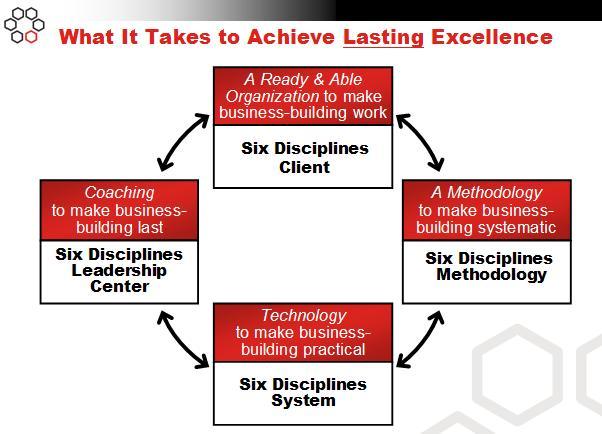
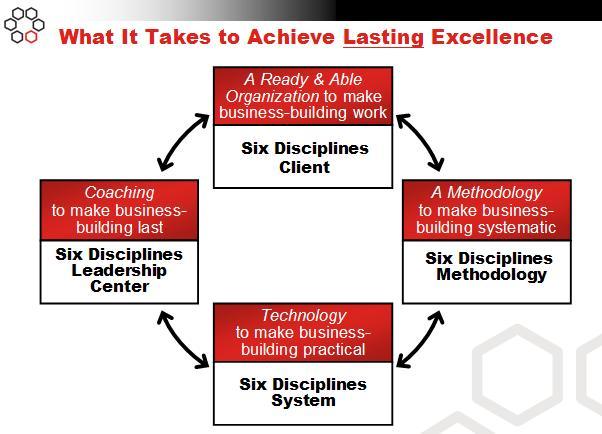
By integrating the proven, time-tested principles of strategic planning, quality management, organizational learning, automated business processes, people performance management and measure-driven improvement, Six Disciplines is a method to help the best performing organizations make the transition from product-building to "business-building" using an approach that includes four essential elements:
- A Methodology to make business-building systematic.
- Technology to make business-building practical.
- Coaching to make business-building last.
- A Ready & Able Organization to make business-building work.
BOTTOMLINE: No matter what method is used for business improvement (what we call "business-building), if you leave out any one of these essential elements, the likelihood of lasting - sustainable -business excellence, is significantly diminished.
Friday, September 30, 2005
Corporations Woo Baby Boomers - Is That So?
Wow...here's a shocker! With more than 1 in 4 workers eyeing retirement, companies are scrambling to keep valued employees.
According to this CNN/Money Magazine article:
BOTTOMLINE: Older employees, younger employees...it's not age that's in demand. It's the level of knowledge, experience, maturity, and passion that is really in demand.
According to this CNN/Money Magazine article:
- "Corporate America is finally waking up to the extensive experience mature employees bring to the table and placing value on the benefits of retaining older workers."
- "Firms are actively seeking to keep their baby boomer employees, enticing individuals with flex hours, part-time, telecommuting consulting -- exhausting every known resource to accommodate their employees."
- "More corporations are choosing to "rehire" older employees by involving them in mentoring programs, giving them access to coaching, strategy development and research programs.
BOTTOMLINE: Older employees, younger employees...it's not age that's in demand. It's the level of knowledge, experience, maturity, and passion that is really in demand.
For Franchises, Growing Rapidly Isn't Always Best
Dane, over at Business Opportunities Weblog, links to a Wall Street Journal article "For Franchises, Growing Rapidly Isn't Always Best"
The key take-aways:
BOTTOMLINE: Were you aware that Six Disciplines is much more than a just top-selling business improvement book? We've also invested more than 50-man years of R&D and more than $10 million dollars to develop Internet technologies that make the Six Disciplines Methodology practical.
We deliver the Methodology and Internet technologies through our growing nationwide network of Six Disciplines Leadership Center franchises. Our goal is to launch 70 Six Disciplines Leadership Centers throughout the U.S. - over the next 10 years. Interested? Here's more on the Six Disciplines Leadership Center franchise opportunity.
The key take-aways:
- "We outgrew ourselves," says Ralph Rubio, founder of Rubio's Restaurants and current chairman. "We thought we had a prototype such that we could just franchise it, but it wasn't working." Recently the chain decided to start franchising efforts again -- this time with a more disciplined approach.
- "When growing quickly trumps other goals, such as grooming competent leaders, controlling costs, picking prime locations or building a customer base, the company's operations can turn sloppy."
- "The problem (with Boston Markets) , experts say, was the company became so obsessed with growth that it overlooked principles of good business like grooming good managers and building relations in the community.
BOTTOMLINE: Were you aware that Six Disciplines is much more than a just top-selling business improvement book? We've also invested more than 50-man years of R&D and more than $10 million dollars to develop Internet technologies that make the Six Disciplines Methodology practical.
We deliver the Methodology and Internet technologies through our growing nationwide network of Six Disciplines Leadership Center franchises. Our goal is to launch 70 Six Disciplines Leadership Centers throughout the U.S. - over the next 10 years. Interested? Here's more on the Six Disciplines Leadership Center franchise opportunity.
Monday, September 26, 2005
BizJournals.com Recognizes Six Disciplines Leadership Centers
According to BizJournals.com, "The Internet and computer technology impact nearly every aspect of our business and personal lives, especially with regard to co mmunications, finance, entertainment and retail. Companies that provide these vital services need not be international conglomerates - the market is huge, and franchisors are able to offer many of the same products and services previously available only from industry giants."
BOTTOMLINE: BizJournals.com recognizes Six Disciplines Leadership Centers as the showcase entry in the "Business Management Technologies" category.
BOTTOMLINE: BizJournals.com recognizes Six Disciplines Leadership Centers as the showcase entry in the "Business Management Technologies" category.
On Creating A High-Performance Organization
What can small businesses learn from larger enterprises? Plenty - if you look in the right places.
In this issue of McKinsey Quarterly, strong financial results at Barclays Bank masked an underlying malaise, according to CEO John Varley. In some areas of the business, employee engagement and customer satisfaction—areas for future growth—were weak. Barclays has shifted its attention beyond immediate shareholder concerns, focusing instead on long-term performance and the development of measures to track the bank's health.
"If you concentrate first on creating a high-performance, healthy organization that has everything your customers are looking for, your shareholders will be just fine over time."
The full article is here. (Free subscription required!)
In this issue of McKinsey Quarterly, strong financial results at Barclays Bank masked an underlying malaise, according to CEO John Varley. In some areas of the business, employee engagement and customer satisfaction—areas for future growth—were weak. Barclays has shifted its attention beyond immediate shareholder concerns, focusing instead on long-term performance and the development of measures to track the bank's health.
"If you concentrate first on creating a high-performance, healthy organization that has everything your customers are looking for, your shareholders will be just fine over time."
The full article is here. (Free subscription required!)
Business Startups - More Than We Think?
A new study just released by the Kauffman Foundation finds that there are 500,000 new business start-ups in the US every month. If accurate, that means we are now seeing start-up rates of 6 million a year!
With that kind of entrepreneurial spirit and passion, you would think that we would be seeing a significant bump in the enconomy?
BOTTOMLINE: "The biggest challenge of an individual small business is "survival." 80% of all new business start-ups are out of business within five years. And if that doesn't get your attention, 80% of the 20% that survive the first five years don't survive the second five." (Six Disciplines for Excellence, page 41.)
(Thanks to Jeff over at the Entrepreneurial Mind for the tip)
With that kind of entrepreneurial spirit and passion, you would think that we would be seeing a significant bump in the enconomy?
BOTTOMLINE: "The biggest challenge of an individual small business is "survival." 80% of all new business start-ups are out of business within five years. And if that doesn't get your attention, 80% of the 20% that survive the first five years don't survive the second five." (Six Disciplines for Excellence, page 41.)
(Thanks to Jeff over at the Entrepreneurial Mind for the tip)
Friday, September 23, 2005
The Barriers To Focus
Being focused - whether at the office or at home, is critical to getting things done, and done correctly.
Lisa Haneberg, over at Management Craft, conducted a survey among her readership that asked the question:
"If only I could ___________ , I would be more focused."
Interestingly, (but not surprisingly) a quick take of the responses reads like a long list of excuses or barriers to focusing.
BOTTOMLINE: The skill of focus or concentration is a habit. It can be learned and improved over time. And, as any habit, it does take a degree of discipline.
Take a look here for all the responses. (How many of responses have you used as barriers to your own focus?)
Lisa Haneberg, over at Management Craft, conducted a survey among her readership that asked the question:
"If only I could ___________ , I would be more focused."
Interestingly, (but not surprisingly) a quick take of the responses reads like a long list of excuses or barriers to focusing.
BOTTOMLINE: The skill of focus or concentration is a habit. It can be learned and improved over time. And, as any habit, it does take a degree of discipline.
Take a look here for all the responses. (How many of responses have you used as barriers to your own focus?)
Thursday, September 22, 2005
Sometime's It's Not Enough....To Be Excellent™
Sometimes, it's not enough to have a systematic business-building methodology, and Internet technologies to make business-building practical, and coaching services to help keep the best performing organizations on track, to help them achieve lasting excellence.
Sometimes, you have to take extreme measures in your "search" to be excellent.
(Thanks to the fun folks at GoogleFor.com)
Sometimes, you have to take extreme measures in your "search" to be excellent.
(Thanks to the fun folks at GoogleFor.com)
The Craftsman-to-Manager Paradox
This post, by Dave Gray (founder and CEO of XPLANE) explores the paradox:
"If you are a craftsman, you were probably promoted because you are highly productive. Most likely you are productive for a few reasons:
"If you are a craftsman, you were probably promoted because you are highly productive. Most likely you are productive for a few reasons:
- You manage your time effectively
- You require minimal supervision
- You are reliable
- You take pride in a job well done
Here’s the paradox: You meet the above criteria because you are a self-reliant perfectionist. As you move into management, the very things that made you effective as a craftsman are now deadly threats to your success as a manager. Your independence and self-reliance, which was an asset, is now a liability.
Read the entire article here.
Technorati's Take On Be Excellent™
OK....it's time for Be Excellent™ to have its "15 minutes of fame."
Technorati is one of the web's top blog search engines.
Technorati's front-end designers and developers cooked up a fun new feature: Technorati Blog Finder.
Blog Finder helps answer the question, "How can you find authoritative blogs on a subject?"
Want to find out more about "excellence"?
How about "business-building"?
Or "business excellence"?
Maybe "business execution"?
...you get the picture....now, back to work!!
Technorati is one of the web's top blog search engines.
Technorati's front-end designers and developers cooked up a fun new feature: Technorati Blog Finder.
Blog Finder helps answer the question, "How can you find authoritative blogs on a subject?"
Want to find out more about "excellence"?
How about "business-building"?
Or "business excellence"?
Maybe "business execution"?
...you get the picture....now, back to work!!
Wednesday, September 21, 2005
Kawasaki's Rule No. 1: Make Meaning
Guy Kawasaki, managing director of Garage Technology Ventures, an early-stage venture capital firm out of Palo Alto (and former Apple employee and evangelist) put down on paper everything he learned in 20 years so that others—entrepreneurs and intrepreneurs, product managers, and engineers—wouldn't have to repeat his mistakes.
Kawasaki developed a Top 10 format for all of his speeches/presentations.
The first thing he learned is that the people who change the world—the people who really make a difference—aren't motivated by money. (The people who succeeded were the ones who wanted to make meaning and create products/sevices they themselves would use.)
There are three principle ways of making meaning:
1. The first is to increase the quality of life of your customer.
2. The second way to make meaning is to right a wrong: To take something and look at the marketplace and say, 'You know, there must be a better way to do this.
3. The third way to make meaning is to perpetuate something good. So to make meaning, you must improve the quality of life, fix something that's bad, or perpetuate something that's good.
(Thanks to the Always-On-Network for this recap)
Kawasaki developed a Top 10 format for all of his speeches/presentations.
The first thing he learned is that the people who change the world—the people who really make a difference—aren't motivated by money. (The people who succeeded were the ones who wanted to make meaning and create products/sevices they themselves would use.)
There are three principle ways of making meaning:
1. The first is to increase the quality of life of your customer.
2. The second way to make meaning is to right a wrong: To take something and look at the marketplace and say, 'You know, there must be a better way to do this.
3. The third way to make meaning is to perpetuate something good. So to make meaning, you must improve the quality of life, fix something that's bad, or perpetuate something that's good.
(Thanks to the Always-On-Network for this recap)
Rethinking Company Loyalty
In this Harvard Business School Working Knowledge article, the authors reveal that your best workers are likely to show more loyalty to their careers than the company.
If an employee's loyalties to his career and to an employer aren't mutually exclusive, how can leaders ensure that the employee-employer relationship pays off for both parties?
1. Align career growth with company goals.
2. Design work with variety and autonomy.
3. Focus on relationships.
4. Highlight the link between employees' values and your company's mission.
(Reprinted with permission from "The New Loyalty: Make it Work for Your Company," Harvard Management Update, Vol. 10, No. 3, March 2005. )
If an employee's loyalties to his career and to an employer aren't mutually exclusive, how can leaders ensure that the employee-employer relationship pays off for both parties?
1. Align career growth with company goals.
2. Design work with variety and autonomy.
3. Focus on relationships.
4. Highlight the link between employees' values and your company's mission.
(Reprinted with permission from "The New Loyalty: Make it Work for Your Company," Harvard Management Update, Vol. 10, No. 3, March 2005. )
Tuesday, September 20, 2005
Microsoft Re-Orgs Again - With Agility In Mind
The plan calls for a reorganization of Microsoft into three large divisions led by individual presidents, each reporting to Steve Ballmer, Microsoft's chief executive.
1. Jeff Raikes will head up the company's Business division, which will house Microsoft's Information Worker group (which includes its Office product line), and its Business Solutions packaged applications group (which includes the Solomon product line - formerly Solomon Software - founded by Six Disciplines CEO and Founder, Gary Harpst, author of Six Disciplines for Excellence)
2. Kevin Johnson and Jim Allchin will be co-presidents of the Platform Products and Services division, which will comprise Windows Client, Server and Tools and the MSN division.
3. Robbie Bach will be president of the Entertainment and Devices division, which will oversee games and mobile device development.
"Our goal in making these changes is to enable Microsoft to achieve greater agility."
--Steve Ballmer, Microsoft CEO
BOTTOMLINE: Having been a Microsoft employee for more than four years, we recognized re-orgs as annual, planned events. With all the buzz these days moving to Google, I can appreciate the need for agility. But don't forget alignment. (Without it, you'll see people moving very quickly - in every direction at once.)
1. Jeff Raikes will head up the company's Business division, which will house Microsoft's Information Worker group (which includes its Office product line), and its Business Solutions packaged applications group (which includes the Solomon product line - formerly Solomon Software - founded by Six Disciplines CEO and Founder, Gary Harpst, author of Six Disciplines for Excellence)
2. Kevin Johnson and Jim Allchin will be co-presidents of the Platform Products and Services division, which will comprise Windows Client, Server and Tools and the MSN division.
3. Robbie Bach will be president of the Entertainment and Devices division, which will oversee games and mobile device development.
"Our goal in making these changes is to enable Microsoft to achieve greater agility."
--Steve Ballmer, Microsoft CEO
BOTTOMLINE: Having been a Microsoft employee for more than four years, we recognized re-orgs as annual, planned events. With all the buzz these days moving to Google, I can appreciate the need for agility. But don't forget alignment. (Without it, you'll see people moving very quickly - in every direction at once.)
Business Improvement Methods Under Fire
From Fast Company's blog, with a reference to a Wall Street Journal article. (Subscription required to access Wall Street Journal articles.)
The world of work has seen its share of business improvement movements.
Some, like reengineering, have been seriously revisited -- and criticized.
Others, like Six Sigma, have neared sacred cow status.
Now, quality-improvement programs such as TQM, ISO 9000, and even Six Sigma, are coming under fire -- or at least heavy questioning.
"Managers have stretched the techniques, by applying them too broadly to more creative areas such as research and new-product development. And some companies are rethinking the way they use the systems."
Among the charges: Process management can help routine tasks more effective and efficient, but fall short for new projects -- and innovation. It can force people to focus on optimizing older technologies rather than seeking to keep up with new tools and techniques. And such efforts don't meet the needs of projects and processes that aren't as easily measured.
BOTTOMLINE: Business improvement methods need to be systematic, repeatable, and measurable, supported by technologies that make the methods practical, and need to have a coach/champion/consultant to keep the business process improvement method on track over time. It's what strategy-driven execution is all about.
The world of work has seen its share of business improvement movements.
Some, like reengineering, have been seriously revisited -- and criticized.
Others, like Six Sigma, have neared sacred cow status.
Now, quality-improvement programs such as TQM, ISO 9000, and even Six Sigma, are coming under fire -- or at least heavy questioning.
"Managers have stretched the techniques, by applying them too broadly to more creative areas such as research and new-product development. And some companies are rethinking the way they use the systems."
Among the charges: Process management can help routine tasks more effective and efficient, but fall short for new projects -- and innovation. It can force people to focus on optimizing older technologies rather than seeking to keep up with new tools and techniques. And such efforts don't meet the needs of projects and processes that aren't as easily measured.
BOTTOMLINE: Business improvement methods need to be systematic, repeatable, and measurable, supported by technologies that make the methods practical, and need to have a coach/champion/consultant to keep the business process improvement method on track over time. It's what strategy-driven execution is all about.
Monday, September 19, 2005
The Leadership Attitude
From this 2004 article in the Harvard Business School Leaderhip Workshop:
"You’ll succeed as a leader only if you’re a living example of your values. What causes do you champion? How do you behave with others? What decisions do you make? Now ask yourself what values your answers demonstrate.
If those values don’t align with your organization, change yourself, change organizations, or tone down your leadership aspirations. Values, if clear and consistent in behavior, are a powerful glue that holds an organization together.”
BOTTOMLINE: Strength of senior leadership is the #1 aspect differentiating top-performing organizations from low-performing organizations. Two primary factors discussed in "Six Disciplines for Excellence" (page 28) included:
1. The ability of leadership to define a clear vision.
2. Appropriate involvement of leadership in leading and supporting projects that are strategic to the organization.
"You’ll succeed as a leader only if you’re a living example of your values. What causes do you champion? How do you behave with others? What decisions do you make? Now ask yourself what values your answers demonstrate.
If those values don’t align with your organization, change yourself, change organizations, or tone down your leadership aspirations. Values, if clear and consistent in behavior, are a powerful glue that holds an organization together.”
BOTTOMLINE: Strength of senior leadership is the #1 aspect differentiating top-performing organizations from low-performing organizations. Two primary factors discussed in "Six Disciplines for Excellence" (page 28) included:
1. The ability of leadership to define a clear vision.
2. Appropriate involvement of leadership in leading and supporting projects that are strategic to the organization.
Six Disciplines Leadership Centers Expands into Central West Florida
Six Disciplines Corporation today announced that it has signed an agreement to expand into Florida, with the addition of Six Disciplines Leadership Center of Central West Florida.
Six Disciplines Leadership Centers offer a new class of professional business improvement service that helps the best performing organization to achieve lasting business excellence. Six Disciplines Leadership Centers combine a systematic business-building methodology, practical Internet technologies, local coaching and strategic advisory services to help top-performing businesses to learn, lead and last.
Leading the new Six Disciplines Leadership Center of Central West Florida is Sean Burke, who will be General Manager of the Center. Sean and his team will be responsible for ensuring the long-term success of Six Disciplines clients of the area. Sean’s team will coach and offer strategic advisory services to organizations that adopt the Six Disciplines™ Methodology, in pursuit of continual business process improvement.
Read the entire news release here.
Six Disciplines Leadership Centers offer a new class of professional business improvement service that helps the best performing organization to achieve lasting business excellence. Six Disciplines Leadership Centers combine a systematic business-building methodology, practical Internet technologies, local coaching and strategic advisory services to help top-performing businesses to learn, lead and last.
Leading the new Six Disciplines Leadership Center of Central West Florida is Sean Burke, who will be General Manager of the Center. Sean and his team will be responsible for ensuring the long-term success of Six Disciplines clients of the area. Sean’s team will coach and offer strategic advisory services to organizations that adopt the Six Disciplines™ Methodology, in pursuit of continual business process improvement.
Read the entire news release here.
Qualities To Hire Team Members By
Unlike most visionaries -- or management consultants -- Dee Hock has put his ideas into practice. More than 25 years ago he oversaw the creation of a business that was organized according to the same principles of distributed power, diversity, and ingenuity that he advocates today.
And that business has prospered -- to put it mildly. (HINT: "It's everywhere you want to be" - VISA)
Here's Dee Hock on hiring new team members:
"Hire and promote first on the basis of integrity;
second, motivation;
third, capacity;
fourth, understanding;
fifth, knowledge;
and last and least, experience.
Without integrity, motivation is dangerous;
without motivation, capacity is impotent;
without capacity, understanding is limited;
without understanding, knowledge is meaningless;
without knowledge, experience is blind.
Experience is easy to provide and quickly put to good use by people with all the other qualities.
BOTTOMLINE: Attracting, hiring and retaining quality team members is an attribute that top-performing organizations do 142% better than the lowest performing organizations. At Six Disciplines, we employ a "leave nothing to chance" approach to hiring, which incorporates many of these considerations, (and recommend a similar hiring process to our Clients.) As part of this process, we use the rigorous Six Disciplines Behavioral Assessment to help determine whether these qualities exist in each applicant.
(Thanks to Todd at A Penny For for digging up this gem from an early 1996 copy of Fast Company.)
And that business has prospered -- to put it mildly. (HINT: "It's everywhere you want to be" - VISA)
Here's Dee Hock on hiring new team members:
"Hire and promote first on the basis of integrity;
second, motivation;
third, capacity;
fourth, understanding;
fifth, knowledge;
and last and least, experience.
Without integrity, motivation is dangerous;
without motivation, capacity is impotent;
without capacity, understanding is limited;
without understanding, knowledge is meaningless;
without knowledge, experience is blind.
Experience is easy to provide and quickly put to good use by people with all the other qualities.
BOTTOMLINE: Attracting, hiring and retaining quality team members is an attribute that top-performing organizations do 142% better than the lowest performing organizations. At Six Disciplines, we employ a "leave nothing to chance" approach to hiring, which incorporates many of these considerations, (and recommend a similar hiring process to our Clients.) As part of this process, we use the rigorous Six Disciplines Behavioral Assessment to help determine whether these qualities exist in each applicant.
(Thanks to Todd at A Penny For for digging up this gem from an early 1996 copy of Fast Company.)
What Is Expertise?
Lisa Haneberg, over at Management Craft, blogs the question "What is expertise?"
The common definitions include:
The common definitions include:
Someone who writes a book (or perhaps a blog? ;> ) has expertise."
Someone who has a degree has expertise."
Someone who spends time with a discipline builds expertise"
Someone who gets paid for their knowledge has expertise."
Someone who has a degree has expertise."
Someone who spends time with a discipline builds expertise"
Someone who gets paid for their knowledge has expertise."
BOTTOMLINE: Any one of these definitions, by itself, is suboptimal. Expertise should be defined as:
Subject matter knowledge (factual or fictional skill) X repeatable processes (practice, practice practice)
_________________________________________________________
Time
Thursday, September 15, 2005
Small Business Brief Reviews Six Disciplines for Excellence
Linda Riley over at Small Business Brief published this review of "Six Disciplines for Excellence."
Thanks Linda!
Thanks Linda!
Small Business Trends Calls Out Be Excellent™
Anita Campbell with Small Business Trends references the Be Excellent blog in her recent TrendTracking entry:
"Be Excellent, the blog of Six Disciplines Corporation, has a new format. Skip Reardon, the Marketing Director of Six Disciplines, writes the blog. Part of the blog's purpose is to be a companion to the Six Disciplines book and methodology.
But Skip has broadened the subject matter. He is writing about a variety of small business topics culled from different sources, not just about the book. I especially like his "Bottomline" summary paragraph at the end of each post, in which he emphasizes his point."
Thanks for noticing, Anita!
"Be Excellent, the blog of Six Disciplines Corporation, has a new format. Skip Reardon, the Marketing Director of Six Disciplines, writes the blog. Part of the blog's purpose is to be a companion to the Six Disciplines book and methodology.
But Skip has broadened the subject matter. He is writing about a variety of small business topics culled from different sources, not just about the book. I especially like his "Bottomline" summary paragraph at the end of each post, in which he emphasizes his point."
Thanks for noticing, Anita!
Monday, September 12, 2005
Communicating The Vision: A Sign of Leadership
The good (but not surprising) news: better communication results in improved employee performance.
A survey published in Management-Issues of more than 18,000 employees of U.S. companies by professional services firm Towers Perrin suggests that business leaders are doing a better job in communicating with employees than they were 12 months ago.
Nearly two-thirds (63 per cent) of respondents to the 2005 Communication Effectiveness Survey say senior leadership effectively communicates the company's progress in meeting business objectives, up nine points from 2004.
The same proportion say that leadership has communicated a clear vision for the company's long-term success, an eight-point increase from 2004.
BOTTOMLINE: Effective communications are one of the key advantage that smaller organizations have over larger organizations - particularly when communicating the mission, vision, values, strategic position, vital few objectives, and performance expectations.
A survey published in Management-Issues of more than 18,000 employees of U.S. companies by professional services firm Towers Perrin suggests that business leaders are doing a better job in communicating with employees than they were 12 months ago.
Nearly two-thirds (63 per cent) of respondents to the 2005 Communication Effectiveness Survey say senior leadership effectively communicates the company's progress in meeting business objectives, up nine points from 2004.
The same proportion say that leadership has communicated a clear vision for the company's long-term success, an eight-point increase from 2004.
BOTTOMLINE: Effective communications are one of the key advantage that smaller organizations have over larger organizations - particularly when communicating the mission, vision, values, strategic position, vital few objectives, and performance expectations.
Thursday, September 08, 2005
Which Type of Leader are You?
The Entrepreneur, The Manager, and The Charismatic -- these are the three types of brilliant leaders, according to the groundbreaking book, In Their Time: The Greatest Business Leaders of the 20th Century.
So which kind are you?
To find out, take this quiz -- exclusive to Fastcompany.com and created by the book's co-author, Anthony J. Mayo.
So which kind are you?
To find out, take this quiz -- exclusive to Fastcompany.com and created by the book's co-author, Anthony J. Mayo.
Tuesday, September 06, 2005
Three Types of Great Leaders
In this FastCompany article, Harvard Business School professors Anthony J. Mayo and Nitin Nohria have unearthed an immutable attribute that's shared by all of the giants of business:
They had an innate ability to read the forces that shaped the times in which they lived -- and to seize on the resulting opportunities.
Their expanded scope has resulted in a groundbreaking book on business leadership, to be published next month by Harvard Business School Press: In Their Time: The Greatest Business Leaders of the 20th Century.
In the new book, Nohria identified three prototypical leadership types -- the entrepreneurial leader, the leader as manager, and the charismatic leader -- and showed how each used their contextual intelligence to thrive in their times. "Leaders and those who aspire to lead benefit from having a sense of history," he says. "Not because history repeats itself. History's real value is that it allows you to imagine what's possible."
BOTTOMLINE: "In each of these dimensions, there are very important changes afoot. They will coalesce and create opportunities for entrepreneurial leaders to launch new businesses, for managers to maximize the value of existing businesses, and for leaders of change to rescue businesses that have fallen into decline. The one thing that we know for certain is that context is vitally important; it will shape the opportunities in these new times."
They had an innate ability to read the forces that shaped the times in which they lived -- and to seize on the resulting opportunities.
Their expanded scope has resulted in a groundbreaking book on business leadership, to be published next month by Harvard Business School Press: In Their Time: The Greatest Business Leaders of the 20th Century.
In the new book, Nohria identified three prototypical leadership types -- the entrepreneurial leader, the leader as manager, and the charismatic leader -- and showed how each used their contextual intelligence to thrive in their times. "Leaders and those who aspire to lead benefit from having a sense of history," he says. "Not because history repeats itself. History's real value is that it allows you to imagine what's possible."
BOTTOMLINE: "In each of these dimensions, there are very important changes afoot. They will coalesce and create opportunities for entrepreneurial leaders to launch new businesses, for managers to maximize the value of existing businesses, and for leaders of change to rescue businesses that have fallen into decline. The one thing that we know for certain is that context is vitally important; it will shape the opportunities in these new times."
Tuesday, August 30, 2005
Organizations of the Future
CFO Magazine asks: "Are you ready for the organization of the future?"
The BusinessPundit responds: The future is in self organizing, dynamic, flexible organizations. Why aren't very many companies moving in that direction? Who wants to be responsible for the results of a group without being allowed to micromanage the group? I'll tell you who - a manager that spends time training staff and setting clear expectations.
BOTTOMLINE: Organizations of the future will be built on trust, authenticity, and empowerment - not control and micromanagement.
The BusinessPundit responds: The future is in self organizing, dynamic, flexible organizations. Why aren't very many companies moving in that direction? Who wants to be responsible for the results of a group without being allowed to micromanage the group? I'll tell you who - a manager that spends time training staff and setting clear expectations.
BOTTOMLINE: Organizations of the future will be built on trust, authenticity, and empowerment - not control and micromanagement.
Thursday, August 11, 2005
On Leading Change: An interview with P&G's CEO
Six Disciplines, among many things, is a catalyst for organizational change. What can a small business CEO learn about leading organizational change - from the CEO of Proctor & Gamble?
Plenty!
In this McKinsey Quarterly interview, Alan G. Lafley, CEO and longtime insider, recounts how he orchestrated recent change at P&G.
Lafley describes his role helping managers to make strategic choices by challenging their deeply held assumptions. While many companies assume that outsiders are needed to shake things up,
Lafley argues his 25 years in operations give him a depth of understanding that allows for 'more intelligent' risk taking.
Plenty!
In this McKinsey Quarterly interview, Alan G. Lafley, CEO and longtime insider, recounts how he orchestrated recent change at P&G.
Lafley describes his role helping managers to make strategic choices by challenging their deeply held assumptions. While many companies assume that outsiders are needed to shake things up,
Lafley argues his 25 years in operations give him a depth of understanding that allows for 'more intelligent' risk taking.
Subscribe to:
Posts (Atom)