The Six Disciplines blog has moved!

You will be automatically redirected to our new home. If that does not occur, please visit:

Monday, April 23, 2007

Small Business Trends Showcases The Two-Word Strategy

Anita Campbell, editor over at Small Business Trends, (and host of Small Business Trends Radio) showcases an interview with Six Disciplines' CEO and founder Gary Harpst, in her post Using a Two-Word Strategy to Get Employees on the Same Page.

Anita's interview asks Harpst:

  • What are some examples of famous two-word strategy statements?
  • Some people might suggest those are brand taglines. Why do you think they are more? What’s the value?
  • A business needs more of a strategy than just two words, correct?
  • How would you suggest entrepreneurs and business owners use the two-word strategy statement in their strategic planning? What’s the process?
  • Could you give us some examples of two-word strategy statements that might be applicable to small businesses in the following industries (just to prime the pump and get the thinking going)
  • What if you’ve tried and can’t come up with a two-word statement. Does that mean your business lacks focus and that your organization will be off track? What do you do?

BOTTOMLINE: Check out the answers to these questions about the two-word strategy exercise.

Traits of Successful Entrepreneurs

In honor of National Small Business Week, the Small Business Development Centers of Ohio list some personality traits which successful entrepreneurs have and apply to their businesses:

  • Passion for their business. Loving what you do can leave you feeling exhilarated rather than exhausted.
  • Persistence. Entrepreneurs are willing to work longer and harder than others. That outlook is crucial to overcoming the challenges they face. The true entrepreneur has the discipline to complete the less enjoyable tasks properly and on schedule.
  • Good health and high energy are vital because starting a business takes a lot of effort and time.
  • Creativity is needed to develop innovative products and services and to solve problems.
  • Independence and self-reliance. Entrepreneurs like making their own decisions and carrying them out. They also are willing to take on the responsibilities that come with their freedom.
  • Intuition is the ability to see beyond the obvious. The intuitive entrepreneur has an uncanny ability to predict how a situation will affect his business and to make the right decisions in advance.
  • Self-confidence. Entrepreneurs believe in their ability to make their business prosper, even when those around them do not. They are optimistic and have faith in their own ideas, allowing them to be realistic and open to change.
  • Entrepreneurs are invariably hard-working people. How do you feel about working 12 hours a day?
(Hat tip for this list goes to Doug Peters, CEO of GreaterFindlay, Inc. - and a Six Disciplines client!)

Small Business Statistics

In honor of National Small Business Week, we'd like to offer up some interesting (and startling) facts and statistics about small businesses from different sources:

According to the SBA, small businesses:

  • provide 75 percent of the net new jobs added to the economy
  • represent 99.7 percent of all employers
  • employ 50.1 percent of the private work force
  • provide 40.9 percent of private sales in the country.
  • account for 39.1 percent of jobs in high technology sectors in 2001
  • account for 52 percent of private sector output in 1999
  • represent 97 percent of all U.S. exporters
Businesses start -- and fail -- in the United States at an increasingly staggering rate.

  • Every year, over 500,000 people start a business of some sort.
  • By the end of the first year, at least 40% of them will be out of business.
  • Within 5 years, more than 80% of them—400,000 people—will have failed!

And, if your business has managed to survive for 5 years or more, don’t breathe a sigh of relief.
More than 80% of the enterprises that survive the first 5 years will fail in the second 5 years.

BOTTOMLINE: What makes sustainability in business so hard? The top issues small businesses struggle with can be grouped into categories: financial, customer, production, people, limited resources, and growth. At times, these challenges can be daunting, indeed overwhelming. It's encouraging to know that the struggles we encounter every day are normal. All small businesses face them. And like other "heroes," we continue the fight - because the cause is worth it.

Entrepreneur Magazine Radio Interviews CEO Gary Harpst

Kick Start Guy, Romanus Wolter, interviews Gary Harpst, CEO and Founder of Six Disciplines, LLC, and author of Six Disciplines for Excellence, about how to conquer the biggest business challenges.

Reaching over 2 million visionaries and entrepreneurs monthly, Romanus is known as the "The Kick Start Guy." As the Success Coach for Entrepreneur magazine, the author of the popular Kick Start Your Success (Wiley & Sons) and Kick Start Your Dream Business (Ten Speed Press), he provides practical, proven action steps that close the gap between goals and success.

Listen to this interview with CEO Gary Harpst here on Entrepreneur Magazine Radio.

Be Excellent Honors National Small Business Week

Each year the President of the United States issues a proclamation calling for the celebration of Small Business Week. Each year National Small Business Week is sponsored by the U.S. Small Business Administration (SBA).

The celebration honors the estimated 25.5 million small businesses in America that employ more than half the country's private work force, create three of every four new jobs, and generate a majority of American innovations.

The U.S. Small Business Administration will mark Small Business Week 2007, with events to be held on April 23-24, 2007, at the Ronald Reagan International Trade Center in Washington, D.C.

BOTTOMLINE: Consider that most people spend half their waking hours at work. To a business leader who takes the risk of owning and building a business, this is both exciting and awe-inspiring. It's exciting because of the great opportunity to do something meaningful in the lives of other people. It's awe-inspiring (and sobering) because of the responsibility it implies, derived from the understanding that oftentimes a single decision may significantly affect the lives of many others. Those who take this stewardship seriously truly are heros.

Six Disciplines LLC and all of the Six Disciplines Leadership Centers salute all of our small and mid-sized business clients - and all small businesses during National Small Business Week!

Friday, April 20, 2007

Sustainable Change

There's a great manifesto for change over at Change This, called "Manifesto to Accelerate: 15 Truths."

In it, author Dan Coughlin offers 15 Truths about accelerating momentum in business, and advises:

"To achieve sustained greatness in any business endeavor, you have to play at it with a Sustained And Focused Effort (SAFE)."

BOTTOMLINE: According to Coughlin, "The only way to sustain your focus and your effort through this challenge is to have fun while you do it. Enjoy the journey. Play it SAFE. Make it a game, not a job. Finally, find what you’re passionate about and pour it into what you do everyday in order to accelerate."

Ensuring Successful, Sustainable Change

Most business improvement efforts (efforts that are introduced to change performance) are declared failures and abandoned before they are even given a chance to succeed.

In fact, 75% of all change initiatives fail - due to lack of sustainability. The changes just don't "stick."

Why?

Are we overestimating people's ability to learn to do things differently (learn new habits), and underestimating their resistance to change (unlearn old habits)?

The tough part isn't introducing change - it's making change sustainable - making business improvement last.

Here' are steps to ensure that change initiatives will stick:

  1. Create a sense of urgency.
  2. Build a strong guiding change initiative team.
  3. Develop a clear vision for what you want the outcome to be.
  4. Ask the tough questions.
  5. Work the plan.
  6. Build in short-term wins.
  7. Embed change initiatives into your organization's culture.
  8. Repeat as necessary.

BOTTOMLINE: To enure that the results of any business improvemente change initiatives last, re-read these 8 steps often during the change process and measure your performance against them.

Destructive Habits of Good Companies

Over at 800-CEO-Read, Todd posts about a new book from Jagdish Sheth, who says his journey started as he tried to understand why so many companies that were highlighted in books like In Search of Excellence and Good To Great failed to have continued success. Sheth argues that companies acquire habits that lead to their fall.

His latest book is called The Self-Destructive Habits of Good Companies...And How To Break Them.

Sheth says there are seven deadly sins that are destructive to corporations:

  1. Denial
  2. Arrogance
  3. Complacency
  4. Competency Dependence
  5. Competitive Myopia
  6. Territorial Impluse
  7. Volume Obsession

Here's the chapter summary on Competitive Myopia.

Thursday, April 19, 2007

Six Disciplines to Expand Into Austin, San Antonio TX

FINDLAY, OHIO, April 19, 2007 — Six Disciplines, LLC today announced plans to expand its award-winning Six Disciplines Leadership Center franchises into the Austin and San Antonio, TX regions.

Six Disciplines Leadership Centers provide a premiere class of business execution coaching services to enable small and mid-sized organizations to become accountable, to stay on track, and to achieve a sustainable level of business excellence.

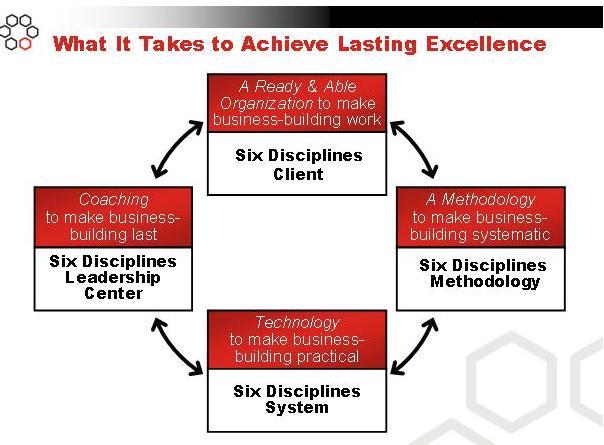
“With Six Disciplines Leadership Center franchises already operating in Ohio, Indiana, Florida and North Carolina, we’re pleased to announce our plans to expand into the Austin and San Antonio areas,” said Rich Minder, Director of Franchise Development for Six Disciplines. Research with our clients proves that it takes an integrated business-building methodology, local coaching, and an activity management system to enable organizations to achieve sustainable business performance improvement. We are actively seeking qualified professionals in Austin and San Antonio to become franchise owners/coaches to small and mid-sized businesses using the revolutionary Six Disciplines™ business excellence program,” added Minder.

More than $20 million and 85 man-years of R&D have been invested in developing the Six Disciplines program, making it the most comprehensive execution-optimized business excellence program for small and mid-sized businesses in the country. Organizational development experts have likened Six Disciplines to the Malcolm Baldrige National Quality Program, which is a comprehensive framework for measuring and ensuring performance excellence within an organization. The Six Disciplines Leadership Center advantage is that it not only provides a systematic business excellence framework, it also offers coaching services and an integrated activity management system that helps organizations execute their strategies in a sustainable way.

For more information about the Six Disciplines Leadership Center franchise opportunities in Austin or San Antonio, call Rich Minder at 317-691-4759, visit www.SixDisciplines.com/franchise or e-mail: FranchiseInfo@SixDisciplines.com.

About Six Disciplines
Six Disciplines, LLC, founded in 2000, has developed the first sustainable business excellence program – optimized for execution – specifically for small and mid-sized businesses. The Six Disciplines program integrates a proven, best-practices methodology, local accountability coaching, an innovative activity management system, and a shared learning community to enable sustainable business excellence. Six Disciplines addresses the barriers that prevent individuals from effectively executing their organization’s strategy, while creating a new culture of effective work habits and focused business processes.

The Six Disciplines program is offered exclusively through Six Disciplines Leadership Centers, an award-winning network of independently owned and operated franchises that provide accountability coaching and total organizational engagement services for small and mid-sized businesses. The breakthrough methods for planning and executing more effectively are revealed in the top-rated book “Six Disciplines for Excellence: Building Small Businesses That Learn, Lead and Last,” by Six Disciplines founder and CEO Gary Harpst, available from bookstores nationwide and from Amazon by visiting www.SixDisciplines.com/book. Visit Six Disciplines on the web at www.SixDisciplines.com.

Wednesday, April 18, 2007

Six Key Principles of Organizational Accountability

CEO Refresher has an interesting article on what it means to be accountable in organizations.

The authors (Shaun Murphy, Ph.D. and Bruce Klatt, M.A. are senior partners in Murphy Klatt Consulting) list the following six principles that form the foundation for negotiating and understanding accountability:

I. Accountability is a Statement of Personal Promise
II. Accountability for Results Means Activities aren't Enough
III. Accountability for Results Requires Room for Judgment and Decision Making
IV. Accountability is Neither Shared nor Conditional
V. Accountability for the Organization as a Whole Belongs to Everyone
VI. Accountability is Meaningless Without Consequences

BOTTOMLINE: Organizational accountability entirely subverts the tendency to make excuses and shift blame. When employees make clear and specific commitments for their own work based on clear expectations and proportional rewards, entire organizations become aligned and achieve specific measurable results.

Making Organizational Change Sustainable

Do you Have What It Takes To Create a Change-capable Organization?

Organizational survival requires rapid adaptation to a changing environment. If survival is at stake, why is it so hard for us to implement change -- and have it stick?

Why is there such a lag in our response to environmental changes? For more than twenty years the Pia Group has been studying organizations to find the answers to these questions and to identify successful paradigms for creating and leading change-capable organizations.

Unsurprisingly, successful lasting change is a rarity.

Here they list 12 requirements for lasting organizational change. The requirements include:
  1. A clear vision of your purpose and goal
  2. Flexible thinking
  3. Involvement and commitment
  4. An empowering culture
  5. Recognition of the human aspects of change
  6. Antidotes to fear
  7. Action – avoid paralysis by analysis and get started!
  8. Effective communication
  9. Talent management
  10. Positive reinforcement
  11. Meaningful metrics
  12. Passion for the change

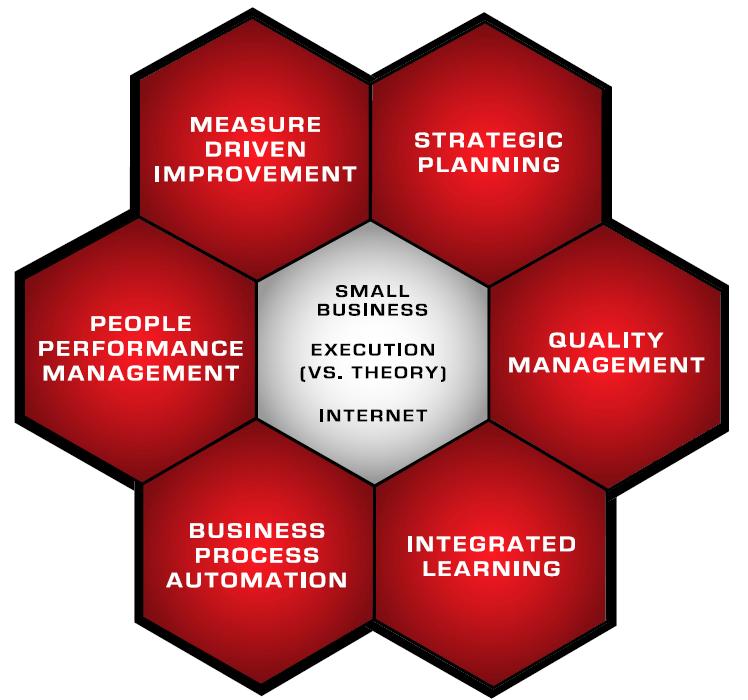
BOTTOMLINE: When you read Six Disciplines for Excellence, you'll notice many, many similarities. Parallel genius? Perhaps. The Six Disciplines Methodology was developed based on the best practices of many different business disciplines - including strategic planning, quality management, business process automation, people performance management, measure-driven improvement - and organizational learning/organizational change.

Monday, April 16, 2007

The Importance of Organizational Alignment

There are many simple analogies that can be used to define alignment within an organization.

Alignment can be thought of as "everyone being on the same page" or "rowing in the same direction" or "singing from the same song sheet."

Simply put, alignment is about three basic ideas:

  1. Defining and communicating (cascading) strategy throughout the organization
  2. Establishing clear organizational accountability (both team leader and team member)
  3. Managing initiatives and projects against the goals and strategy

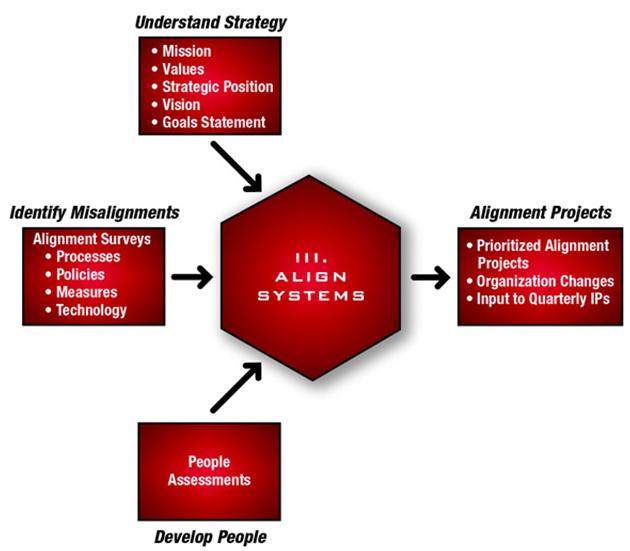
BOTTOMLINE: In Six Disciplines for Excellence, Discipline III. Align Systems is all about the toughest discipline of all. Although critical, deciding what's important and setting goals that lead the organization are not where most organizations fail. Remember, 90% of effectively formulated strategies fail due to execution. It's after goals are set that companies run into one of their most challenging foes - their own systems and processes. Businesses are made up of processes, policies, technologies, measures and people - all of which need to be aligned with the companies goals. The term "alignment" means "close cooperation." So aligning systems means getting all of the components of the business working in close cooperation to meet the goals of the company.

Organizational Learning and Continual Improvement

Organizational learning happens when you are proactive about learning and improving instead of just letting it happen. You can accelerate your internal capabilities, expand insight and experience startling advances in your thinking - and in your organization's ability to do the same.

Effective learning needs to be conscious vs. unconscious, active not reactive. It must be something we actively do, not just "let it happen". If learning ability is not conscious, it can't be improved. It just becomes "another habit" without effective application to the circumstances in our business lives.

So...how do we become better learners, and subsequently, good change masters within our organizations?

The answer is simple. Become an active, conscious learner on a daily basis reviewing your Individual Plan (or log of your most important projects, tasks and initiatives.)

BOTTOMLINE: Set aside time daily to consciously learn from your experiences. You will discover a little-known secret that will put you on a course to life-long, continuous learning and improvement. You will be more able to focus, understand processes, eliminate non-productive habits, become more predictable - and more disciplined in your approach.

The end result? More confidence, more clarity, more accomplishment. What's wrong with that??

Hire for Passion

What's the key to finding the right team?

Hire people with a passion for your mission.

In a Entrepreneur Magazine article "Common Cause," the authors reinforce the theme mentioned in Collins' "Good to Great" book: "How do I find the right people? First, get rid of the wrong people."

BOTTOMLINE: "Hire people who are mission-driven--people who share your vision. If you don't, your business will struggle, or may never even get off the ground. Big business can afford to hire managers and employees. Entrepreneurs need to hire missionaries. Mission comes from the heart, not just the mouth."

Ideas for Improving Corporate Culture

Leadership advice from this article in Incentive Intelligence comes Performance Cultures the GE Way.

Their premise?

DARE TO DIFFERENTIATE. Relentlessly assessing and grading employees build organizational vitality and foster a true meritocracy. Employees are constantly judged, ranked, and rewarded or punished for their performance. There's nothing like a bit of anxiety and the knowledge that you're being measured against peers to boost performance.

CONSTANTLY RAISE THE BAR. Leaders continually seek to improve performance, both their own and their team members. "The one reason executives fail at GE is they stop learning," says Conaty. Continuous learning is so valued that GE training courses are considered high-profile rewards. Getting tapped to go to Crotonville, the 53-acre executive training center in New York's Hudson River Valley, is a signal that someone is poised to go to the next level.

BECOME EASY TO REPLACE. Great leaders develop great succession plans. Insecure leaders are intimidated by them.

KEEP IT SIMPLE. Most organizations require simple, focused, and disciplined communications. "You can't move 325,000 people with mixed messaging and thousands of initiatives," notes Conaty. Leaders succeed by being consistent and straight forward about a handful of core messages.

BOTTOMLINE: "Create a few simple performance metrics tied to a few simple company metrics, measure, communicate and publish success and failure with the appropriate rewards and you will have a performance culture. The key is that these things operate within a system. One missing link and the system fails. You can't measure and not report, you can establish goals and not measure, you can't report and not reward."

Google's Plan for World Domination

Time for a little Monday fun....check out this whiteboard, which enables you to zoom in on Google's plans for world domination.

Creativity at its best!

Friday, April 13, 2007

Zane's Review of Six Disciplines for Excellence: Part I

Zane Safrit, the CEO of Conference Calls Unlimited, is one of those high-energy people with a positive attitude - and a PASSION for life to match.

What he's done at CCU is amazing. Here's the 411:

"18 months ago Conference Calls Unlimited ceased investing in traditional advertising. Truth be known, it wasn’t an investment. It was a donation. And the ROI was that of a donation: A thank-you note, a towel and a jar of jelly-beans. We directed that budget to our customers’ experience and incentivizing our staff. It works. Customer churn is less than 1%. Close-ratio is over 75%. Profits tripled."

In addition to his personal blog, he also writes marketing entries here.

As you can tell from his entries, he's an incredibly sharp person - with a wide variety of interests (in particular - health care, sports -- and great taste in music as well!).

BOTTOMLINE: Zane is in the process of reading "Six Disciplines for Excellence" - his initial review can be read on his blog - here. Zane - any new insights??

A Season of Inspiration: Part IV


Spring is a time for personal renewal...

Recognize that your life is your supreme value, that it is too precious to waste or sacrifice to the unsound opinions or whims of others. Reflect, as calming and honestly and rationally as you can, on your own life, to take stock of yourself.
Ensure that your values and actions serve your life and your well being.

What are your priorities? Do the things you desire and spend time on truly give you the deepest, long-term satisfaction? Are you living up to your fullest potential?

Spring is ... a Season of Inspiration.

(Many thanks to JB ....for the continued Inspiration)

How To Engage Your Workforce

The Harvard Business School's HBS Working Knowledge published an article "Why Your Employees Are Losing Motivation"

Their premise?

Business literature is packed with advice about worker motivation—but sometimes managers are the problem, not the inspiration. Here are eight best-practices to fire up the troops.

1. Instill an inspiring purpose. A critical condition for employee enthusiasm is a clear, credible, and inspiring organizational purpose: in effect, a "reason for being" that translates for workers into a "reason for being there" that goes above and beyond money.

2. Provide recognition. Managers should be certain that all employee contributions, both large and small, are recognized.

3. Be an expediter for your employees. Incorporating a command-and-control style is a sure-fire path to demotivation.

4. Coach your employees for improvement. A major reason so many managers do not assist subordinates in improving their performance is, simply, that they don't know how to do this without irritating or discouraging them.

5. Communicate fully. One of the most counterproductive rules in business is to distribute information on the basis of "need to know."

6. Face up to poor performance. Identify and deal decisively with the 5 percent of your employees who don't want to work.

7. Promote teamwork. Most work requires a team effort in order to be done effectively. Research shows repeatedly that the quality of a group's efforts in areas such as problem solving is usually superior to that of individuals working on their own. In addition, most workers get a motivation boost from working in teams.

8. Listen and involve. Employees are a rich source of information about how to do a job and how to do it better.

Video of Discipline III. Align Systems


One of the greatest barriers organizations face in pursuing their strategies and goals is - itself. For many organizations, the systems that make up their business (policies, processes, technologies, measures and people) are often at cross purposes with the priorities of the company.

While working on Discipline III. Align Systems, organizations take an organized, systematic approach to keeping their systems aligned with their strategy.

Watch this video of Gary Harpst, CEO and Founder of Six Disciplines Corporation, as he describes Discipline III. Align Systems.

(NOTE: Video is in Windows Media Format )

Thursday, April 12, 2007

The Importance of Alignment in Performance Management

What are the obstacles to successful performance management? What can you do to overcome those obstacles? And how can you move beyond managing performance to improving it?

As the first in a five-part series of articles, the folks at SAS reveal what they've learned from more than 1,100 business professionals about their performance management efforts.

Their findings so far?

  • In the past, performance management in a typical organization meant one of two things: finance managers scrutinizing company expenditures to track revenue against goals, or the human resources department prodding managers to evaluate their employees' job performance. Not anymore.
  • Now performance management has found its way across the organization. In the vast majority of companies surveyed, most areas of the organization are involved in performance management activities to some degree. In fact, only 16 percent of respondents indicate that performance management efforts are contained within one department.
  • Despite the broader use of performance management, enterprisewide initiatives are not the norm. Most efforts involve many departments, but only a third of these are aligned strategically across departments.
  • The problem? Large-scale deployments are often bogged down by their own weight.

BOTTOMLINE: Alignment is the primary benefit companies hope to receive from their performance management efforts. However, many companies admitted to struggling with alignment issues, such as collaboration, resource optimization and tying planning to strategy, and it appears that they are looking to performance management systems to help.

To overcome these challenges, companies must nurture a culture of commitment and collaboration. Leaders must effectively articulate the company strategy. Employees need to understand the benefits of performance measurement, and they need to know their role in the effort and how it maps to the success of the company.

Wednesday, April 11, 2007

Set Goals That Lead - An Overview

The purpose of Discipline II - Set Goals That Lead - is to help organizations formulate goals and initiatives that lead people to take action that is aligned with the what's most important to the organization.

To be complete, a goal must include:

  • A Vital Few Objective
  • A Measure that indicates how to track progress
  • A Target that quantifies the measure
  • A Target Date that indicates the deadline for achieving the target
Listen to this 60-second sound bite from Gary Harpst, founder, CEO and author of Six Disciplines for Excellence, as he briefly describes Discipline II - Set Goals That Lead.

Decide What's Important - A Quick Overview

A fundamental requirement of a sustainable business excellence program is that it must be systematic, cyclical, repeatable.

Business improvement is not a one-time event - it is a long-term process.

Regularly practicing the discipline of Deciding What's Important helps businesses sharpen their focus.

Listen to this 60-second sound bite from Gary Harpst, founder, CEO and author of Six Disciplines for Excellence, as he briefly describes the purpose behind Discipline I - Decide What's Important.

Monday, April 09, 2007

Performance Objectives and the Individual Plan

Performance objectives establish how your company's goals will be achieved. Performance objectives also play a major role in defining the end results expected through your team member's hard work and dedication.

Performance objectives are a necessity in setting clear goals for team members. They also challenge team members to achieve maximum results to promote business growth and make continuous improvements to meet the challenges and changing demands of the marketplace.

Performance objectives must be clear and guide action.

BOTTOMLINE: You've heard of the SMART acronym before, make sure it's part of each team members' Individual Plan for accomplishing organizational goals.

S=Specific
M=Measurable
A=Accountable
R=Realistic
T=Time-based

How Top-Performing Organizations Differ from the Rest

Did you ever wonder why some organizations (businesses, not-for-profits, churches, etc.) just seem to perform better than others? Is it luck? Chance? More resources?

There are five key differences - all of which are described in detail in the top-rated book "Six Disciplines for Excellence"

At Six Disciplines Corporation, we conducted extensive research to determine how top performing organizations differ from the rest. We found several areas where the contrasts were significant between the highest- versus lowest-performing small businesses.

Here's the top five - in order of their importance:

1. Strength of the Leadership Team. Top-performing organizations rated 155% higher than the lower performers. The two primary factors were the ability of leadership to define a clear vision for the company, and the appropriate involvement of leadership in leading and supporting projects that were strategic to the organization.

2. Ability to Attract and Retain Quality People. Top-performing organizations rated 142% higher than the lower performers. The best small businesses have found that success in this area all starts with recruiting.

3. Disciplined Approach To Business. Top-performing organizations rated 114% higher than the lower performers. Top performers are also good planners, but are practical and are disciplined about the commitments they make.

4. Strategic Use of Technology. Top-performing organizations give more emphasis to using technology to impact the business in strategic ways (114% more) than the lower performers.

5. Effective Use of Trusted Relationships. Top-performing organizations rated 100% higher than the lower performers in their ability to utilize the expertise and talents of external organizations.

Other factors contribute to top-performing organizations and how they differ from lower performers (i.e., work ethic/attitude, teamwork, commitment, etc.). The five described above highlight the areas of greatest difference.

BOTTOMLINE: Understand further each of the characteristics of top-performing organizations by investigating the step-by-step Six Disciplines Methodology.

The Usefulness of the SWOT Analysis

Discover new opportunities. Manage and eliminate threats. That's what SWOT is all about.

SWOT Analysis is a powerful technique for understanding your strengths and weaknesses, and for looking at the opportunities and threats you face.

The purpose of looking at strengths, weaknesses, opportunities and threats in Discipline VI. Step Back, is to get your leadership team to use their experience and judgement to begin narrowing the focus of planning toward the most important strengths, weaknesses, opportunities and threats. The year's strategy should be based upon these.

BOTTOMLINE: The resulting SWOT statement is one of the primary input to Discipline I. Decide What's Important, where the same leadership team will begin to update the goals of the company for the next year -- as the Six Disciplines cycle begins again.

Friday, April 06, 2007

Excellence in Sports - Steve Rubel on Tiger Woods

Steve Rubel, a highly regarded blogger (and fellow PR professional) over at Micro Persuasion, offers his insights about following Tiger Woods' traits as an example in his tribute: Become an Online Influencer by Modeling Tiger Woods - and does so by taking a "closer look at the nine traits through a Web 2.0 lens:"

  • Identify and Develop Natural Talents
  • Create a Clear and Compelling Dream
  • Select Teachers, Heroes, and Teammates Who Guide, Inspire, and Support (Coaches!!)
  • Be Confident
  • Manufacture Magnificent Mental Models
  • Let Actions Do the Talking
  • Constantly Improve in Good Times
  • Be Likeable, Be Grateful, Give Back

BOTTOMLINE: Well done, Steve!

Thursday, April 05, 2007

Leadership From Below

CEOs can't change companies on their own. The secret is to foster a leadership mentality throughout the ranks.

Leadership must exist throughout the organization in order for strategy to be executed thoroughly.

From the MIT Sloan Management Review comes this article on Leading from Below.

The Importance of Purpose in Organizational Strategy

Organizations that thrive over time do so by invoking and fulfilling a purpose: ideally one based on a moral tradition that has stood the test of time.

Leader To Leader offers insights in this indepth overview of the book Purpose: The Starting Point of Great Companies, by Nikos Mourkogiannis.

His premise?

  • While it may be tempting to think of organizations as being made up of instructions, processes, and resources, it should never be forgotten that people are their fundamental components.
  • One of the distinguishing features of people is that they have strong ideas about what is right and wrong. If you can resonate, collectively, with those ideas, then you can tap into people's commitment and creativity to a far greater degree

BOTTOMLINE: Many people who talk about organizational purpose are concerned either with accountability or responsibility--what the organization must do to fulfill its obligations. But if you are interested in promoting greater levels of success, then purpose must be considered as a form of choice: to what ends are the leaders, and the rest of the organization, willing to commit themselves?

Commitment - The Essence of Execution

By examining the commitments people make to colleagues and customers, executives can figure out why work (execution) stalls -- and how to get it moving again.

The Harvard Business Review offers this free article "Promise-Based Management: The Essence of Execution."

Their premise?

  • Most of the vexing challenges leaders face—improperly executed strategy, lack of organizational agility, disengaged employees, and so on—stem from broken or poorly crafted commitments.

BOTTOMLINE: Commitments are a two-way street. Leadership needs to commit resources, tools, encouragement - and team members need to commit to executing the strategy.

The 12 Elements of Great Managing

Kent Blumberg, a senior executive coach, has released a free e-book based on his new book 12: The Elements of Great Managing.

Download the free ebook here, but you'll want more after you finish with his summary, so be sure to buy the book too.

Friday, March 30, 2007

Top 10 Most Used Management Tools

More interesting results from the Bain & Company's Management Tools & Trends 2007 study.

According to a survey of more than 1,200 international executives by the global business management consulting firm, the top-10 "most used" management tools globally in Bain's Management Tools & Trends 2007 study are:

  • strategic planning (1st place)
  • customer relationship management (2nd)
  • customer segmentation (3rd)
  • benchmarking (4th)
  • core competencies, mission & vision statements (tied for 5th)
  • outsourcing (7th)
  • and business process reengineering, knowledge management, and scenario & contingency planning (tied for 8th)

Other interesting findings from the 2007 study:

  • 87% of the 1200 surveyed executives agree that information technology can create significant competitive advantage, but not all are as confident about achieving that potential. One in three agreed that they rarely achieve paybacks from their IT investments.
  • 79% agreed that innovation is more important than cost reduction for long-term success
  • Just over half (53%) said that "unclear decision making authority is hurting our performance." This figures climbs to 58% among small businesses (less than $600M in sales)
  • Strategic planning is the most commonly used management tool, with 88% of respondents using it. It also rated highest in satisfaction, at 3.93 out of 5.

Over the past 14 years, 11 Bain Management Tools and Trends surveys have been completed - assembling a database that now includes 8,504 respondents from more than 70 countries in North America, Europe, Asia, Africa, the Middle East and Latin America.


(Hat tip to Chris Fox for providing more detail about the Bain study)

Corporate Culture Increasing as a Key Factor

Management Issues reveals a new survey of more than 1,200 international executives by management consulting firm Bain & Company has found that nine out of 10 believe that corporate culture is as important as strategy for business success.

While corporate culture, for example, is receiving considerably more management attention than in previous years, Bain research shows that fewer than 10 per cent of companies currently succeed at building high-performance cultures.

BOTTOMLINE: Organizational culture and so-called softer issues are now top of mind. Executives are clearly looking beyond cost-cutting for success.

Employee Engagement and Generational Differences

When it comes to employee engagement Watson Wyatt just released data to suggest that different generations share the same engagement drivers and that generational differences in drivers of engagement are not as wide as perceived.

If you want to read an informative book on generational influences at work, take a look at Jennifer J. Deal’s book discussing the research on the common ground between the young and old, Retiring the Generation Gap.

Here are the 10 key principles she developed in her book:

  1. All generations have similar values; They just express them differently
  2. Everyone wants respect: They just don’t define it the same way
  3. Trust matters
  4. People want leaders who are credible and trustworthy
  5. Organizational politics is a problem — No matter how old (or young) you are
  6. No one really likes change
  7. Loyalty depends on the context, not on the generation
  8. It’s as easy to retain a young person as an older one — If you do the right things
  9. Everyone wants to learn — More than just about anything else
  10. Almost everyone wants a coach.

(Hat tip to David Zinger on Employee Engagement! )

End of Q1 Questions

The first quarter of 2007 ends today.

Business leaders at all levels will spend the next few days or weeks collecting financial results and reporting on them.

Will all those reports help you manage your business?

Kent Blumberg offers a great list of "Questions for Leaders at the end of the First Quarter."

It includes:
  • Questions about you
  • Questions about your team
  • Questions about your customers
  • Questions about your business (or your part of the business)

Worth a good look!

Thursday, March 29, 2007

360-Degree Feedback Surveys

The 360-degree feedback survey was originally used to determine professional development needs, but quickly gained popularity as a performance appraisal tool.

The 360-degree feedback survey aims to provide employees with feedback on their performance from those above, below, and at the same level in the company.

With managerial support, employees are expected to analyze the feedback to identify their strengths and weaknesses and then develop a plan to improve their productivity and effectiveness.

If 360-degree feedback is of interest to you, download this document from ManyWorlds that describes the model.

BOTTOMLINE: In addition to built-in performance appraisals, the Six Disciplines System also includes built-in 360-degree feedback surveys, which can be sent automatically via email to those internally (above, below and peer-level), as well as to external stakeholders (customers, suppliers, etc.)

The Secret to Achieving Sustainable Business Excellence is..


....there IS NO SECRET.

Let’s face it. If there was a secret or shortcut to achieving lasting business excellence -- we'd all be doing it.

There's tons of great business improvement ideas out there...take your pick: "Good to Great", "Covey's 7 Habits", "E-Myth", "Built To Last".....and hundreds of others by best-selling business authors.

So why don't organizations use these ideas? Why don't these ideas turn into action? Most importantly - why don't these great ideas last?
What's missing in this picture?

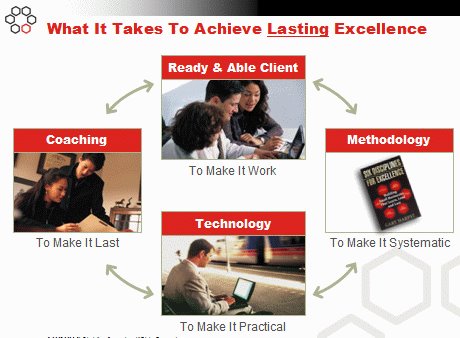
At Six Disciplines, our research shows there are four key components for a complete business excellence program:

  • A holistic business-building methodology
  • Local accountability coaching
  • An activity management system
  • A shared learning community

BOTTOMLINE: Take out any ONE of these, and it just doesn't LAST. It's no secret!

Six Disciplines is the first sustainable business excellence program - optimized for execution - and designed specifically for small and mid-sized businesses.


Wednesday, March 28, 2007

The Importance of Time Tracking

We have all heard the axiom "Time is Money."

With competition and pace at an all-time high, never has it been more critical for organizations to focus on how the asset of time is "spent."

But you're already saying "But I already keep track of my time...."

Do you? Really?

Not just talking about simple timesheets...but really understanding how time is spent, and on what activities the time is being spent - and are these the most important activities - tying back to your organization's strategy and goals.

Automated time tracking has its advantages. Consider the following:

  • Time tracking software reduces timesheet review by 80%. Average timesheet review takes 6 minutes; with an automated time tracking software system, a review takes 1 minute. (Source: American Payroll Association)
  • Time tracking software can have organizational policies and business rules integrated into the submission and approval process, validation is done at the point of entry.
  • Time tracking software monitors time by team and individual, helping to prevent budget and project overruns.
  • Time tracking software reduces time misappropriation (e.g. long lunches, early departures, late arrivals) which accounts for up to 4.08 hours per week. (Source: American Payroll Association)

The benefits of time tracking?

You'll have more flexibility
You'll have more precise estimates
You'll be able to identify why tasks/projects take longer than originally expected
You'll be able to isolate where you need to make improvements in your process

BOTTOMLINE: Time tracking is an integral component of the Six Disciplines program, specifically the Individual Plan. By knowing what activities are being planned, which ones are being worked on, how much time is being allocated, and keeping this updated in "real-time" during the day, organizations using Six Disciplines understand how their time is being "spent" - leading to better alignment of resources.

Common Sense and Execution

This blog entry from The Small Business Weblog entitled You Already Know What It Takes To Build Your Business...Just Do It reinforces "... the reasons most businesses fail is not strategy, it's execution.

"Knowing what to do is not the problem; doing it is!" (page 55, Six Disciplines for Excellence)

Unlike most business improvement books, the methodology described in Six Disciplines for Excellence is specifically designed and optimized for execution.

BOTTOMLINE: When it's diligently and consistently applied (with the coaching assistance from the Six Disciplines Leadership Centers, in conjunction with using the Six Disciplines System,) the Six Disciplines program transforms organizations into ones that can achieve sustainable business excellence.

You Can't Manage It If You Can't Measure It

From NFIB, (The Voice of Small Business) comes a great article "You Can’t Manage It If You Can’t Measure It"

This article reinforces what the Six Disciplines Methodology articulates about measures, as described here in Six Disciplines for Excellence:

Discipline II-A. Define Measures(page 95)
Discipline III-D. Align Measures(page 136)
Discipline IV-E. Monitor Measures (page 174)

BOTTOMLINE: You can't track progress if you don't measure change. Start tracking and measuring progress toward goals. It's the only way to measure effectiveness.

Tuesday, March 27, 2007

Organizational Behavior and Strategy Execution

To create the conditions needed for successful strategy execution, it should be understood that the attitudes and behaviours of people in any organization are driven by five dimensions of organizational behavior:
  1. Strategy Cohesiveness. Do your people really understand the strategy and what it means for their job? Do they buy into it and support it?
  2. Customer Focus. Do your people have an understanding of the customer relationship and the value proposition, even if they have no direct customer contact? Do they know how to deliver value to the customer?
  3. Leadership Behavior. Does leadership communicate a passion and excitement for the future? Is there the necessary style, motivation and commitment?
  4. Performance Management. Are your performance metrics in line with your chosen strategy? Are employees recognized, evaluated and rewarded according to these metrics?
  5. Organizational Culture. Do the attitudes, values and beliefs of employees match the organisation’s core values and core strategy?

The Challenge of Execution

Professor Lawrence G. Hrebiniak, Wharton Business School, identified the following issues related strategy execution in his book "Making Strategy Work: Leading Effective Execution and Change."

All four of the problems mentioned below are people-related issues:

  1. Managers are trained to plan, not execute.
  2. Some top executives do not see themselves as responsible for implementation of the strategies they formulate.
  3. Strategy execution happens over a much longer time frame than strategy formulation.
  4. Strategy execution involves more people than strategy formulation.

BOTTOMLINE: Strategy Execution issues are mainly about People Alignment. The execution of a strategy very often fails because leaders do not focus on the critical issue of aligning the people to the strategy and the processes.


The Need for Organization-Wide Succession Planning

More than one quarter of U.S. businesses have failed to plan for the effects of the aging American workforce, according to the results of a new national survey by Boston College researchers.

Despite reports that the United States faces a shortage of millions of workers within the coming decade as baby boomers retire—taking with them years of experience, talent, and expertise and leaving fewer new workers available to take their place—The National Study of Business Strategy and Workforce Development, conducted by the Boston College Center on Aging and Work, found that many U.S. businesses are unprepared for changing workforce demographics.

Key findings of the research:

Key findings include:

  • Only 37% of employers had adopted strategies to encourage late career workers to stay past the traditional retirement age, despite the fact that late career employees "have high levels of skills and strong professional and client networks, a strong work ethic, low turnover, and are loyal and reliable."
  • 60% of the employers indicated that recruiting competent job applicants is a significant human resources (HR) challenge.
  • 40% indicated that management skills are in short supply in their organizations.
  • Only 33% of employers reported that their organization had made projections about retirement rates of their workers to either a moderate (24.1%) or great (9.7%) extent.
BOTTOMLINE: "Companies that do not plan for this aging workforce may find themselves suddenly faced with a loss of labor, experience, and expertise that will be difficult to offset, given the relatively small pool of new workers and the competition for new talent likely to result from so many companies facing the same problem," says Mick Smyer, codirector of the Center.

Monday, March 26, 2007

Employee Engagement - Part II

Research has shown that the average employee engagement figures for the United States are:

  • 30% Engaged
  • 54% NOT Engaged
  • 16% Actively Disengaged
Keith Ayers in his book, Engagement Is Not Enough, says that it is a leadership issue and the problem is critical.

According to the Gallup Organization, the problem usually begins in the first six months when an average of over 60% of employees switch off. This is basically due to the perceived realization that their expectations are not going to be met.

How to avoid disengagement?

  1. Don't obsess over financial results (vs. creating an enviroment that enables results)
  2. Don't obsess over control and micromanagement (vs. trusting them to get the job done)
  3. Don't obsess over avoiding responsibility (vs. your responsibility to lead)
  4. Don't obsess over logic (vs. emotion)

Best-Kept Secrets of the World's Best Companies

From Business 2.0, here's an article on "Best-kept secrets of the world's best companies."

What a great list!:

  1. Extreme Benchmarking. Compare everything you do against your rivals
  2. Bad News Folders. Keep a constant eye out for trouble
  3. Strategic Strategy Reviews. Turn going-through-the-motions meetings into no-holds-barred debates
  4. A New Office Pool. Use prediction markets to tap hidden knowledge
  5. The Tech Box. Create a lending library of ideas
  6. Outside-In R&D. Bring in experts to help spark new ideas
  7. Office Graffiti. Let workers speak their minds (brainstorm)
  8. Surgical Visits. Seek brutally honest feedback from customers
  9. The Contra Team. Appoint official devil's advocates to challenge the merits of deals
  10. Equity as You Go. Take no stake until you earn it
  11. The Chief Shareholder Officer. Head off shareholder trouble before it starts
  12. Always-On Board Members. Get the directors out of the boardroom
  13. The Corporate Beehive. Use office design to keep the queen in touch with the worker bees.
  14. The Job Audition. Turn the interview process into an all-encompassing tryout
  15. Peer-to-Peer Promotion. Let employees choose their leaders
  16. The Shrink Shrinker. Reward workers for keeping their hands off the merchandise
  17. The Anti-Star System. Determine pay using just two factors: Profits and seniority
  18. The Pyramid Scheme. Use kickbacks--the legal kind--to attract executive talent
  19. The Long Goodbye. Keep retirees in the labor pool
  20. The Three-Minute Huddle. Start each day with a lightning-fast, all-hands briefing
  21. Gainsharing. Pass cost savings on to those who achieved them
  22. Open-Source Ad Campaigns. Let your customers do the marketing
  23. Late-Night Recon. Turn employees into trendspotters
  24. The "Just Looking" Badge. Neutralize your customers' worst fears
  25. Phone Shopping. Become your own customer

BOTTOMLINE: Perhaps you've not heard of some of these practices -- but you may want to start implementing some - today.

Friday, March 23, 2007

The CEO's Role - And Succession Planning

The Hay Group recently revealed research about boards of directors - related to America's "Most Admired Companies (MACs)"

"Good boards understand that selecting the right CEO is probably the most important act that they will take," said Hay Group Vice President Ron Garonzik. "The consequences are too severe if they fail to do so, as recent turnover in CEO positions worldwide has proven."

It’s no surprise, then, that 91% of MACs agree that "We have a well defined plan to cover the emergency loss of the CEO that is discussed at least annually by the Board," v. 65% of the peer group. The MACs are also more likely (70% v. 57%) to "have developed a comprehensive profile for the CEO's successor that reflects our strategy and business model."

The study illustrates that Boards of Most Admired Companies are not only demanding a more significant role in the succession planning process, they are devoting much more time and effort to it than other Boards are.

Read the overview here.

Reasons Why Change Fails

It isn't inadequate processes, strategy or technology that lead so many organizational change programs to run into the sand.

The main reasons for failed change are all about people.

Management-Issues reports that a study from Deloitte Consulting suggests that change programs need to tackle issues in an integrated and focused way and, in particular, look at the people issues facing the business before, during and after the program.

The research has come as a conference of 165 HR directors organized by PricewaterhouseCoopers has separately predicted that a growing focus on people issues means there will be a chief of human resources on the board of most organizations by 2015.

According to the research, there are eight key people-related areas companies need to be addressing:

  1. People risk and impact management
  2. Leadership alignment and stakeholder engagement
  3. Communications
  4. Culture
  5. Organizational design and governance
  6. Talent requirements and HR programs
  7. Workforce transition
  8. Learning and capability transfer
BOTTOMLINE: "Companies don't transform themselves just for fun, but to stay competitive, innovative, and operationally effective."

Thursday, March 22, 2007

Balanced Scorecard as the Next Big Thing?

Many corporate managers have been introduced to a corporate management system called the Balanced Scorecard. Developed at the Harvard Business School by David Norton and Robert Kaplan in the early 1990s, the Balanced Scorecard (BSC) represents the newest and most prolific performance measurement system since Total Quality Management (TQM) and Management by Objectives (MBO).

A growing number of organizations are achieving great financial success through the BSC framework, thereby solidifying the BSC a "here to stay" rather than just another passing fad.

According to studies, the BSC is being implemented in nearly two-thirds of North American corporations. Indicative of the system's growth, many of these implementations are less than six months old.

Thus, as a manager or business leader, if the system has not yet been encountered, it most likely will be in the near future.

According to the Balanced Scorecard Collaborative (www.bscol.com) almost 75% of companies implementing a BSC will also implement a software solution to automate the process.

BOTTOMLINE: While balanced scorecards are an effective way to get alignment, by themselves are not enough. The solution needs to address the barriers of economic, expertise and human factors. Software is just one element - it helps to encourage new habits. Your organization also needs to adopt a systematic business-building methodology - one that is based on prove best-practices. And, we also need coaching/encouragement to continue to make the new change initiative "stick" - just like fitness or dieting, it's hard to do it by ourselves. Balanced scorecards are useful - and not surprisingly, they're built right into the Six Disciplines system.

The Changing Workforce - And Performance Management

According to an article in the Boston Globe, over the next 5 years, the 45-54 year workforce is projected to drop by 10%, and that number will continue to decrease.

The most shocking new is that at some companies, 30-40% of their workforce could retire over the next 10 years.

60% of employers surveyed already feel it is difficult recruiting competent workers.

With the Gen Xers primarily focused on self, and the companies focused on short term profits, how are we going to remain competitive?

What are the kinds of innovative performance management processes, systems and tools that must be embraced?

BOTTOMLINE: What is needed is a sustainable business excellence program. One that is focused on strategy execution. One that directly addresses the barriers to strategy execution, including economic, expertise and human factors. One that integrates a business-building methodology, accountability coaching, and innovative activity management system, and a shared learning community. The first sustainable business excellence program that is optimized for execution (and designed specifically for small and mid-sized businesses) can be found at Six Disciplines.

(Hat tip to the folks at Synaptus)

Wednesday, March 21, 2007

Employee Needs and Company Goals

Paul Allen (the Lesser), offers his take on "Employee Needs and Company Goals."

In his article, he explains "...how extremely revealing (it was) to me about how company goals don’t often align with individual employee efforts and how unempowered many employees are."

To help, he surveyed almost 100 employees and asked them each the following questions:

  1. What is your key goal/metric?
  2. What reporting tool do you use to measure your success?
  3. What resources are available to you to accomplish your goals?
  4. What dependencies might get in the way of you succeeding?

His assertions?

  • Every individual should have a personal scorecard that measures the results they are generating. And I believe in individual and team goals. (He found, however, that most employees didn’t have a goal that aligned with the company’s overall goals, or they didn’t have one at all.)

BOTTOMLINE: "It’s amazing what happens over time if you measure the right things every day and make sure employees are empowered and aligned."

Tuesday, March 20, 2007

The Lost Art Of Long-Range Planning

According to InformationWeek, a panel set up by the U.S. Chamber of Commerce last week recommended several steps to improve this country's competitiveness.

Some interesting findings and recommendations:

  • Small firms represent 99.7% of all employer firms and have generated 60% to 80% of net jobs annually over the last decade.
  • We're all used to the idea that the United States is number one. It's been that way for a long time and we don't expect it to change. The fact is, we've got competition and they are eager to eat our lunch.
  • We've been served a wakeup call. Now we have to answer it, while there's still time left on the clock.
  • This problem has its root in the North American way of doing business: focusing on the short term, the next quarter, to the exclusion of long-range planning.
BOTTOMLINE: While short-term results are important, we need to shift some focus from short-term results to long-term planning. Even with things changing as rapidly as they do these days, there is a place for - and a huge competitive advantage - for conducting long-range planning.

Taking Advantage of Small Business Advisors

In his article Small business: take advantage of advisors, Don Bobinski offers this advice to startups:

  • Startups can give themselves a better chance of surviving if they create a board of advisors to provide regular, outside perspectives on internal and external situations.
  • Short term planning should look like a road map, but "a 10-year plan is going to look more like a compass." It's simply a guide for making decisions.
  • Planning - it's not flashy, it's rarely fun (for an entrepreneur, anyway), and it fails the "does it make me money?" test. At least, on the surface it fails that test.
  • In reality, as the axiom goes, poor planning leads to poor performance.
  • But if any company - especially a start up - is clear about its values, has a focus for where it wants to go, and gets regular, outside perspectives about its internal and external situations, it can find ways to adapt.
  • That means that its chances for survival are greatly increased.

BOTTOMLINE: This advice isn't just for startups. It's for all businesses, in all stages of growth and maturity. Using outside advisors - the right ones -- can make all the difference. That's what our clients tell us every day!

Monday, March 19, 2007

The Six Disciplines Methodology


The identity of your business does not lie in current results -- it lies in what you do in the future.
The Six Disciplines Methodology is all about what you want your business to become.

There are many who "talk" about excellence, and there are some who achieve it for a moment, but there are a few who are willing to learn how to deliver excellence that lasts.

The Six Disciplines Methodology is many different things. It integrates proven best practices of strategic planning, quality management, organizational learning, business process automation, people performance management and measure-driven improvement.

BOTTOMLINE: Six Disciplines is a learning system. It's a systematic way for an organization to learn how to set, and more importantly, to execute strategy. By following its repeatable annual, quarterly, weekly and daily cycles, people within your organization continue to learn and grow at their own pace, aligning with the mission and strategy of your organization. And, it takes only 4% of your organization's time.

Thursday, March 15, 2007

Execution: The Art of Following-Through

Be Excellent covers a wide range of topics, including strategy, planning, measurement, execution, learning and leadership.

While they all are important, we find that the "rubber meets the road" - at execution.

Interestingly enough, most of the business improvement thought leaders out there focus on all the other topics - but few touch on EXECUTION.

Not surprisingly, more than 80% of the focus of "Six Disciplines for Excellence" - is on execution.

Look for more about the coming "Execution Revolution" - from Six Disciplines.


(Thanks to Rob over at Business Pundit for the tip!)

CEO Confidence Continues to Rise

According to the results from a recent survey by Vistage, CEO confidence continues to rise in 2007.

The Q1 2007 Vistage CEO Confidence Index is a compilation of responses from 1,943 CEOs of small- to mid-sized companies, surveyed February 20 – March 2, 2007.

  • Smaller firms expect the economy to continue to improve throughout the year and they are betting on that with new hires and additional spending.
  • Once again, finding and hiring qualified staff was cited as the most critical challenge for more than one-third of all firms.
  • Increased revenues and profits were expected by the vast majority of firms but not at significantly increased levels.

Tuesday, March 13, 2007

Six Disciplines Helps Inc. 500 Company Manage Rapid Growth Amid Management Transition

Sharn Veterinary, Inc., a leading provider of vital signs monitoring equipment for animals used by veterinarians worldwide, searched for a way to harness the company's rapid growth to ensure success over the long haul.

Then they learned about the Six Disciplines Leadership Center in Tampa, a member of a nationwide network of franchised business excellence organizations that provide a complete program to engage the entire organization, enabling them to continuously learn how to achieve sustainable business excellence.

Read the entire case study here about how Six Disciplines helps Sharn to manage rapid growth amid management transitions.

Organizational Accountability and Discipline

From the Center for Simplified Strategic Planning comes this article:

In his book about great organizations, Good To Great, Jim Collins concludes:

"Sustained great results depend upon building a culture full of self-disciplined people who take disciplined action, fanatically consistent with the three circles."

(The three circles for an organization are 1.) what it can be best in the world at, 2.) what its people are already deeply passionate about, and 3.) what drives its economic engine.)

He further states, "A culture of discipline is not just about action. It is about getting disciplined people...who engage in disciplined thought and...who then take disciplined action."

What are the qualities of disciplined workers?

  • They exhibit "training, especially of the mind or character," "a trained condition of order and obedience" and "the training effect of experience, misfortune etc."
  • They have a habit of self-discipline (the discipline comes primarily from within and it is "grooved").
  • They typically finish things they start.
  • They are capable of facing and dealing with brutal facts, even about themselves.
  • They are willing to adhere to the organization's systems for getting work done.
  • They have a passion for doing certain types of work or advancing certain purposes.
  • They possess unique skill sets.

Monday, March 12, 2007

Creating an Accountability-Based Organization

Bob Prosen is CEO of The Prosen Center and has been delivering exceptional business results for more than a quarter-century, first as a successful executive at a variety of U.S. corporations, and lately as a consultant, educator and speaker working with leaders of organizations throughout the US.

Prosen argues that the best way to produce extraordinary results within your organization is to create an accountability-based culture focused on producing results, not activities.

Download his manifesto on "Seven Steps to Creating an Accountability-Based Organization"

What is Employee Engagement?

In 2006, The Conference Board published "Employee Engagement, A Review of Current Research and Its Implications." According to this report (published in Management-Issues), twelve major studies on employee engagement had been published over the prior four years by top research firms.

Each of the studies used different definitions and, collectively, came up with 26 key drivers of engagement.

At least four of the studies agreed on these eight key drivers.

  1. Trust and integrity – how well managers communicate and 'walk the talk'.
  2. Nature of the job –Is it mentally stimulating day-to-day?
  3. Line of sight between employee performance and company performance – Does the employee understand how their work contributes to the company's performance?
  4. Career Growth opportunities –Are there future opportunities for growth?
  5. Pride about the company – How much self-esteem does the employee feel by being associated with their company?
  6. Coworkers/team members – significantly influence one's level of engagement
  7. Employee development – Is the company making an effort to develop the employee's skills?
  8. Relationship with one's manager – Does the employee value his or her relationship with his or her manager?

But all studies, all locations and all ages agreed that the direct relationship with one's manager is the strongest of all drivers.

BOTTOMLINE: "Employee engagement is a very big deal. There is clear and mounting evidence that high levels of employee engagement keenly correlates to individual, group and corporate performance in areas such as retention, turnover, productivity, customer service and loyalty. While differences varied from study to study, highly engaged employees outperform their disengaged counterparts by a whopping 20 – 28 percentage points!

Friday, March 09, 2007

The Eight Essentials of Communicating Change

Good advice on communicating change, based on the principles for developing and implementing an effective internal communication strategy:


  1. Ensure the CEO is the champion of communication and the champion communicator.
  2. Match actions and words.
  3. Ensure your communication is two-way.
  4. Place emphasis on face-to-face communication.
  5. Ensure responsibility for communication is shared.
  6. Deal with the bad news - as well as the good.
  7. Serve the audience's needs as well as your own.
  8. Design your communication strategy to suit your organization.

Thursday, March 08, 2007

Managing During Change

Barbara Kay, an executive coach and trainer with Advantage Coaching & Training, offers her take on the key issues of change management (at Management Issues):

Barbara's assertions:

  • Change management is a hot topic. There are change management consultants, change management systems and coaches who help people handle change.
  • With all of that expertise available, it can still feel like we are just barely getting by during times of change.

The first battle of any change situation is harnessing a desire to succeed.

The second big win was their sincere appreciation for their staff and a keen interest in supporting staff needs.

The third victory was their realistic yet hopeful attitude.

Finally they had adopted a powerful change leadership attitude.

BOTTOMLINE: "Change is not easy. Dramatic and repeated changes are especially challenging. When you think that you are barely managing, take stock, because you may be doing much better than you realize. "

Wednesday, March 07, 2007

Three Barriers Preventing Effective Strategy Execution

For small and mid-size businesses, there are three primary barriers to executing strategy more effectively:

  • Economics. While larger businesses can afford to invest significantly in resources like consultants, coaching, systems and software, small businesses simply cannot afford these expensive offerings – let alone the resources and expertise to integrate them into a single system.
    Expertise. While larger enterprises have access to resources, best-practices and expertise on individual disciplines like strategic planning, performance management, business intelligence, TQM, balanced scorecards, etc., small businesses lack the expertise, resources or understanding of how to tie their strategic goals to the day-to-day activities of their people.
  • Human Factors. Both large and small businesses have the same fundamental challenge: they’re run by people. For the most part, they know the right things to do. But the fact is, they don’t always do them. Organizational behavior, attitudes, motivation, habits, resistance – many human nature factors can contribute to poor execution – and are certainly barriers to sustainable performance improvement.

Even more important is: how to address these barriers in such a way as to make performance improvement sustainable - year after year.

So…what is the solution?

What is needed is a sustainable program for business excellence – one that is optimized for execution.

Tuesday, March 06, 2007

The Five Whys Technique for Problem Solving

Problem solving requires asking the right questions.

If you're an engineer who's been involved in Six Sigma, you've heard of the Five Whys Technique for solving problems. It's a brilliant technique made popular by car-maker Toyota in the 1970s, but it has widespread application.

The Five Whys Technique says that it usually takes five questions to find the truth or the "root cause."

In industry, a Five-Whys conversation would sound like this:

  1. Why did that machine suddenly stop? Because a fuse blew.
  2. Why did a fuse blow? Because the fuse wasn't the right size.
  3. Why was the wrong size in the fuse box? Because one of our engineers put it there.
  4. Why did the he do that? Because somebody in the supply room issued the wrong size fuse.
  5. Why? Because the stock bin for fuses was mislabeled.

BOTTOMLINE: Try this technique next time you get a chance. You don't always have to say "Why." You can throw in a "Help me understand why" or "What was your thinking for doing that" or some other phrase that helps you peel away another layer of the onion. A great way to get the root cause of a problem.

(Tip of the hat to Stephen Meyer, B21 Publisher for his examples...)

The ABC's of Organizational Change

Dr. John R. Grinnell offers his take on The ABC's of Organizational Change.

Truly, one of the best summaries I've read on this topic! in a long time!

Things to Keep in Mind When Changing Beliefs to Change an Organization:

A. Some Ideas are Better than Others
B. Communicate a Compelling Reason for Change
C. Create a Change Action Map
D. Set Leadership Structure Early.......

Read the entire list and summary here.

The Strategy-Execution Gap

From a Q&A interview with David Norton (inventor of the Balanced Scorecard)

  • There have been a number of studies on the success rate companies have in executing strategy, and they generally conclude that something like nine out of ten organizations that have strategies fail to execute them. That's even true when those strategies have been well-formulated at the top and they have buy in from senior management. That's a pretty foreboding statistic.
  • Alignment is about creating an approach and a framework that lets the organization define what's important and then cascade that and communicate that to the lower levels of the organization so everybody understands what the strategy is and how they fit in.
  • If you don't link strategy management and operations management, then you're stuck in either a bottoms-up world, where you're focusing on operations and you don't really have control of whether it's impacting the strategy, or you come top down and focus only on strategy, but you can't make things happen. You've got to tie those two things together.

Read the rest of this Q&A here.

Monday, March 05, 2007

Time for An Execution Revolution

Today in business, leaders are habitually underestimating the challenge of strategy execution-- and as such, nine out of ten strategy executions fail.

Just think about that figure for a moment.

  • Billions of dollars invested in creating strategies are lost.
  • Millions of man hours are wasted.Hundreds of thousands ideas evaporate.

It is a horrendous failure rate that unbelievably is tolerated around the world. Far too many leaders can more easily recall an implementation that failed – whether it was strategy, technology or marketing. It is time to correct this by putting the spot light on execution.

It is time for an Execution Revolution!

One of the largest contributing factors to the high number of failed execution is that when leaders return to their offices after creating their challenge, they are commonly left on their own to work out how to implement it.

They must figure out how to inform the people in their division of the imminent changes; explain what needs to change and why; review the way the team is working and the current rewards and recognition to ensure it supports the new strategy; motivate their people; assess the current measures being used and report back to their peers. It is a multitude of activities that creates a maze that many leaders become lost in.

BOTTOMLINE: Execution of strategy is not a single decision or action -- but a cluster of structured and sustained activities over a period of time.

The Benefits of Business Coaching

A recent study by the International Coach Federation (ICF) reported that most small business owners, who hadn't been coached, would like to achieve positive change in their business development, career, and financial and physical health. The top six professional and business development areas identified in the study were: productivity and effectiveness, planning, sales and marketing, business management, positioning their firm for the future and leadership.

Of those in the study that had been coached, their top four professional and business development areas were: productivity and effectiveness, leadership, sales and marketing and planning.

  • 69% of the coached business owners met with their business coach at least two times per month, mostly on a one-on-one basis in person or over the telephone, working on productivity and effectiveness, planning, sales and marketing and their leadership skills.
  • 49% of the business owners who were coached spent $500 or more in professional development and 42% spent $500 or more in personal development.
  • 47% of small business owners paid monthly coaching fees ranging from $250 - $3,000.

The most valuable results of the coaching experience reported in the ICF small business study:

  • 28% of small business owners said brainstorming was the most valuable result of business coaching
  • 28% of small business owners said independent viewpoint was the most valuable result of business coaching
  • 18% of small business owners said encouragement was the most valuable result of business coaching
  • 15% of small business owners said being accountable to the coach was the most valuable result of business coaching

Top Strategies for Embracing Change

Management Issues raises a post on the "Top Strategies for Embracing Change."

Their assertions?

  1. Today's rapidly changing technology has forced almost all of us to change, in some cases almost daily.
  2. Change is so difficult and is almost always resisted.
  3. The organization must create an environment that fosters new learning and behaviors - that "persuades" employees to change.

Below are their suggestions for embracing change. (I've indicated Six Disciplines' approach to each suggestion. You'll notice they align quite well.)

Motivation is essential. Before your employees are really motivated to work at change, they must be convinced of the personal and professional benefits to themselves, as well as to their organization. (At Six Disciplines, we cover this as part of Discipline II, Set Goals That Lead, in the Engage The Team process.)

Procedural and cultural changes require working with the latest tools of persuasion, negotiation and learning. Managers should coach and encourage rather than criticize or punish. Self-righteous, critical or condescending behavior will only frighten people back into their old tried-and-true behaviors. (At Six Disciplines Leadership Centers, our certified coaches work with individuals from all levels to explain how the change process works to their benefit, to break down old habits, and replace them with new habits and cultural changes.)

It pays to reward success. By rewarding success, you will create internal champions. Others will follow them more easily. (At Six Disciplines, we encourage our clients to include both recognition (unpaid) and reward (paid) as components to effective change.)

Promote changes with workshops. People respond better to workshop exercises that have "face validity" - that is, whose content is related to the work people actually perform. The workshop should combine process and content. (At Six Disciplines, we use workshops at all levels of the organization, to get total organizational engagement.)

Launch the change management program. While smaller companies might be able to just dig in and start the process, in larger organizations it may be necessary to create some drama. Involve everyone (At Six Disciplines, we refer to this as "engage the team.")

Alignment is necessary. Too often, alignment behind a company's goals, objectives, values and beliefs is taken for granted. (At Six Disciplines, that's what Discipline III. Align Systems is all about.)

BOTTOMLINE: "When all is said and done, change can be exciting, and if managed correctly, it will be a vital component in the vitality and continued growth of your organization. So go for it!"

Friday, March 02, 2007

Excellence Quotes for 3/2/07

"The secret of joy is contained in one word--excellence. To know how to do something well is to enjoy it." (Pearl Buck)

"We are what we repeatedly do. Excellence, therefore, is not an act but a habit." (Aristotle)

"Strive for perfection; settle for excellence." (Don Shula)

"Excellence means when a man or woman asks of himself more than others do." (Jose Ortega Y Gasset)

"Excellence is an art won by training and habituation. We do not act rightly because we have virtue or excellence, but we rather have those because we have acted rightly. We are what we repeatedly do. Excellence, then, is not an act but a habit." (Aristotle)

Thursday, March 01, 2007

Six Disciplines Leadership Center Franchise Webcast

Opportunities like this are very rare: the chance to own a Six Disciplines franchise and to be your community's exclusive provider of the first sustainable business excellence program --optimized for execution.

Click on a day/time below to register for a webcast that you attend straight from your PC. When you register, we'll send you a FREE copy of the top-rated book, Six Disciplines for Excellence, by author, CEO and founder of Six Disciplines Corporation, Gary Harpst.

Thursday, March 8th 11:00 AM - 12:00 PM EST
Tuesday, March 20th 1:00 PM - 2:00 PM EST


During the webcast, you'll learn the proven business benefits of owning and operating a Six Disciplines franchise and evaluate whether this opportunity is right for you.

You'll see how Six Disciplines offers countless benefits, both personally and professionally, including:

  • Tremendous Growth Potential
  • Coaching to Achieve Strategy-Driven Execution
  • Annuity-Based Business Model
  • Area of Primary Responsibility
  • Proven Support Systems
  • Comprehensive Training Including Online Learning

Entrepreneur Magazine named Six Disciplines to their Top 99 Franchise 'Top Guns' in 2006.

Six Disciplines is the premiere execution-optimized business coaching franchise opportunity, and we are looking for a select few passionate professionals. If you have executive level or business ownership experience, good business relationships with small to medium sized business in your territory, and want to own a business that helps organizations achieve sustainable business excellence, then Six Disciplines is the right business coaching franchise for you.

Now is the time to take advantage of Six Disciplines' investment of more than $20 million and 50 man-years of R&D developing the Six Disciplines program. Our expanding nationwide network of franchise operations called "Six Disciplines Leadership Centers," are locally owned and operated professional service businesses that exclusively offer the complete Six Disciplines business excellence program.

For more information, call 419.581.2821, visit www.sixdisciplines.com or e-mail: FranchiseInfo@sixdisciplines.com.

Confidence in Small Business Leaders Skyrockets

According to the Startup Journal, Americans are gaining confidence in the country's small business leaders.

When asked how much confidence they have in leaders of a range of public and private institutions, 54% expressed a "great deal" of confidence in leaders of small business, a new Harris Interactive poll found.

That put the small business sector atop the list of institutions in which respondents expressed the most confidence. The military came second with 46%, and major educational and medical institutions came next, with each sector notching 37%. The telephone poll of 1,013 Americans was conducted Feb. 6-12.

See how people responded to different sources here.

Managing Upwards Using 360 Feedback Surveys

Fast Company has a posting about "boss evaluations."

In the article, former Dell CEO Kevin B. Rollins told The New York Times that he had instituted a policy at the computer company in which all managers would receive periodic evaluations from their underlings. Including himself.

BOTTOMLINE: Managing upwards, or using 360 feedback surveys, is not a new people performance management practice. However, it may be foreign to some smaller businesses. The good news? 360 Feedback Surveys and Individual Performance Appraisals are built right into the Six Disciplines Activity Management System.

What Gets Measured Gets Improved

Bud Bilanich, the CommenSense Guy, reposted a blog post from Bob Parsons (CEO with GoDaddy.com - formerly of Parsons Technology), who stated:

"One thing I learned early in my business career is that anything of significance that is measured and watched, improves."

Here's the rest of the article.

BOTTOMLINE: For organizations that want to achieve sustainable business excellence, significant activities must be measured and watched (monitored). A key design element of the Six Disciplines program is "if it can't be measured, it can't be managed."